- MADHYA PRADESH - Reopening of Willingness for Upgradation Link
- Telangana Management Quota 2026 – CMR Institute of Medical Sciences Seat Removed from Vacancy
- MCC Round 3 (MBBS/BDS) – SEAT MATRIX UG Counselling 2026
- KEA UGNEET 2026: 3rd Round Online Seat Allotment Note
- Jharkhand Combined Entrance Competitive Examination Board (JCECEB) Counseling Schedule 2026
- Tamil Nadu NEET UG 2026 Round 1 Counselling Schedule Revised
- BFUHS MBBS/BDS Admission 2026 Schedule Out
- TN-Guidelines for MCC
- Gujarat NEET UG 2026 Counselling: ACPUGMEC Begins Online Registration & Document Verification Schedule
- MCC Issues Important Notice for PwBD Candidates Applying for NEET UG Counselling 2026
- KEAM 2026: Kerala Opens Fresh Applications for MBBS & Medical Allied Courses
- Dr. NTRUHS AP MBBS/BDS Counselling 2026-27: Online Registration & Documents List Released
- Tamil Nadu MBBS & BDS 2026 Registration Deadline Announced
- NTA Declares NEET (UG) 2026 Results: 11.21 Lakh Candidates Qualify
- KEA Opens Fresh Registration for MBBS, BDS & AYUSH Admissions 2026
- NTA NEET (UG) 2026 Exam Fee Refund: Bank Account Update Deadline Extended to 31 July
- NEET UG 2026 Refund Update: Last Date to Confirm Bank Details Extended
- Tamil Nadu MBBS 2026 Registration Started
- Tamil Nadu GQ MBBS 2026 – Important Dates Announced
- TN MBBS 2026 MQ Prospectus Released – Important Dates Announced
About Georgian National University SEU, Georgia
Discover SEU’s university profile, medical faculty, location, academic environment and key features for international students.
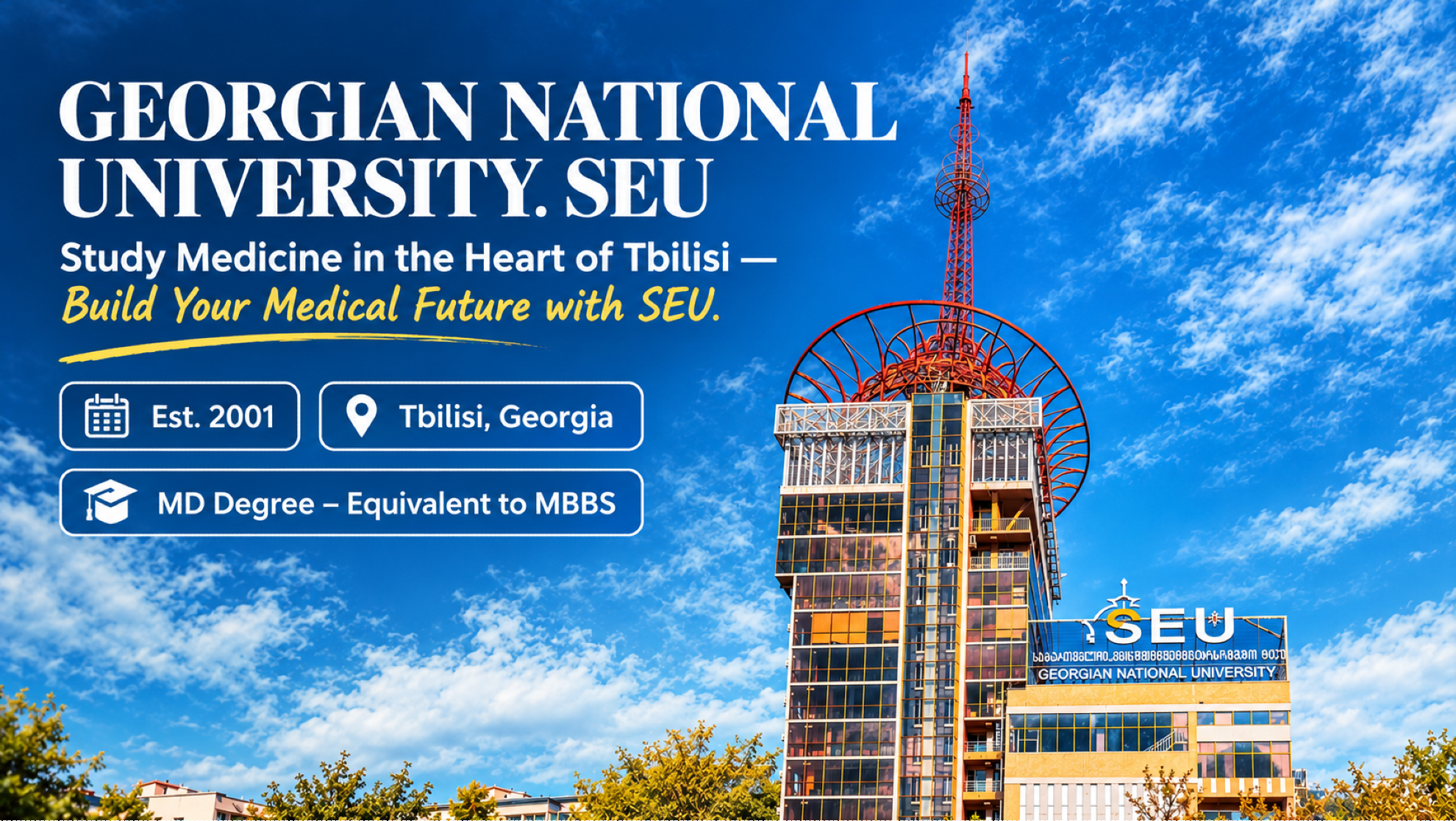
Georgian National University SEU – overview
Georgian National University SEU is a private university in Tbilisi, established in 2001. The university provides education in several study fields, among which Medical, Business, Law, Social Sciences and various other study courses. For foreign students, the most popular study program is the Medical Doctor in English.
The information below will provide you with the necessary information about this educational institution.
Location – Tbilisi, Georgia
SEU is located at 9 Tsinandali Street, Isani-Samgori, within the capital city of Georgia – Tbilisi.
Being the capital and biggest city in Georgia, Tbilisi is one of the largest educational, medical, commercial, and cultural centers in the Caucasus region. Moreover, for international students, communicating with other students in the capital is easier and more accessible than anywhere else, as well as being surrounded by excellent healthcare institutions.
University with an international orientation
SEU’s mission is to create an international academic environment and to provide high-quality education, science, innovation, and development of students’ skills, following the idea of the European Higher Education Area. SEU guarantees its students comprehensive knowledge according to the European educational standards.
Academic staff and students of SEU have opportunities for international academic mobility, collaboration, and partnerships. In particular, SEU participates in the Erasmus + exchange program and has bilateral agreements with foreign universities.
SEU for medical students
SEU offers a one-cycle Medical Doctor study program taught in English. The study program includes basic biomedical sciences, pre-clinical sciences, clinical sciences, research, and professional competencies.
Students are trained to become confident doctors able to continue their education and professional development while complying with local and international standards.
Modern and progressive
SEU sees itself as a modern and progressive university that is guided by innovative, dynamic, and up-to-date methods in education, science, and student services. SEU website also shows a wide range of international activities, including student exchange programs, various scientific research, and student events, as well as an overview of the campus.
Why SEU for international students?
SEU Medical University is a great choice for an international student who is looking for a high-quality educational experience in Georgia because of the following reasons:
- SEU is located in Tbilisi, the capital of Georgia
- SEU is a private institution
- SEU provides education in English
- SEU has an international academic environment
- SEU implements the concept of modern medical education and research
- SEU has opportunities for international academic mobility
- SEU is located in an educational and medical center
- SEU as a great option for Indian students
Among the options for Indian students preparing to study medicine abroad, SEU Medical University is one of the best choices. The reason for this is the availability of education in English. However, Indian students must check the latest list of recognized universities and their accreditation in their local licensing authority – the National Medical Commission, for the year of graduation.
Why Choose GEORGIAN NATIONAL UNIVERSITY SEU for MBBS/MD?
If you are seeking a medical university in Georgia, the Georgian National University SEU can be presented as an option for its English-taught Medical Doctor (MD) programme, structured medical curriculum, practical training, simulation-based learning and international orientation.
1. English-Taught Medical Doctor Programme
The main advantage for international students is that SEU offers its Medical Doctor programme in English. This prevents international students from studying the main medical subjects in a language other than the primary language of instruction.
The programme is structured as a 12-semester course and corresponds to 360 ECTS credits, which is consistent with a six-year course of study.
Why this matters for Indian students:
Students can have more focus on medical subjects than a language barrier in classroom teaching.
2. Six-Year Medical Education
SEU's MD programme is structured for 6 years / 12 semesters.
The curriculum covers basic medical sciences to pre-clinical and clinical education. Students study subjects such as:
- Anatomy
- Histology
- Physiology
- Biochemistry
- Cell Biology
- Molecular Biology
- Genetics
- Immunology
- In the later stages, the students are introduced to pathology, pharmacology, microbiology, clinical sciences and clinical practice.
This gives students a progression from basic concepts → clinical knowledge → practical medical skills.
3. Strong Focus on Practical & Clinical Skills
SEU's curriculum includes more than just classroom theory. Clinical and Professional Skills (CAPS) are covered throughout the programme.
According to SEU's programme documentation, these skills are taught during all 12 semesters, with practical training taking place in simulation laboratories and clinical settings.
Students can therefore develop skills in:
- Patient communication
- Clinical examination
- Medical procedures
- Professional behaviour
- Clinical decision-making
- Practical application of medical knowledge
4. Simulation-Based Medical Training
Another important feature is the use of simulation-based education.
SEU's program documentation notes the use of high-fidelity mannequins, anatomical specimens, microscopic specimens and audio-video equipment in medical education.
This type of training enables students to obtain practice in a controlled environment before applying in real clinical situations.
5. Modern Teaching Methods
SEU uses different teaching approaches rather than relying solely on traditional lectures.
The medical program mentions methods including:
- Problem-Based Learning (PBL)
- Case-Based Learning (CBL)
- Practical sessions
- Seminars
- Laboratory work
- Simulation-based training
They are meant to encourage students to understand how medical knowledge applies to real clinical problems, rather than just memorising information.
6. International Exposure & Global Orientation
SEU has an internationalisation focus and has developed partnerships and opportunities involving institutions outside Georgia.
Its medical programme documentation mentions agreements involving Medipol University in Turkey and Memorial Hospital Group, with planned short-term hospital visits for medical students. It also refers to AMOpportunities for international clinical experiences.
For students interested in obtaining international academic exposure, this can be an additional attraction.
7. An Option for Indian Students
SEU has historically promoted its Medical School internationally, including for Indian students. Its programme documentation states that the School of Medicine was registered in the former Medical Council of India (MCI) database and was also listed in the World Directory of Medical Schools.
Important: MCI has been replaced by the National Medical Commission (NMC) in India. Therefore, for a student planning to practice medicine in India, the applicable NMC rules for foreign medical graduates should be checked for their admission/graduation year rather than relying on older MCI references.
8. Studying Medicine in Tbilisi
SEU is located in Tbilisi, the capital of Georgia.
For international students, studying in the capital can offer:
- A large international student community
- Hospitals and healthcare institutions
- Public transportation
- Restaurants and everyday facilities
- Shopping and entertainment
- A comparatively active student lifestyle
- This can be more comfortable for students coming from India.
9. International Student Environment
SEU has developed English-taught programmes and actively promotes their international profile. Their programme documentation notes participation in international education exhibitions and the effort to attract a diverse international student population.
For Indian students, an international environment can be helpful as they are likely to interact with students from different countries and backgrounds.
10. Focus on Research & Professional Development
Along with medical knowledge, the curriculum includes research skills, reasoning and argumentation, aiding students develop academic and analytical abilities.
The first two years, for example, include research-related learning alongside biomedical sciences and clinical/professional skills.
This can enable students to develop a more comprehensive outlook towards medicine rather than examination focused.
SEU Rankings, Accreditation & Recognition
When choosing a medical university abroad, apart from general information about rankings, an Indian student must evaluate the following critical points:
• The legal status of the university under the jurisdiction of the home country;
• Medical program accreditation;
• The inclusion of the institution in the World Directory;
• And the eligibility of the university under the NMC regulations.
Now, let's take a closer look at SEU's ranking, accreditation, recognition, and other critical factors for Indian students.
SEU’s Ranking & Reputation
While Georgian National University SEU is included in a number of international ranking databases, it is essential to understand that these are general university rankings, not medical-specific.
uniRank 2026: SEU is ranked 11th in Georgia and 8065th in the world in the uniRank.
EduRank 2026: SEU is 13th in Georgia, 3174th in Asia, and 8217th in the world. EduRank’s methodology is based on research, citations, and the impact of the institution and its alumni.
Webometrics January 2026: SEU is 15746th in the world in Webometrics according to January 2026 Georgia data.
Notably, SEU is not ranked in the QS World University Rankings and Times Higher Education World University Rankings. So, it is not possible to advertise SEU as QS-ranking university.
Medical School Accreditation
By far the most critical point for any medical student is the accreditation status of the program. Fortunately for Indian students, SEU’s Faculty of Medicine offers a high-quality medical education with all the necessary accreditations.
According to SEU, the study program is a one-cycle, English-language Medical Doctor course that is accredited by Georgia’s National Center for Educational Quality Enhancement (NCEQE) and complies with ENQA and WFME standards.
In addition, SEU provides the following information about the MD program:
- Degree: Medical Doctor
- Study mode: Full-time
- ECTS credits: 360
- Study period: 6 years
- Language: English
- Qualification: First higher-education cycle (Master level) according to the Georgian higher-education system
SEU’s academic regulations also confirm that upon completion of the 360 ECTS cycle, students will receive the Medical Doctor qualification.
National Recognition in Georgia
SEU is a legally recognized higher-education institution in Georgia. The recognition/accreditation of the university is carried out by the National Center for Educational Quality Enhancement (NCEQE), which is the national accreditation organization for higher education in Georgia.
It is essential to distinguish between university recognition and program accreditation.
Recognition means that the institution is officially authorized to provide higher education.
Accreditation refers to the specific program (e.g., Medicine) and confirms that it meets established quality standards.
Both are essential for a medical student, but the two concepts are not the same.
World Directory of Medical Schools
SEU is included in the World Directory of Medical Schools (WDOMS). However, it is critical to understand the difference between the terms “accreditation” and “inclusion in the directory.”
It is entirely up to the university to apply for inclusion in the WDOMS.
According to WDOMS, “the inclusion of a medical school in the Directory does not imply endorsement, accreditation, or recognition by the World Directory.”
Therefore, it is wrong to say that SEU is “accredited” by WDOMS. Instead, SEU medical school is included in WDOMS.
This nuance is critical for Indian students who often confuse the concepts of “accreditation” and “endorsement.”
WFME Medical Education Standards
SEU states that its Medical School program complies with WFME standards through the accreditation process in Georgia.
WFME is an international organization that promotes quality assurance and capacity building in medical education.
SEU’s accreditation in accordance with WFME standards means that the medical education system used meets international standards.
For the student, this means that he or she can be confident in the quality of the educational process provided by SEU.
NMC Eligibility Requirements for Indian Students
When advertising SEU to Indian students, it is critical to carefully phrase claims about NMC recognition.
SEU is not yet recognized as an authorized institution under the NMC regulations for Indian students. Therefore, it is impossible to say with a straight face that SEU is “NMC approved.”
However, if the Indian student wants to pursue an MBBS/MD degree at SEU, he or she should be aware that there are specific requirements set by the NMC for graduation from SEU.
These include:
• Qualification for NEET exam;
• Required number of years of study;
• Language of instruction;
• Clinical training requirements;
• Requirements for internships;
• Requirements for the curriculum and much more.
Ultimately, it is the Indian student who should research the NMC’s eligibility requirements for graduation from SEU at the time of admission.
SEU Recognition & Ranking Summary
Category Description
- Institution :Georgian National University SEU
- Status :Private
- Location :Tbilisi, Georgia
- Degree :Medical Doctor
- Study period :6 Years
- Programme volume :360 ECTS
- Language :English
National authority NCEQE
Medical accreditation Nationally accredited
WDOMS Medical school listed
WFME SEU meets WFME standards
uniRank 2026 11 in Georgia
EduRank 2026 13 in Georgia
Indian Students NMC requirements must be checked
SEU MD/MBBS Program Details
For students considering medicine in Georgia, Georgian National University SEU offers a 6 year English-taught Medical Doctor (MD) programme. Designed as a one-cycle medical education programme, SEU's course combines basic medical sciences, pre-clinical education, clinical subjects, practical and professional skills.
Important: it should be noted that in Georgia the qualification is officially known as Medical Doctor (MD) - not "MBBS". Although for Indian students this is considered studying MBBS abroad, the official SEU degree title is Medical Doctor.
1. Overview of Programme
Particular SEU Medical Doctor Programme
- Degree: Medical Doctor (MD)
- University: Georgian National University SEU
- Location: Tbilisi, Georgia
- Duration: 6 Years
- Semesters: 12 Semesters
- Medium of Instruction: English
- Total Credits: 360 ECTS
- Programme Type: One-cycle educational programme
- Field: Medicine / Healthcare
- Status: Accredited
SEU's official programme catalogue details the Medical Doctor as 360 ECTS, English-language one-cycle programme, and confirms its accredited status.
2. Six-Year Course Structure
SEU's MD Programme is divided into 12 semesters over six years, and designed so that students progress from basic sciences to clinical medicine and practical training.
Year 1 & 2: Basic Medical Sciences
During the first stage students lay the scientific foundations needed to understand the human body and disease.
This can include subjects such as:
- Anatomy
- Histology
- Physiology
- Biochemistry
- Cell Biology
- Molecular Biology
- Genetics
- Immunology
- Microbiology
- Basic medical sciences
The objective of this stage is to give students an understanding of the human body's structure and function prior to their clinical studies.
Year 2 & 3: Pre-Clinical Medical Education
Students move on gradually from the basics to understanding diseases and their mechanisms.
This stage introduces such subjects as:
- Pathology
- Pharmacology
- Microbiology
- Pathophysiology
- Clinical examination
- Introduction to clinical medicine
- Medical research and related skills
Students start understanding how changes in the body can lead to various diseases, and how diseases are diagnosed and managed.
Year 3 - 6: Clinical Medicine
The latter stages of course are more focused on clinical medicine and care.
Students learn such areas as:
- Internal Medicine
- Surgery
- Pediatrics
- Obstetrics & Gynecology
- Psychiatry
- Emergency Medicine
- Family Medicine
- Neurology
- Other clinical disciplines
This is an important stage, as students are starting to apply their theoretical knowledge to the practical aspects of medicine and patient care.
3. Clinical & Practical Training
One of the important highlights of SEU's medical programme is that practical education is embedded within the curriculum.
SEU states that practical class in clinical disciplines is held in leading Georgian clinics, and the university has a simulation laboratory, where students can develop their practical skills using simulators and mannequins.
This enables students to experience the progression such as:
Classroom Theory → Simulation Training → Clinical Environment → Learning with Patients
4. Clinical & Professional Skills
SEU's programme places specific emphasis on developing clinical and professional skills, rather than just theoretical knowledge.
Students can develop such skills related to:
- Patient communication
- Medical history taking
- Physical examination
- Clinical reasoning
- Basic medical procedures
- Professional ethics
- Teamwork
- Patient safety
- Communication with healthcare professionals
SEU's programme documentation highlights the clinical/professional skills training throughout the programme and simulation and clinical settings as the learning environments.
5. Simulation-Based Learning
SEU's Faculty of Medicine has a simulation laboratory that is equipped for practical medical education.
Students can practice procedures and clinical scenarios using such resources as:
- Medical simulators
- Mannequins
- Anatomical learning resources
- Practical training equipment
The benefit is that students can practice important skills in a controlled environment prior to applying them clinically.
6. Clinical Training at American Hospital Tbilisi
SEU's current medical-school information has a particularly interesting highlight in its relationship with American Hospital Tbilisi (AHT).
SEU describes American Hospital Tbilisi as their exclusive partner and affiliated clinic and SEU students have the opportunity to undertake clinical courses there, attend masterclasses by Georgian and foreign doctors and develop practical skills in a clinical environment.
This can be highlighted as an important point when explaining the programme to prospective students.
7. International Clinical Opportunities
SEU also highlights the opportunities for students to undertake practical experiences over winter and summer breaks at medical clinics abroad, including opportunities mentioned in the USA, UK and Turkey.
However, students should bear in mind that such opportunities may depend on availability, eligibility, programme arrangements and individual requirements, not presented as an automatic clinical rotation for all students.
8. English-Medium Education
SEU's Medical Doctor programme is officially listed as being taught in English.
This is particularly important for international students as:
- Lectures are in English
- Medical study materials can be accessed in English
- Students can communicate without needing to know Georgian as a primary language of instruction
- International students from different countries can study together
Students will still have to learn basic communication skills in Georgian for everyday life, and depending on their clinical environment, interacting with patients.
9. Degree Awarded
Following the successful completion of the 360 ECTS credits, students receive the qualification of:
Medical Doctor (MD)
The programme is classified as a one-cycle educational programme.
Therefore, when explaining the programme for Indian students, it is better to say:
"SEU offers a 6-year Medical Doctor (MD) programme, commonly referred to by Indian students as an MBBS programme."
rather than claiming that the university awards an Indian-style MBBS degree.
10. Tuition Fee
SEU's published programme catalogue lists the tuition fee for foreign citizens at:
US$5,900 per year
The same programme catalogue lists 4,990 GEL for the domestic fee category and US$5,900 for foreign citizens.
For six years, a simple calculation at the published annual rate would be:
US$5,900 × 6 = US$35,400
However, when drafting a final fee sheet for students, it is advisable to confirm the 2026-27 fee, payment schedule and any applicable discounts or changes directly with SEU, rather than presenting the six-year figure as a guaranteed fixed price.
11. Teaching Methodology
SEU's medical programme uses a combination of theoretical and practical methods of teaching.
Students may be exposed to:
- Lectures
- Seminars
- Laboratory sessions
- Practical classes
- Case-based learning
- Problem-based learning
- Simulation training
- Clinical training
- Independent study
The objective is to move students beyond simply memorising medical information and assist them to understand how medical knowledge is applied to patient cases.
12. Research & Academic Skills
Medical education at SEU includes the development of research and analytical skills for students.
Students are expected to learn how to:
- Find and evaluate medical information
- Understand scientific literature
- Analyse medical problems
- Apply evidence-based thinking
- Develop academic and professional communication skills
These skills can be beneficial not only during medical school, but also for students who wish to pursue postgraduate education, research or specialisation.
13. What Indian Students Should Know
For Indian students considering SEU, simply checking out the university's tuition fee is not enough.
Before admission, students should verify that their planned course of study meets the NMC requirements for foreign medical graduates for their particular admission year.
Students should consider especially:
- NEET eligibility
- Duration of the medical programme
- English-medium instruction
- Clinical training
- Internship requirements
- Qualification awarded
- Applicable NMC/FMG regulations
- Requirements for registration in India after graduation
- A foreign medical degree does not automatically provide a licence to practise medicine in India; students must meet applicable Indian regulatory requirements.
Why The SEU MD Programme Can Be Attractive
Key highlights:
- 6-year Medical Doctor programme
- English-medium education
- 360 ECTS
- Structured basic-to-clinical medical curriculum
- Simulation-based medical training
- Practical and clinical education
- Clinical training opportunities in Georgian medical institutions
- Partnership with American Hospital Tbilisi
- International clinical/practical opportunities subject to arrangements
- International student environment
- Medical qualification awarded as Medical Doctor (MD)
SEU Fees Structure 2026 | Study MBBS Abroad
For those planning to study Medical Doctor at Georgian National University SEU, the primary financial concern will be the annual tuition fee. Additionally, one should budget accommodation, food, insurance, residence/visa-related expenses, travel and other personal expenses.
From the published admission guidelines of SEU, the Medical Doctor (MD) programme is listed at US$5,900 per year for international students. The duration of the programme is 6 years / 12 semesters.
1. SEU Medical Doctor Tuition Fee
- Particular Fee
- Programme Medical Doctor (MD)
- Duration 6 Years
- Medium English
- Annual Tuition Fee US$5,900
- Estimated 6-Year Tuition US$35,400
- Calculation: US $5,900 × 6 years = US$ 35,400
The exact amount payable should always be confirmed with SEU for the student's particular admission/intake as university fees and payment conditions change.
2. Tuition Fee in Indian Rupees
For an Indian-student budget, using an illustrative exchange rate of INR95 / $1:
$5,900 X INR95 = INR5,60,500 per year
Therefore,
Year Tuition Fee @ INR95/USD
- 1st Year INR5.61 Lakh
- 2nd Year INR5.61 Lakh
- 3rd Year INR5.61 Lakh
- 4th Year INR5.61 Lakh
- 5th Year INR5.61 Lakh
- 6th Year INR5.61 Lakh
- 6-Year Total INR33.63 Lakh
Important: This is a calculation using INR95/USD - the actual INR amount will vary according to exchange rate and university payment terms.
3. Accommodation Expenses
Accommodation is separate from the US$5,900 tuition fee unless specifically included in the student's accommodation arrangement.
Students in Tbilisi typically choose between either:
- Student accommodation/hostel
- Shared apartment
- Private apartment
- Accommodation through student networks
- The actual cost depends on:
- Location
- Number of students sharing
- Room type
- Furnishing
- Distance from SEU
- Whether utilities are included or excluded
For a budget document, I would recommend keeping it as a separate estimated expense (rather than a single amount) unless SEU has a confirmed hostel package for the intake.
4. Food & Living Expenses
Food and daily living expenses are also separate from tuition.
A student's monthly expenses can include:
- Food and groceries
- Local transportation
- Mobile/internet
- Personal expenses
- Study materials
- Entertainment
- Miscellaneous expenses
For an Indian student, the overall living cost will heavily depend on whether the student cooks, eats at restaurants, shares accommodation and how frequently they travel.
Suggested budgeting approach
Rather than promise an exact amount, present it as:
Living Expenses = Food + Transportation + Personal Expenses
This gives parents a more realistic picture as individuals can vary considerably in their spending habits.
5. Medical Insurance
International students should also budget for health/medical insurance applicable for their stay in Georgia.
The exact insurance cost can vary depending on:
- Insurance provider
- Coverage
- Duration
- Student's policy
- Current Georgian requirements
Therefore the insurance amount should be confirmed before finalising the student's total budget.
6. Visa & Residence-Related Expenses
Students should also keep a separate budget for immigration-related costs.
Potential expenses can include:
- Visa/application charges, where applicable
- Residence permit/application costs
- Document translation
- Notarisation
- Apostille/legalisation
- Passport/document expenses
- Travel to/from offices
These expenses are not part of SEU's US$5,900 annual tuition fee.
7. Flight & Travel Expenses
The student's first year budget should also include travel expenses from India to Georgia.
This can include an India → Tbilisi flight ticket.
The price depends on:
- Departure city in India
- Travel date
- Airline
- Baggage allowance
- Booking period
- Seasonal demand
As airfare fluctuates considerably, it is better to show it as an estimated expense, rather than a university fee.
8. Other Academic & Personal Expenses
Students should keep aside some additional money for:
- Books and study materials
- Medical instruments, if required
- Lab/clinical items
- Stationery
- Printing
- Laptop/tablet
- Clothing and winter wear
- Personal requirements
These are not necessarily charged by SEU as a fixed annual fee.
9. SEU Initial Tuition Payment
SEU's current 2026 information for first-year registration states that students in the English one-cycle Medicine programme have an initial tuition payment of 499 GEL for the local registration process.
This should not be confused with the full international tuition fee of US$5,900/year. It is mentioned in SEU's 2026 registration instructions for the relevant registration process.
Therefore, for an international applicant, the exact payment schedule should be confirmed with SEU/admissions before making a payment.
10. Estimated Overall Budget
Using INR 95 = US $1 purely for an illustrative calculation:
Tuition :$ $5,900 × 6 = US$ 35,400 ≡ INR33.63 Lakh
Then the student should separately budget for:
- Expense 6-Year Treatment
- Tuition INR33.63 Lakh
- Accommodation Additional
- Food Additional
- Medical Insurance Additional
- Visa/Residence Additional
- Flights Additional
- Books/Personal expenses Additional
- Admission/processing expenses As applicable
Calculated at an illustrative INR95/USD exchange rate; not a guaranteed INR fee.
11. What Parents Should Understand
When discussing SEU's fees with parents, it is important to differentiate between:
University Fee : $5,900/year and
Total Cost of Studying in Georgia:
Tuition + Accommodation + Food + Insurance + Visa/Residence + Travel + Personal Expenses
This prevents parents from assuming that the $5,900 figure represents the student's complete annual expenditure.
Eligibility Criteria for SEU Admission 2026
The students applying for the Medical Doctor (MD) at Georgian National University SEU will need to meet the university's eligibility criteria as well as the applicable NMC requirements for Indian students.
SEU's admission guidelines mention academic, passport/documentation, and English-language requirements for the international candidate.
1. Academic Qualification
For admission to the MD programme, the student needs to have completed higher secondary (or equivalent).
For Indian students, this typically includes:
- 10th passed
- 12th passed with PCB (Physics, Chemistry, and Biology)
- A valid school-leaving (12th standard) certificate and transcript
- Students are advised to submit their academic transcripts and certificates as part of the application.
For Indian Students
A typical academic progression path for an Indian student is:
10th → 12th with PCB → NEET → SEU
However, the student needs to confirm the specific eligibility percentage for their desired intake year.
2. PCB Background
Since the candidate needs to have studied the relevant science subjects (Physics, Chemistry, and Biology) to pursue medicine, a student coming from the Commerce or Arts stream is not considered eligible for the MD programme at SEU.
It is important to note this for the Indian students since counselling for medical education in India typically follows the NEET eligibility guidelines.
3. NEET Qualification for Indian Students
For an Indian student, NEET qualification is mandatory for pursuing medical education abroad.
The National Medical Commission (NMC) has advised Indian students to consider the applicable Indian law requirements while applying for MBBS abroad.
NMC also stipulates the regulations for foreign medical graduates (FMGs) who seek to practice in India.
Therefore, for an Indian student, it is important to comply with the following eligibility criteria:
12th with required subjects + NEET qualification + SEU admission requirements + applicable NMC requirements
In other words, it is a mistake to suggest to an Indian student that they will automatically be eligible to practice in India after getting admitted to SEU. The SEU student's eligibility for registration in India will depend on the NMC regulations in force at the time of their admission/graduation.
4. English Language Proficiency
Since SEU's MD programme is taught in English, students will need to demonstrate English language proficiency.
SEU's admission guidelines specifically mention an English proficiency certificate/document with a minimum level of B1 for the applicants.
SEU will consider appropriate evidence of language proficiency depending on the applicant's academic background and admission pathway.
The applicant can demonstrate English proficiency in the following ways:
- By submitting a recognised English proficiency certificate
- By demonstrating prior education in English, where applicable
- By taking the university's English language test, if applicable
SEU's admission guidelines also mention an English language test at the university level.
Important distinction
While many universities require IELTS, it is best to double-check with SEU to see if IELTS is mandatory for your intake year.
A safer way to phrase this would be "Applicants must demonstrate the required level of English proficiency through an English proficiency certificate/document or the university's English proficiency test, as applicable."
5. Valid Passport
Along with the academic documents, international students will also need a valid passport for SEU admission.
The student should ensure that:
- Their passport is valid
- Their name on the passport matches the name on other documents
- Their passport copy is clear
- The student will also need a passport for the visa/residence and travel formalities.
6. Academic Documents Required
Academic Documents:
- 10th certificate/marksheet
- 12th certificate/marksheet
- Academic transcript
- School leaving certificate, where applicable
- Identification Documents:
- Passport
- Passport-size photographs
- Other identification documents, if any
- Additional Documents:
- English language proficiency proof, if any
- NEET scorecard/eligibility proof, for Indian students
- Application form
- Other documents specified by SEU/admission authorities
SEU's admission guidelines specify translation of the passport and original transcripts.
7. Document Translation
International students may need to translate documents, as the case may be, depending on the language requirements specified by the Georgian authorities/university for admissions.
If the documents are not in an acceptable language, the student may need to get them:
- Translated (certified)
- Legalised/apostilled, where applicable
Submitted in the specified format
The exact process will depend on the type of document and the country of origin.
For Indian students, it is best to familiarise themselves with the current document legalisation procedure in Georgia before applying.
8. Age Requirements
The student needs to meet the age requirements for undergraduate medical education.
For an Indian student, it is best to cross-check the NEET/NMC eligibility requirements for the relevant year instead of relying solely on the university's age requirements. The reason is that the university's eligibility criteria and the NMC's age requirements for foreign medical graduates may not be aligned.
9. Medical Documents
As an international student, you may be asked to provide medical documents by the university or the immigration authorities in Georgia.
Depending on the requirements, you may need to submit:
- Medical certificate
- Health/fitness certificate
- Vaccination records
Any other medical documents
You should confirm the list of required documents beforehand.
10. Financial Requirements
While finances are not a criterion for admissions, students still need to prepare themselves for the cost of:
- Tuition fees
- Accommodation
- Food
- Insurance
- Visa/residence formalities
- Travel tickets
- Personal expenses
- Study/books
For SEU's MD programme, the tuition fee for foreign students is approximately USD 5,900 per annum. Students should confirm the fee directly with SEU for their intake year. A student should budget for the entire 6 years of the programme instead of just the first year.
Georgian language is not required for most international students since the MD programme is taught in English.
SEU's admission guidelines state that knowledge of the Georgian language is optional, but students can take up Georgian language classes as an add-on course.
It may be beneficial to know some basic Georgian language for better communication with the locals, especially during the clinical rotations.
11. Admission Assessment / Interview
Depending on the admission pathway, SEU may assess the candidate's:
- Academic background
- Language proficiency
- Motivation for applying for Medicine
- Educational documents
- General aptitude for the course
It is always a good idea to keep all documents and relevant information about your academic background ready for the admission assessment/interview.
12. Special Checklist for Indian Students
For an Indian student, I would highlight the following points as the basic eligibility:
Basic Eligibility
- 12th passed or equivalent
- Physics studied
- Chemistry studied
- Biology studied
- Relevant academic eligibility fulfilled
- NEET qualified
- English language proficiency
- A valid passport
- Required academic documents
- NMC/FMGL requirements fulfilled
- SEU Admission 2026 – Eligibility at a Glance
Requirement
Indian Class 12 Student Required:
- Physics
- Chemistry
- Biology
- NEET
Required for Indian medical aspirants under applicable rules
- English: Required proficiency
- English certificate: As applicable; SEU documentation specifies B1
- Passport: Required
- Academic Transcripts: Required
- Medical documents: As applicable
- Georgian language: Not mandatory for the English MD programme
- Financial planning: Required for the full study period
SEU's published admission documentation supports the English-proficiency and documentation requirements, while Indian students must additionally comply with the current NMC framework.
Admission Process for SEU – Step by Step
The admission process for the Medical Doctor (MD) course at Georgian National University SEU involves several steps, ranging from eligibility checks and document collection to final visa/residence formalities before reporting to the institute.
For international students, it is recommended to begin the process much in advance to the desired intake, given the additional time that may be required for document translation/legalisation and immigration-related formalities.
As per SEU’s published admission guidelines, students are required to submit academic documents and demonstrate English language proficiency for admission.
Step 1: Eligibility Check
The first step is to evaluate eligibility for the English-taught Medical Doctor course. For an Indian student, the tentative eligibility criteria checklist includes:
- Class 12 or equivalent qualification with Physics, Chemistry and Biology background
- Required academic eligibility
- NEET qualification, where applicable per Indian regulations
- Ability to demonstrate required English language proficiency
- Valid passport
- Ability to meet the applicable NMC requirements
Eligibility Note – Indian Students
It is pertinent to note that eligibility for admission to a Georgian medical university and eligibility for registering with the NMC are two different criteria.
Therefore, prior to making any payments to the university, it is recommended that the student reviews the NMC/FMGL requirements for the relevant year of graduation.
Step 2: Document Collection
Once eligibility has been established, the student can begin compiling the required documents for admission. Most academic courses require submitting the following documents:
- Academic Documents
- Class 10 certificate/marksheet
- Class 12 certificate/marksheet
- Complete academic transcripts
- School-leaving certificate, if applicable
- Identification Documents
- Valid passport
- Passport-size photographs
- Medical/MBBS-specific Documents
- NEET scorecard/qualification proof, for Indian students, where applicable
- English language proficiency proof
- Additional documents as required by SEU
SEU’s published admission guidelines explicitly require the submission of the passport and original transcripts, among other documents, in the specified format and/or with translation, where applicable.
Step 3: Document Translation & Legalisation, if Applicable
Students may be required to prepare certain documents in the format specified by the Georgian authorities. The tentative process for document translation/legalisation may include:
- Original Documents
- Translation
- Notarisation/Certification, where applicable
- Apostille/Legalisation, where applicable
- Submission to SEU/Relevant Authorities
The exact requirements for document translation/legalisation may vary depending on the student’s country and the document type, and should be verified before submission.
Step 4: SEU Application
Once documents have been compiled, the student’s application can be submitted via the relevant SEU/international admissions channel. The application typically requires providing the following information:
- Personal information
- Passport details
- Educational background
- Qualifications
- Selected program
- Language proficiency information
- Contact information
- Supporting documents
For the medical program, the selected course of study must be specified as the Medical Doctor (MD) program. SEU’s published course documentation indicates that the MD program is a 6-year, 12-semester program.
Step 5: Language Proficiency Assessment
Since the MD program is taught in English, students are required to demonstrate English language proficiency. SEU’s application documentation mentions a specific English language assessment at the university, and students are advised to review SEU’s admission guidelines for relevant information.
Depending on the student category and current admission guidelines, students may be required to:
Submit an English language proficiency certificate, where applicable
Undergo SEU’s language proficiency test, if applicable.
Note: It is not advisable to mention IELTS as compulsory unless SEU’s admission guidelines explicitly state so for the relevant intake. It is best to advise students to follow the counselling guidelines as per SEU’s published documentation.
Step 6: Interview / University Assessment, if Applicable
Depending on the admission guidelines, SEU may request a student to appear for an interview or assessment. This step is typically undertaken to evaluate the student’s:
- Language proficiency
- Educational background
- Reasons for applying to SEU
- Understanding of the program
- Overall suitability for the program
As such, students are advised to prepare for basic questions, including:
- Why Medicine?
- Why Georgia?
- Why SEU?
- What are their career plans?
Students are advised to confirm with SEU for their intake’s specific requirements.
Step 7: Admission Decision / Offer
After evaluating the application, SEU will issue the relevant admission decision.offer, which the student should review, including:
- Admission confirmation details
- Personal information (including passport information)
- Program name and duration
- Payment details
- Intake/year
Additional admission conditions, if any
- Program: Medical Doctor (MD) – English-taught
- Duration: 6 Years / 12 Semesters
- Published annual tuition: US$5,900 per year (as per SEU admission guidelines).
Step 8: University Fee Payment
After accepting the admission offer, the student is required to make the specified payment as per SEU’s guidelines.
Students should ensure that they:
- Use the university’s official payment information
- Verify the exact payment amount
- Save the payment receipt
- Confirm that the payment has been successfully credited
Do not make any payments to unofficial personal accounts, if applicable
Students are advised to carefully review SEU’s payment schedule since the payment due dates may vary from the total tuition fee for the entire intake year and should not assume that a single lump-sum payment of the entire tuition fee is compulsory for their intake unless SEU’s guidelines explicitly state so.
Step 9: Admission Documentation Finalisation
Once payments have been made, students can complete the necessary admission documentation. It is advisable to store electronic copies and/or hardcopies of the following documents in addition to one’s passport:
- Admission/offer letter
- Payment receipt
- Passport
- Academic documents
- Translated documents
- Apostille/legalisation documents
- Other documents relevant to one’s admission
- The aforementioned documents may also be required for immigration formalities.
Step 10: Visa / Residence Formalities
The student must complete the relevant visa/residence formalities for Georgia, depending on their nationality and current immigration rules and regulations. The process generally follows this general guideline:
- Admission confirmation
- Immigration documentation
- Residence formalities, where applicable
- Approval/documentation
- Visa and travel to Georgia
Students are advised to refer to the latest official government/SEU guidelines rather than older visa guidelines when completing formalities.
Step 11: Flight Booking & Travel Preparation
After completing admission and immigration formalities, the student can begin finalising travel arrangements to Georgia. Prior to travel, students should ensure they have:
- Flight ticket
- Accommodation booked
- Travel/health insurance, where applicable
- Original documents
- Passport
- Admission documents
- Payment receipts
- Emergency contact information
- Some local currency and/or a payment method
- Essential medication/personal items
Important: It is advisable to carry important documents such as the passport and original admission documents in hand luggage rather than in checked baggage.
Step 12: Reporting to SEU & Registration
Once in Georgia, the student must report to SEU and complete the relevant registration/orientation formalities.
The process generally follows this general guideline:
- University reporting
- Student identification
- Academic orientation, including course/timetable information
- Student portal access and/or access to relevant digital platforms
- Accommodation formalities, if applicable
- Introduction to university services and facilities
- Overview of clinical/simulation training facilities
Since SEU’s medical program incorporates clinical training, it is recommended that students familiarise themselves with the relevant academic and clinical guidelines.
Step 13: Commence MD Programme
After completing university-level formalities, the student can begin their Medical Doctor programme. The general progression of studies is as follows:
Year 1–2: Basic Medical Sciences
Year 2–3: Pre-Clinical Sciences
Year 3–6: Clinical Medicine and Practical Training
Graduation: Medical Doctor (MD)
SEU’s MD program spans 360 ECTS credits over 12 semesters.
SEU MD Admission Process – Flow Chart
Steps Involved Details
- Eligibility check Determine eligibility as per SEU guidelines
- Document collection Collect relevant documents
- Translation/legalisation, where applicable Translate documents as required
- SEU application Submit completed application
- Language assessment, if applicable Undergo English language assessment, if applicable
- Interview/assessment, if applicable Attend interview/assessment, if applicable
- Admission decision Receive admission decision.offer
- Fee payment Pay required admission fee
- Documentation finalisation Complete relevant admission documentation
- Visa/residence formalities Complete visa/residence formalities
- Flight booking Air travel arrangements
- Reporting to SEU Report to SEU and complete registration/orientation
- Commence MD programme Begin 6-year MD programme
Special Flow for Indian Students
For your counselling material, I would suggest specifying the Indian student’s process as follows:
Eligibility for Indian Students
- Class 12 with PCB
- NEET Qualification
- Eligibility Check
- Document Collection
- SEU Application
- English Assessment / Interview, where applicable
- Admission Confirmation
- Fee Payment
- Documentation & Legalisation
- Visa/Residence Formalities
- Flight to Georgia
- SEU Registration
- Commence 6-Year MD Programme
Accommodation in Georgia for SEU Students
Accommodation in Georgia is a major concern for Indian students and parents considering Georgian National University SEU (Tbilisi). Given that most foreign students in Georgia are expected to stay for a period of several years, finding an appropriate, cheap and safe place to live is of paramount importance.
For SEU students, the options for finding accommodation include shared apartments, private apartments, student hostels/residences and other forms of renting/accommodation. Students are advised to research availability and pricing options before signing any contract since availability depends on timing and can change rapidly.
1. Preferred Accommodation Types by SEU Students
Being based in Isani district, Tbilisi, students can consider nearby Isani and Varketili areas as a good option for finding accommodation. Compared to central Tbilisi, Isani/Varketili areas offer a good balance between price and convenience. Current available housing options across Isani district, Tbilisi:
Popular Accommodation Type Approximate Cost Description
- Shared room/apartment $230–300+ per person Shared apartment for budget-friendly students
- 2-room apartment $460–570+ total 2–3 student occupancy
- 1-room apartment $370–440+ Single occupancy
- Studio apartment $310–340+ Single occupancy
Student hostel/residence Varied Student-friendly residences
The figures given are based on general market trends and should not be mistaken for SEU-recommended prices. According to the 2026 housing market guide, average rent in Varketili is approximately $284/month per person for a shared 2-bedroom in Isani and around $232/month.
2. Shared Apartment – Popular Option For International Students
One of the most popular options for international students is a shared-apartment. This is especially recommended for first-time international students who would like to experience living in Georgia with other international students.
This involves renting a multi-room apartment with other students (typically 2–4 students, depending on the apartment)
Shared utilities may include:
- Kitchen
- Bathroom
- Living Room
- Washing Machine
- Refrigerator
- Internet
- Electricity
Meanwhile, each student can have a private room or share a room with one or more students, depending on the apartment.
Most students prefer shared apartments since it allows them:
- To save money on rent
- To enjoy relative privacy
- To find furnished apartments
- To connect with other international students
- To share utility costs
- To have more privacy than in a hostel
For example, based on current SEU regional housing data, a 2-room apartment shared by 2 students costs approximately $568/month, or approximately $284 per person per month.
3. Student Hostel / Residence
Some students may prefer a student hostel/residence over a private apartment. This is especially true for students who are used to a hostel/residence environment and/or travelling abroad for the first time.
Student hostels/residences typically have a range of amenities including:
- Furnished beds
- Study space
- Kitchen
- Wi-Fi
- Washing Machine
- Common Areas
- Heating
- Security
- Laundry
While SEU is known to provide excellent educational opportunities for its students, students should bear in mind that SEU can provide a university hostel/residence only on a case-to-case basis. In other words, when considering a private hostel/residence, students should always double-check if it is officially affiliated with SEU. For students considering a hostel/residence option, it is best to double-check availability in advance.
Overall, it is important to note that hostels/dormitories in Georgia are highly dependent on the educational institution. In particular, SEU and other universities do not always have sufficient dormitory capacity. As such, many international students consider private hostels/residences or apartments for their accommodation needs.
4. Accommodation in Isani and Other SEU-Region Areas
As mentioned previously, many SEU students consider Isani district, Tbilisi as a convenient area for finding accommodation.
Being a region near SEU, Isani offers students excellent commuting opportunities, including metro access, and is generally student-friendly. In terms of amenities, Isani offers excellent value for money when compared to other districts in central Tbilisi. As of 2026, Isani district housing market guide suggests the following approximate figures:
Popular Accommodation Type Approximate Cost Description
- Shared 2-room apartment $284/person Shared by 2 students
- 1-room apartment $441/month
- 2-room apartment $568/month
- Studio apartment $340/month
Another budget-friendly option for SEU students is the Varketili district. Being part of the capital city, Varketili offers all amenities while allowing students to minimize their overall monthly expenses.
Popular Accommodation Type Approximate Cost Description
- Shared 2-room apartment $232/person Shared by 2 students
- 1-room apartment $372/month
- 2-room apartment $464/month
- Studio apartment $312/month
Another option for SEU students is the Avlabari district. Similar to Isani and Varketili, Avlabari offers excellent commuting opportunities while providing a wider choice of both private and shared apartments.
Popular Accommodation Type Approximate Cost Description
- Shared 2-room apartment $326/person Shared by 2 students
(Actual cost may vary depending on the apartment)
5. Commuting From Accommodation to SEU
One of the main advantages of using Isani/Varketili as your accommodation region is the ability to commute via metro and other local transport.
To minimize commuting time, consider finding accommodation that is within walking distance of metro stations or bus stops. Other local transport options in Tbilisi include:
- Metro
- Bus
- Minibus
- Taxi
Having local transport accessibility should be a priority when searching for accommodation in Isani/Varketili.
Counselling Tip
Instead of basing your accommodation search solely on price, consider the following factors:
Accommodation → University → Metro/Bus → Grocery Store → Hospital/Clinic
Having everything within accessible distance will greatly facilitate your day-to-day student life.
6. Consider Additional Expenses When Calculating Accommodation Budget
While rent is usually the largest expense, students should be mindful of additional costs associated with their accommodation. The following expenses can be factored into your overall accommodation budget:
- Expense Description
- Monthly Rent See Accommodation Budget Below
- Electricity Can vary significantly depending on the season and apartment
- Gas Especially important to consider during the cold season
- Water Typically a separate utility
- Internet Most apartments have an internet connection, but students should clarify whether it is included in the rent or not
- Maintenance Usually included in the rent, but students should clarify if any additional costs are possible
- Deposit/advance Some landlords request an additional deposit or advance in addition to the monthly rent
- Furniture Most apartments for rent are furnished, but students should always clarify what furniture is available
- Transportation Local transport fares should be factored in depending on the location of your accommodation
According to the 2026 SEU regional accommodation guide, utility expenses can vary from $25–50/month in summer and $50–110/month in winter, depending on the apartment. Meanwhile, internet connectivity typically costs between 30–60 GEL/month.
7. Essential Facilities To Look For In An Apartment
Before finalizing your accommodation option, it is recommended to clarify whether the following facilities are available:
- Essential Facilities
- Bed and mattress
- Study table/chair
- Wardrobe
- Refrigerator
- Washing Machine
- Kitchen
- Hot water
- Heating
- Wi-Fi
- Air conditioning (if required)
- Safety
- Secure entrance
- Working locks
- Safe neighborhood
- Working electricity and gas
- Fire safety
- Emergency contact information
- Study Facilities
It is especially important for medical students to have a quiet place to study since their studies involve a significant amount of self-reading.
8. Double-Check Rental Agreement Before Paying Any Money
Before signing the lease/Rental Agreement and making any payments, it is crucial to understand all of your obligations. Here are some of the most important details that should be clarified in writing:
- Document Description
- Monthly Rent Monthly Rent
- Contract Duration Contract Duration
- Deposit/Advance An additional deposit or advance, if required
- Additional Expenses Clarification on who is responsible for additional expenses (electricity, water, etc.)
- Maintenance Clarification on who is responsible for maintenance
- Notice Period How much notice is required to terminate the contract
- Guest Policy Guest Policy
- Leaving Conditions Conditions for leaving the apartment
- Refund Policy Refund Policy, if applicable
Based on information provided by local real estate agencies, students can typically rent an apartment by showing their passport. In most cases, landlords require first and last month’s rent in advance, but this may vary from case to case. Double-check the payment conditions before making any payments.
9. Top Things To Consider Before Booking An Apartment
As a foreigner, it is important not to fall for scams. Prior to making any payments, students should:
- Visit the place (or conduct a live video view)
- Double-check the address
- Clarify who owns the apartment
- Review the rental agreement
- Clarify what is included in the rent
- Ask about additional expenses (electricity, water, internet)
- Inquire about heating options
- Double-check the distance to SEU
- Clarify refund/deposit policy
- Keep a copy of all documents and payment receipts
- Avoid unauthorized agents, if any
The above considerations are especially important for Indian students who may look for options online prior to arrival in Georgia.
10. Accommodation Options For Indian Students
When it comes to accommodation options, Indian students tend to prioritize:
- Essential Facilities
- Safe environment
- Indian/international student roommate(s), if applicable
- Kitchen
- Access to local groceries
- Budget-friendly rent
- Good/secure internet
- Washing Machine
- Heating
- Convenient transportation to SEU
- Kitchen Facility
A private/shared kitchen is always a useful facility because it helps students save money on eating out. When searching for an apartment with a kitchen, students should inquire about:
- Gas/electricity
- Refrigerator
- Cooking utensils
- Microwave (if required)
- Storage space
- Water supply
11. Hostel Or Apartment: What Do Parents Prefer?
There is no right or wrong answer when it comes to the choice between hostel/apartment. Below are some of the advantages associated with each option.
- Hostel / Residence Shared Apartment
- More student-friendly More independent
- Easier for first-time travellers More privacy
- May have enhanced security May be more expensive
- Common areas More like a home
- More rules More flexibility
- Easier to adjust to at first More economical when shared
For a First-Year Student
A student residence/hostel can be a more convenient option for a first-year student since he/she will have all the necessary facilities available.
For a Senior Student
A shared apartment can be a good option for a senior student since he/she will likely have more privacy and independence.
12. Accommodation Options Before Coming To Georgia
Ideally, students should look for temporary or long-term accommodation options well in advance.
A recommended student accommodation planning sequence would be as follows:
Admission Confirmation → Accommodation Search → Property Inspection → Rental Agreement → Payment → Accommodation Confirmation → Travel to Georgia
Students should always avoid arriving in Georgia without accommodation, especially during the admission season, since budget-friendly options can be limited during that time.
13. Monthly Living Expense Budget Estimate
In addition to tuition fees, it is recommended for students to have a separate living expense/running expense budget. Below is a sample breakdown:
- Expense Estimate Range
- Shared Accommodation $230–300+
- Utilities & Internet Varies
- Groceries/Eating out Varies
- Local Transportation Affordable
- Personal Expenses Varies
Please note that the figures given are only a reference and should not be mistaken for actual figures recommended by SEU. The actual expenses will depend on accommodation type/location, lifestyle and other factors.
14. SEU Student Accommodation Options Recommendation
Based on the findings, a recommended accommodation plan for most budget-conscious Indian students would be:
Option 1 – Shared Apartment
2–3 students can share a furnished apartment
This is a good option for most students since it balances privacy, affordability and independence.
Option 2 – Student Residence
Student-friendly residence
A convenient option for first-year students or students who prefer a hostel/residence environment.
Option 3 – Private Apartment
Staying in a private apartment on a single occupancy basis
A good option for students who prefer more privacy, although it tends to be more expensive than shared accommodation.
Life in Georgia for Indian Students
Studying at Georgian National University SEU means that students are not adapting to a new university, but also a new country, culture, language, food, weather and lifestyle.
For Indian students, Tbilisi is generally convenient as a student city as it has international students, public transportation, restaurants, shopping facilities and access to healthcare but students should also be prepared for some cultural and lifestyle adjustments during the first few months.
1. What Is Student Life Like in Georgia?
Life in Georgia can be different from life in India.
Students generally experience:
- A quieter lifestyle
- European-style university education
- International student communities
- Independent living
- Public transportation
- Cafés, restaurants and shopping areas
- Opportunities to travel around Georgia
- A multicultural environment
Tbilisi is Georgia's capital and the main centre for education, business and international students.
Georgia is also known for its hospitality and welcoming culture. The official tourism authority describes Georgian people as having a strong tradition of hospitality towards visitors.
2. Indian Student Community in Georgia
Indian students form an important part of the international student community in Georgia.
For a student coming from India, having other Indian students around can make the initial adjustment easier.
Students can usually connect with other Indians on:
- University student groups
- WhatsApp/Telegram groups
- Indian student communities
- Hostel/residence groups
- University events
- Seniors and alumni
Why this matters
During the first few months, students may experience:
New country → New food → New language → New university → New friends
Having a supportive group of classmates and seniors can make this transition much easier.
3. Life in Tbilisi
SEU students studying in Tbilisi get the advantage of living in Georgia's capital.
Tbilisi offers:
- Restaurants and cafés
- Shopping malls
- Supermarkets
- Pharmacies
- Hospitals and clinics
- Public transport
- Gyms
- Parks
- Libraries/study spaces
- Tourist attractions
- International communities
The city provides a combination of modern urban facilities and historic Georgian culture.
For students, this means that they can manage most day-to-day requirements without having to travel outside the city.
4. Monthly Living Expenses
The monthly expenditure of an Indian student depends heavily on accommodation and lifestyle.
A practical planning range for students can be approximately:
Expense Approx. Monthly Budget
- Shared accommodationINR10,000–INR18,000+
- Food & groceriesINR7,000–INR12,000+
- TransportINR1,500–INR3,000
- Mobile/InternetINR500–INR1,200
- Personal expensesINR2,000–INR5,000
- Approx. TotalINR23,000–INR39,000+
These are planning estimates, not fixed university charges. Rent, food habits, exchange rates and personal spending can significantly change the final amount. Recent 2026 guides similarly show that accommodation is usually the biggest variable and that disciplined students can keep their monthly spending considerably lower than students who frequently eat out or use taxis.
Money-saving tip
The easiest ways to control expenses are:
Share accommodation + cook at home + use public transport + limit frequent taxis.
5. Food for Indian Students
Food is one of the biggest lifestyle adjustments for Indian students.
Georgian cuisine is different from Indian cuisine and includes many dishes based around:
- Bread
- Cheese
- Vegetables
- Meat
- Beans
- Dumplings
- Nuts
- Fresh produce
Some famous Georgian foods include:
- Khinkali: Large Georgian dumplings, traditionally filled with meat but also available in other varieties.
- Khachapuri: A famous Georgian cheese-filled bread.
- Lobio: A traditional bean-based dish.
- Badrijani: Eggplant prepared with walnut-based filling.
- Pkhali: Vegetable-based Georgian appetiser/spread.
6. Can Indian Students Get Indian Food?
Yes.
Indian students can find Indian restaurants and groceries in Tbilisi, although availability is not comparable to major Indian cities.
Students can also buy ingredients such as:
- Rice
- Dal
- Atta
- Spices
- Turmeric
- Chilli powder
- Garam masala
- Pickles
- Snacks
Many Indian students prefer cooking at home, particularly because it can be more economical and allows them to maintain their normal food habits. Recent student-focused guides also note that cooking is a common way Indian students manage food costs in Tbilisi.
Vegetarian Students
Vegetarian students can manage their diet, but they should clearly communicate dietary requirements when ordering food.
It is useful to learn a few basic words/phrases related to:
Vegetarian
- No meat
- No chicken
- No pork
- No eggs
7. Grocery Shopping
Students can purchase everyday groceries from supermarkets and local shops.
Common purchases include:
- Fruits & vegetables
- Milk & dairy products
- Rice
- Bread
- Eggs
- Meat
- Snacks
- Cleaning products
- Personal-care products
Indian-specific products may cost more than they would in India, so students who cook regularly should plan their grocery budget accordingly.
8. Transportation in Tbilisi
Students can use public transportation for daily travel.
Main options include:
- Metro: The metro is one of the convenient ways to travel around Tbilisi.
- Buses: City buses connect different parts of the city.
- Taxi: Taxi applications are useful when public transport is inconvenient, particularly when carrying luggage or travelling late.
- Walking: Depending on where the student lives, some daily activities can also be completed on foot.
Student Tip
For regular university travel:
Metro/Bus > Frequent Taxi
Using public transport regularly can help students keep their monthly expenses under control. Recent student-budget guidance specifically recommends public transport as the more budget-friendly option compared with frequent taxi use.
9. Weather & Climate
Students coming from India should prepare for a different climate.
Georgia experiences distinct seasons and temperatures vary considerably depending on region and altitude. The country's official tourism information describes a wide variety of climate zones, including humid subtropical, continental and mountain climates.
- Spring: Generally pleasant weather with greenery and occasional rain.
- Summer: Warm to hot conditions, particularly in lower-altitude areas.
- Autumn: Cooler weather and generally comfortable conditions.
- Winter: Tbilisi can become cold and students should bring proper winter clothing.
Indian Student Tip
Students travelling from warmer parts of India should carry:
- Winter jacket
- Thermal wear
- Sweater
- Warm socks
- Gloves
- Waterproof shoes
- Winter accessories
Don't underestimate the winter.
10. Language – Do Students Need Georgian?
SEU's MD programme is taught in English, so students do not need to study medicine in Georgian.
However, students may encounter Georgian when dealing with:
- Shops
- Public transport
- Restaurants
- Landlords
- Local services
- Everyday conversations
Therefore, learning a few basic Georgian words can be helpful.
Useful words
- English: Georgian
- Hello: Gamarjoba
- Thank you: Madloba
- Yes: Ki
- No: Ara
- Please: Tu sheidzleba
- Goodbye: Nakhvamdis
Students do not need to become fluent in Georgian to live in Tbilisi, but basic local communication can make daily life easier.
11. Healthcare & Medical Facilities
Tbilisi has hospitals, clinics, pharmacies and healthcare facilities.
For medical students, this is particularly relevant because clinical education is an important part of their programme.
SEU's Faculty of Medicine states that clinical disciplines are taught through practical training in Georgian clinics and medical institutions. SEU also identifies American Hospital Tbilisi as an affiliated/exclusive partner clinic for opportunities including clinical courses and practical learning.
For everyday health needs, students should keep:
- Passport/ID documents
- Insurance details
- Emergency contact numbers
- University contact information
- Important medical records
12. Safety for Indian Students
Safety is one of the first questions parents ask.
Students should follow normal international-student precautions:
- Keep important documents safely
- Avoid carrying large amounts of cash
- Use trusted transportation
- Keep emergency contacts saved
- Avoid isolated areas late at night
- Be careful with unfamiliar people/online rental offers
- Follow Georgian laws and university rules
Georgia's official tourism authority currently describes the country as safe for travellers and highlights its hospitality.
However, students should understand that no country is completely risk-free. Good personal habits and awareness remain important.
13. Life for Female Indian Students
Female students can maintain an independent student lifestyle in Tbilisi while following sensible safety practices.
Recommended habits include:
- Choose verified accommodation
- Share location with family when travelling
- Avoid isolated areas late at night
- Use reliable transportation
- Keep emergency contacts available
- Stay connected with classmates
- Inform family about accommodation details
- Parents can also maintain regular communication through WhatsApp/video calls.
14. Academic Life & Study Culture
One major adjustment for Indian medical students is the style of education.
Students should not expect the exact same environment as Indian coaching-based education.
At SEU, the MD programme includes:
- Lectures
- Practical classes
- Laboratory work
- Simulation-based training
- Clinical/professional skills
- Problem-based learning
- Case-based learning
- Continuous assessment
The SEU programme is structured across 6 years / 12 semesters / 360 ECTS, with clinical and professional skills taught throughout the programme.
Student Responsibility
Students should develop:
Regular study habits + attendance + self-study + practical participation + exam preparation
Medical school abroad still requires serious academic discipline.
15. Making Friends & Social Life
International students can meet people from different countries.
Students may make friends through:
- University
- Accommodation
- Student events
- Sports
- Clubs
- Cultural activities
- International student groups
This is one of the positive aspects of studying abroad because students get exposure to different cultures and perspectives.
16. Travel & Weekend Life
Georgia is relatively compact and offers many opportunities for students to explore during breaks.
Popular destinations include:
- Kazbegi: Known for mountain scenery and the Gergeti Trinity Church.
- Batumi: A Black Sea coastal city.
- Mtskheta: A historic city close to Tbilisi.
- Kakheti: Known for its landscapes and wine-making tradition.
- Gudauri: Popular for winter activities.
Georgia's official tourism information highlights destinations such as Svaneti, Tusheti, Kazbegi and the Black Sea region as popular travel areas.
Student Advice
Travel should be planned around:
Classes + exams + assignments + clinical schedules.
Academics should always remain the priority.
17. Religion & Cultural Diversity
Georgia has its own strong cultural and religious traditions.
International students should respect:
- Local customs
- Religious places
- Dress expectations where appropriate
- Georgian traditions
- Local laws
At the same time, students can generally maintain their own cultural practices and personal beliefs while living in the country.
18. Staying Connected With Family in India
Indian students can easily remain connected with their families using:
- Video calls
- Internet calling
- Social media
A good routine can be:
Daily short call + weekly longer video call
This can help reduce homesickness, especially during the first few months.
19. Homesickness & Cultural Adjustment
The first few months can be challenging.
Students may miss:
- Family
- Indian food
- Friends
- Festivals
- Familiar language
- Indian lifestyle
This is completely normal when moving abroad.
How to handle it:
- Stay connected with family
- Make friends
- Maintain a daily routine
- Cook familiar food
- Stay physically active
- Focus on academics
- Participate in social activities
- Ask seniors for help when needed
The first 3–6 months are often the biggest adjustment period for students moving abroad, so preparation and a good support system are important.
20. Residence & Legal Formalities
Students should make sure their immigration/residence status remains valid throughout their studies.
Georgia's State Services Development Agency provides a Study Residence Permit for foreigners studying in authorised higher/vocational educational programmes. The application requires documents including a travel document, proof of lawful stay, confirmation from the educational institution and financial-support documentation.
Students should therefore:
- Keep passport valid
- Maintain legal stay
- Follow university instructions
- Complete residence formalities when applicable
- Keep copies of important documents
- Never ignore immigration deadlines
21. Managing Money in Georgia
Students should learn to manage their monthly budget.
Recommended approach:
Monthly Budget = Rent + Food + Transport + Utilities + Personal Expenses + Emergency Fund
Students should keep some emergency money separately instead of spending their entire monthly allowance.
It is also sensible to maintain access to both:
- A bank/payment method
- Some emergency cash
Exchange rates between the Indian Rupee (INR) and Georgian Lari (GEL) can change, so students should not treat an INR estimate as a fixed long-term cost.
22. What Should Indian Students Bring From India?
Important documents
- Passport
- Admission documents
- Academic certificates
- Visa/immigration documents
- Insurance documents
- Passport-size photographs
- Medical records/prescriptions
Clothing
- Regular clothes
- Winter jacket
- Thermal wear
- Comfortable shoes
- Formal clothes
- Food
Students may bring a reasonable personal supply of permitted, non-perishable food items/spices, while checking current airline and Georgian customs rules before travelling.
- Study Items
- Laptop
- Chargers
- Power adapters
- Stationery
- Headphones
- External storage, if required
23. Main Challenges Indian Students May Face
Studying in Georgia has advantages, but students should also understand the challenges how to Manage It
- Different food: Cook at home / find suitable restaurants
- Cold winters :Carry proper winter clothing
- Language barrier: Learn basic Georgian
- Homesickness: Stay connected with family
- Independent living: Develop a daily routine
- Academic pressure: Study consistently
- Managing expenses: Prepare a monthly budget
- Different culture: Respect local customs
- Finding accommodation: Verify before paying
- Administrative formalities: Follow university/immigration guidance
24. Advantages of Life in Georgia for Indian Students
International environment
Students interact with people from different countries.
English-medium medical education
SEU's MD programme is conducted in English.
Independent lifestyle
Students develop confidence and responsibility.
Public transportation
Students can use metro and buses for daily travel.
International exposure
Students experience a different acade
mic and cultural environment.
Travel opportunities
Students can explore Georgia during holidays.
Indian community
Indian students can connect with peers and seniors.
25. Things Students Should Be Prepared For
Georgia is not India, and students should not expect everything to be identical.
Students may need to adjust to:
- Different food
- Different weather
- Different language
- Different academic system
- Independent household management
- Living away from family
- Different cultural practices
- Currency and budgeting
- Immigration/residence procedures
A student who comes prepared generally adjusts much faster.
26. Quick Comparison: India vs Georgia
Factor India vs Georgia
- Language Familiar English for SEU programme; Georgian in daily life
- Food Familiar Indian cuisine Georgian + international cuisine; Indian options available
- Family Usually nearby Living independently
- Weather Varies by region Four distinct seasons in many areas
- Education Familiar system European/international style
- Transport City dependent Metro, buses, taxis in Tbilisi
- Culture Familiar New cultural environment
- Living Often family-based Independent student lifestyle
International exposure Depends on institution High in international student settings
27. Tips for First-Year SEU Students
Before travelling:
- Finalise accommodation.
- Keep all documents organised.
- Arrange sufficient initial funds.
- Carry appropriate winter clothes.
- Save emergency contacts.
- Inform family about your accommodation.
- Download useful maps/transport apps.
- Connect with university/student groups.
After reaching Georgia:
- Complete university registration.
- Complete required immigration/residence formalities.
- Learn your route to SEU.
- Locate nearby supermarket/pharmacy.
- Find a suitable food routine.
- Meet classmates and seniors.
- Create a monthly budget.
- Focus on academics from the first semester.
FMGE/NExT Preparation & Coaching Support at SEU
For Indian students planning to study medicine abroad, FMGE/NExT preparation should be considered from the beginning of medical school, not something to start only after graduation.
For students at Georgian National University SEU, the advantage is that the university's MD curriculum provides a strong foundation in basic sciences, clinical subjects, practical skills and clinical exposure. SEU has also recently conducted FMGE-focused academic activities and masterclasses, including a 2026 FMGE masterclass with a DocTutorials faculty member.
Important: Students should distinguish between SEU's academic curriculum/FMGE-oriented activities and a separate, guaranteed full-time FMGE coaching programme. The current SEU sources confirm FMGE masterclasses and exam-oriented sessions, but do not establish that every student receives a dedicated six-year FMGE coaching package.
1. What Is FMGE?
FMGE = Foreign Medical Graduate Examination.
It is the screening examination associated with Indian medical graduates who obtain their primary medical qualification outside India and seek registration to practise medicine in India, subject to the applicable rules.
The National Medical Commission (NMC) continues to maintain the FMGE/foreign medical graduate framework, including the Foreign Medical Graduate Licentiate Regulations, 2021. NMC also published a June 2026 FAQ concerning the FMGL framework.
2. What Is NExT?
NExT = National Exit Test.
NExT has been proposed by the Indian regulatory framework as a common examination mechanism involving medical licensure and postgraduate medical education.
However, students should not assume that simply joining a foreign university automatically means they will be taking NExT instead of FMGE.
The applicable examination and transition rules depend on the regulations and government/NMC implementation applicable to the student's cohort.
Therefore:
Do not choose a foreign medical university solely on the promise that “FMGE will be replaced by NExT.”
Always verify the latest NMC notification applicable to your batch.
3. Why FMGE/NExT Preparation Should Start Early
Medical students have to study a large number of subjects.
If a student waits until the final year to start revision, it can become difficult to revise the entire syllabus.
A better approach is:
- Year 1–2: Build concepts
- Year 3–4: Connect concepts with clinical medicine
- Year 5: Start serious exam-oriented preparation
- Year 6: Intensive revision + MCQs + mock tests
- After graduation: Dedicated final preparation according to the applicable Indian examination
This approach reduces the pressure of trying to learn everything at the last moment.
4. How SEU's MD Curriculum Can Support FMGE Preparation
SEU's English-language Medical Doctor programme is a 6-year, 12-semester programme carrying 360 ECTS.
The curriculum includes basic medical sciences, preclinical subjects, clinical subjects and Clinical & Professional Skills throughout the programme.
SEU's programme also uses:
- Interactive lectures
- Practical training
- Laboratory work
- Simulation training
- Problem-Based Learning (PBL)
- Case-Based Learning (CBL)
- Case-based clinical reasoning
- Clinical/professional skills training
These components can help students develop the conceptual and clinical foundation needed for later exam preparation.
5. Basic Sciences – Foundation for Competitive Exams
During the initial years, students study subjects such as:
- Anatomy
- Histology
- Physiology
- Biochemistry
- Cell Biology
- Molecular Biology
- Genetics
- Immunology
- Research basics
- Health and Society
- Ethics and communication
These subjects are important because many clinical questions ultimately require an understanding of basic medical concepts.
6. Preclinical & Clinical Subjects
As students progress through the programme, they move towards subjects such as:
- Pathology
- Pharmacology
- Microbiology
- Internal Medicine
- Surgery
- Paediatrics
- Obstetrics & Gynaecology
- Psychiatry
- Community Medicine
- Ophthalmology
- ENT
- Orthopaedics
- Other clinical disciplines
The exact curriculum is determined by the university's approved programme.
FMGE/NExT strategy: Students should avoid studying every subject as an isolated topic.
Instead:
Pathology + Pharmacology + Medicine
should gradually be connected together.
For example:
Diabetes → Pathology → Pharmacology → Clinical management → Complications
7. Clinical Exposure at SEU
Clinical exposure is particularly important for Indian students.
SEU states that practical classes in clinical disciplines take place in leading Georgian clinics and medical institutions. The university also identifies American Hospital Tbilisi (AHT) as an affiliated/exclusive partner clinic and says SEU students have opportunities for clinical courses, masterclasses and practical skill development there.
SEU also states that students can have opportunities for clinical practice during winter and summer breaks in medical clinics abroad, including the USA, UK and Turkey, subject to the relevant arrangements.
Why this matters for FMGE/NExT preparation
Clinical exposure helps students understand:
- Patient history
- Clinical examination
- Diagnosis
- Investigations
- Differential diagnosis
- Treatment principles
- Communication
- Practical procedures
This can complement theoretical preparation.
8. FMGE Masterclasses at SEU
One particularly relevant development is that SEU has conducted FMGE-focused masterclasses.
In 2026, SEU announced an FMGE Masterclass organised with support from its Industry Collaboration and Career Development Department. The session involved SEU graduate ambassador Mohit Bopanna and Dr. Sandeep Sharma from DocTutorials' Pediatrics faculty.
SEU says the session covered:
- Paediatrics topics
- Exam-oriented concepts
- FMGE-style questions
- Strategies for solving FMGE-style questions
The event was specifically aimed at helping students prepare for the examination.
Why this is useful
Instead of only studying the university syllabus, students can also get exposure to:
Concept → Exam pattern → Question-solving → Time management
9. External Faculty & Exam-Oriented Sessions
SEU's 2026 FMGE masterclass is a good example of collaboration with external exam-preparation expertise.
The university has also hosted a Dermatology conceptual course involving a DocTutorials faculty representative, showing that such academic/exam-oriented external sessions can be part of student activities.
However, students should understand that:
A masterclass is not the same thing as a complete FMGE coaching course.
If a student wants intensive preparation, they may still choose a dedicated FMGE preparation platform/coaching provider alongside university studies.
10. Suggested FMGE Preparation Strategy at SEU
A student can follow a structured six-year approach.
1st Year – Build Strong Basics
Focus on:
- Anatomy
- Physiology
- Biochemistry
- Histology
- Basic medical terminology
Main goal:
Understand, don't just memorise.
2nd Year – Strengthen Basic Sciences
Focus on:
- Pathology
- Pharmacology
- Microbiology
- Immunology
Continue revision of first-year subjects
Main goal:
Start connecting basic science with disease.
3rd Year – Move Towards Clinical Medicine
Focus on:
- Medicine
- Surgery
- Clinical reasoning
- Pathology correlation
- Pharmacology correlation
- Start solving MCQs regularly.
Main goal:
Theory + clinical application + questions
4th Year – Increase MCQ Practice
Students should gradually increase:
- Question banks
- Subject tests
- Clinical case questions
- Previous-style questions
- Revision cycles
Main goal:
Identify weak areas early.
5th Year – Serious Exam Preparation
Students should now have a structured exam strategy.
Focus on:
- High-yield topics
- MCQs
- Previous questions
- Rapid revision
- Mock tests
- Clinical concepts
Main goal:
Convert medical knowledge into exam performance.
6th Year – Final Preparation
The final year should include:
- Complete revision
- Multiple question-bank cycles
- Full-length mock tests
- Time management
- Weak-topic revision
- Exam strategy
Main goal:
Exam readiness.
11. MCQ Practice
MCQs should not be postponed until graduation.
A good progression is:
- 1st Year → 10–20 questions/day
- 2nd Year → 20–30/day
- 3rd–4th Year → 30–50/day
- 5th–6th Year → Higher volume according to preparation stage
These numbers are suggested study targets, not official SEU requirements.
The important point is consistency.
12. Time Management for FMGE/NExT
Medical students often make one major mistake:
They study only for university examinations.
University exams are important, but students planning to return to India should simultaneously maintain an exam-oriented revision system.
Ideal daily structure
University classes → University revision → MCQs → Weak-topic revision
Actual timetable varies by semester.
13. Digital Resources
Students can use digital resources for:
- Video lectures
- Question banks
- Flashcards
- Mock tests
- Revision notes
- Clinical cases
However, students should avoid subscribing to too many platforms.
Better strategy:
1 Main video resource + 1 question bank + 1 revision source
rather than using five different resources and becoming confused.
14. Clinical Skills & FMGE/NExT
Competitive exams are not only about memorisation.
Students should develop proper clinical understanding.
At SEU, Clinical & Professional Skills are integrated throughout the programme, including simulation-lab and clinical training with practical assessment methods such as OSPE/OSCE.
Students can therefore focus on:
- History taking
- General examination
- Systemic examination
- Communication
- Basic procedures
- Clinical decision-making
- Patient safety
15. Simulation-Based Learning
Simulation training allows students to practise clinical situations in a controlled environment.
SEU describes simulation facilities using:
- Simulators
- Mannequins
- Anatomical specimens
- Microscopic specimens
- Audio-visual equipment
This can help students develop practical confidence before dealing with real patients.
16. University Exam vs FMGE/NExT Preparation
Students should understand that these are not exactly the same.
University Preparation vs FMGE/NExT Preparation
- Semester examinations ;National-level competitive examination
- University syllabus ;Broad exam-oriented syllabus
- Theory + practicals ;Strong emphasis on MCQs/application
- Internal assessments ;Mock tests/question banks
- University-specific pattern ;National examination pattern
- Short-term preparation ;Long-term preparation
Best approach:
Don't choose one over the other.
Build university knowledge in a way that also supports future Indian licensing examination preparation.
17. Important NMC Consideration for Indian Students
Indian students should not rely only on university or consultant statements regarding FMGE/NExT eligibility.
NMC maintains the official regulatory framework for foreign medical graduates, including the Foreign Medical Graduate Licentiate Regulations, 2021, and publishes updates/FAQs concerning foreign medical graduates.
NMC also published a notice on 28 August 2026 stating that the FMGE Screening Test may be scheduled in the coming months by the National Board of Examinations in Medical Sciences.
Therefore:
Always verify:
- Your eligibility
- Applicable examination
- Eligibility Certificate requirements, where applicable
- Internship requirements
- Registration requirements
- Current NMC regulations
- Requirements applicable to your admission year
18. Don't Believe “100% FMGE Guarantee”
Students and parents should be careful with statements such as:
- “100% FMGE pass guarantee”
- “NMC-approved university means guaranteed FMGE”
- “You don't need to study separately for FMGE”
- “NExT will definitely replace FMGE for your batch”
No university can guarantee an individual student's examination result.
What actually matters:
Good university education + strong clinical exposure + consistent self-study + quality question practice + proper revision.
19. What Makes SEU Useful for FMGE-Oriented Students?
Based on SEU's current official information, the relevant strengths include:
English-medium MD programme
Makes academic learning accessible for international students.
6-year medical programme
Provides sufficient time to build medical knowledge.
Clinical & Professional Skills
Skills are integrated throughout the programme.
Simulation training
Students can practise skills in controlled environments.
Clinical exposure
Clinical training takes place in Georgian medical institutions.
AHT affiliation
SEU identifies American Hospital Tbilisi as an affiliated/exclusive partner clinic.
FMGE-focused academic activities
SEU has conducted FMGE masterclasses involving external exam-preparation faculty.
20. Recommended Preparation Roadmap
Year Academic Focus FMGE/NExT Focus
- 1st : Anatomy, Physiology, Biochemistry Build concepts
- 2nd : Pathology, Pharmacology, Microbiology Start MCQs
- 3rd : Medicine/Surgery & clinical subjects Clinical MCQs
- 4th : Major clinical subjects Regular question-bank practice
- 5th : Advanced clinical preparation Serious exam preparation
- 6th : Internship/clinical consolidation Full revision + mocks
- Post-graduation : As applicable Final exam-focused preparation
21. How Students Can Maximise Their Chances
Follow the 5-point formula:
- Attend university classes seriously
- Understand concepts instead of memorising blindly
- Solve MCQs throughout medical school
- Revise previous subjects regularly
- Follow the latest NMC/NBEMS requirements
This approach is much better than trying to complete the entire FMGE syllabus in a few months.
22. Message for Parents
Parents should understand that FMGE/NExT success depends primarily on the student's preparation, not simply on the university name.
When evaluating an overseas medical university, parents should look at:
- Quality of medical curriculum
- Clinical exposure
- Practical training
- Simulation facilities
- Academic support
- Faculty
- Student performance
- Opportunities for exam-oriented sessions
- Compliance with applicable Indian regulations
SEU's current official information demonstrates clinical training, simulation-based education and FMGE-focused academic events, which are relevant positives for Indian students.
Pros & Cons of Georgian National University SEU – Honest Assessment
When it comes to choosing a medical university abroad, SEU has several attractive features – but students must not be blinded only by promotional claims.
SEU offers a 6-year English-medium Medical Doctor programme of 360 ECTS, clinical/professional skills training and practical education in the Georgian medical institutions.
At the same time, students wishing to return to India must independently verify the NMC requirements applicable to their admission year. NMC specifically advises students to check the university's course duration, curriculum, medium of instruction, clinical training and internship arrangements before admission.
SEU has conducted FMGE-focused academic activities, but students must not interpret this as a guaranteed full-time FMGE coaching programme.
PART A – Pros of SEU
1. English-Medium Medical Doctor Programme
One of the biggest advantages for international students is that SEU's Medical Doctor programme is taught in English.
The programme is:
- English-medium
- 6 years
- 12 semesters
- 360 ECTS
- Awarded qualification: Medical Doctor
This makes it easier for Indian students to follow lectures, study medical literature and communicate academically without having to learn an entirely new language for their medical education.
Why this matters for Indian students
Students can focus on:
Medical subjects + clinical skills + exam preparation
instead of spending significant academic effort learning the language of instruction.
2. Six-Year Medical Programme
SEU's MD programme is structured over 6 years / 12 semesters / 360 ECTS.
The programme includes:
Early years
- Anatomy
- Physiology
- Biochemistry
- Histology
- Cell biology
- Genetics
- Immunology
Later years
- Pathology
- Pharmacology
- Microbiology
- Medicine
- Surgery
- Other clinical disciplines
This gives students time to gradually move from basic sciences → preclinical subjects → clinical medicine.
3. Strong Focus on Clinical & Professional Skills
A particularly useful feature of the SEU curriculum is the emphasis on Clinical and Professional Skills (CAPS).
SEU's programme incorporates clinical/professional skills throughout the 12 semesters, with practical training in simulation laboratories and clinical environments.
Students can develop skills related to:
- Patient communication
- History taking
- Physical examination
- Clinical reasoning
- Practical procedures
- Professional behaviour
- Patient safety
This is important because medical education should not be limited to memorising theory.
4. Simulation-Based Learning
SEU describes its medical education as including simulation-based training.
Students can use:
- Simulators
- Mannequins
- Anatomical specimens
- Microscopic specimens
- Audio-visual equipment
The programme also uses practical assessment approaches such as OSPE/OSCE.
Why this is a positive
Students can practise clinical skills in a controlled environment before dealing with real patients.
For a student coming directly from school, this can make the transition into clinical medicine easier.
5. Clinical Training in Georgian Medical Institutions
SEU states that practical classes in clinical disciplines are conducted in leading Georgian clinics and medical institutions.
This is an important factor when comparing medical universities.
A student should always ask:
“Where will I actually receive my clinical training?”
rather than looking only at the university's classroom infrastructure.
6. American Hospital Tbilisi Connection
SEU identifies American Hospital Tbilisi (AHT) as an affiliated/exclusive partner clinic.
According to SEU, students have opportunities there to:
- Take clinical courses
- Attend masterclasses
- Learn from Georgian and foreign doctors
- Develop practical clinical skills
This can provide useful exposure to a modern clinical environment.
Important clarification:
Students should still ask for the specific clinical rotation structure for their batch, rather than assuming every student will spend the same amount of time in every affiliated hospital.
7. International Exposure
SEU's medical faculty describes opportunities for clinical practice during winter/summer breaks in clinics abroad, including the USA, UK and Turkey, subject to arrangements.
This can be attractive for students who want international exposure.
However:
International clinical opportunities ≠ automatic recognition or licensing in another country.
These opportunities should be viewed as additional educational exposure.
8. Tbilisi Is a Major Advantage
SEU is located in Tbilisi, Georgia's capital.
For an international student, living in a capital city can provide advantages such as:
- Better public transportation
- More accommodation choices
- Restaurants
- Shopping
- Healthcare facilities
- International communities
- Airports and transport connections
- Cultural activities
For Indian students, Tbilisi can therefore be a convenient base for student life.
9. International Student Environment
SEU has an international student population, which can help students interact with people from different backgrounds.
This can improve:
- Communication skills
- Cultural awareness
- Confidence
- Adaptability
- International networking
For students travelling abroad for the first time, having an international environment can make the transition easier.
10. FMGE-Oriented Academic Activities
For Indian students, this is an important positive.
SEU has conducted FMGE-focused masterclasses, including a 2026 session involving an external DocTutorials faculty member.
The session covered:
- Paediatrics
- Exam-oriented concepts
- FMGE-style questions
- Question-solving strategies
But there is an important distinction
This should be described as:
“FMGE-oriented academic support/activities”
rather than:
“Guaranteed six-year FMGE coaching.”
Students who want intensive preparation may still choose an external FMGE preparation platform.
11. Modern Teaching Methods
SEU's medical programme describes the use of several teaching approaches, including:
- Problem-Based Learning (PBL)
- Case-Based Learning (CBL)
- Case-based clinical reasoning
- Interactive lectures
- Practical training
- Laboratory work
- Simulation
This is a positive because students are encouraged to apply knowledge to clinical situations rather than only memorising information.
12. Research & Academic Development
Medical education is not only about passing examinations.
SEU's programme includes elements related to:
- Research basics
- Evidence-based learning
- Academic development
- Clinical reasoning
This can be beneficial for students interested in eventually pursuing:
- Residency
- Postgraduate education
- Clinical research
- Academic medicine
13. Georgian Medical Education Is More Internationally Oriented
Studying medicine in Georgia gives students exposure to a healthcare and educational environment outside India.
Students get experience with:
Different healthcare systems + different patient populations + international classmates + different teaching approaches.
This can help develop adaptability and independence.
14. Potentially More Accessible Than Some Western Options
For students who want an English-medium medical programme abroad, Georgia can be an attractive alternative to significantly more expensive destinations.
SEU's current listed tuition for foreign citizens is US$5,900 per year according to its programme catalogue/admission information.
That gives a straightforward tuition calculation of approximately:
US$5,900 × 6 = US$35,400
Accommodation and living expenses are additional.
PART B – Cons / Limitations of SEU
Now comes the part that is equally important.
SEU is not automatically the best choice for every student.
15. Foreign Medical Education Always Requires NMC Due Diligence
This is probably the most important consideration for an Indian student.
NMC's current foreign medical graduate framework places requirements around:
- Course duration
- Medium of instruction
- Curriculum
- Clinical training
- Internship
- Registration/eligibility
- Licensing examination requirements
The 2021 FMGL regulations specify, among other conditions, a minimum 54-month foreign medical course, a 12-month internship in the same foreign medical institution, English-medium instruction, specified subjects, registration in the country where the degree is awarded, and the applicable Indian examination/licensure requirements.
NMC's April 2026 advisory further warned Indian students to conduct due diligence regarding foreign institutions and highlighted duration, medium, curriculum, clinical training and internship arrangements.
Therefore:
Never rely only on an agent saying “NMC approved.”
Students should verify the applicable requirements themselves.
16. FMGE/NExT Is Not Guaranteed
This is another major point.
SEU can provide:
- Medical education
- Clinical training
- Practical skills
- FMGE-oriented academic sessions
But no university can guarantee that a student will pass FMGE/NExT.
The student's result depends on:
Understanding + revision + MCQs + clinical knowledge + consistency + exam strategy.
Therefore, students should be prepared to do independent exam preparation.
17. Separate FMGE Coaching May Still Be Necessary
Although SEU has conducted FMGE-focused masterclasses, students seeking intensive exam preparation may want a dedicated preparation platform.
That means an Indian student may have:
University fees + accommodation + living expenses + external FMGE preparation expenses
if they choose additional coaching.
This should be included in the student's long-term financial planning.
18. Language Barrier in Everyday Life
The MD programme is in English, but Georgia's everyday language is Georgian.
Students may encounter Georgian in:
- Shops
- Local transportation
- Government offices
- Rental agreements
- Restaurants
- Local services
English is sufficient for academic study, but learning basic Georgian can make daily life easier.
Student advice:
Learn basic phrases such as:
- Hello – Gamarjoba
- Thank you – Madloba
- Yes – Ki
- No – Ara
19. Food Can Require Adjustment
Indian students may initially find Georgian food very different from Indian cuisine.
Students may need to adjust to:
- Different spices
- Different cooking styles
- Cheese-heavy foods
- Bread-based dishes
- Different meat preparations
Indian food and groceries are available in Tbilisi, but students shouldn't expect the same variety or prices as in India.
Solution:
Students who have kitchen facilities can save money and maintain familiar food habits by cooking themselves.
20. Living Away From Family
This is not specifically a SEU disadvantage, but it is an important reality of studying abroad.
Students need to become responsible for:
- Cooking
- Laundry
- Grocery shopping
- Budgeting
- Accommodation
- Transportation
- University work
- Immigration formalities
For a student accustomed to living with family, the first few months can require significant adjustment.
21. Weather Can Be a Challenge
Students from warmer parts of India may find Georgian winters difficult.
They need:
- Warm jackets
- Thermals
- Sweaters
- Warm shoes
- Gloves
- Winter accessories
Heating costs can also increase during colder months.
22. Distance From India
Travelling between India and Georgia takes time and money.
Students should budget for:
- Flights
- Airport transfers
- Travel during holidays
- Emergency trips home
Parents should therefore maintain an emergency travel fund.
23. Tuition Is Not the Complete Cost
One common mistake is to compare universities based only on tuition fees.
The actual budget includes:
Tuition + Accommodation + Food + Insurance + Residence/visa costs + Flights + Personal expenses + Study materials
Therefore, a student should compare the complete six-year cost, not simply the annual tuition.
24. Academic Pressure Is Still High
Studying medicine abroad does not mean that medical school is easy.
Students still have to deal with:
- Large syllabus
- Practical examinations
- Clinical subjects
- Internal assessments
- Semester examinations
- Attendance requirements
- Self-study
- Future FMGE/NExT preparation
Students who choose Georgia because they believe:
“MBBS abroad will be easy”
may struggle.
25. Clinical Exposure Needs to Be Understood Properly
Clinical exposure is one of SEU's strengths, but parents should ask specific questions.
For example:
Which hospitals are used?
In which year do clinical rotations begin?
How many hours of clinical training are provided?
How many students are assigned to each group?
Is the student observing or actively participating?
Where is the internship completed?
Is the internship arrangement compatible with the student's intended Indian registration pathway?
This is especially important because NMC's 2026 advisory stresses compliance concerning clinical training and internship arrangements.
26. Recognition Should Not Be Confused With Ranking
Another common misconception is:
“A university with a ranking is automatically better for medical licensing.”
Not necessarily.
Students should separately evaluate:
- University accreditation: Is the institution/programme appropriately accredited in Georgia?
- Medical-school listing: Is the medical school properly listed in relevant directories?
- Indian regulatory compliance: Does the student's course satisfy the NMC requirements applicable to their batch?
- Licensing: What examination/registration pathway will apply after graduation?
These are different questions.
27. SEU May Not Suit Every Student
SEU could be suitable for students who want:
- English-medium medical education
- Tbilisi location
- International environment
- Simulation/practical training
- Structured six-year programme
- Clinical exposure
- An internationally oriented learning environment
But students who want:
- A university in India
- Family living nearby
- Completely Indian food/environment
- No foreign-language adjustment
- Guaranteed FMGE results
- Zero independent study
- may not find studying abroad suitable.
28. SEU Pros vs Cons – At a Glance
Pros and Cons / Considerations
- English-medium MD ;Need to adjust to life abroad
- 6-year / 360 ECTS programme ;FMGE/NExT preparation requires student effort
- Clinical & Professional Skills throughout programme; External coaching may still be useful
- Simulation-based training ;Daily life involves Georgian language
- Clinical exposure in Georgian institutions ;Food/culture adjustment
- AHT affiliation; Living expenses are separate
- FMGE-oriented academic activities; Need to independently verify NMC compliance
- International environment ;Distance from India
- Located in Tbilisi; Winter can be challenging
- PBL/CBL teaching approaches Medical school; remains academically demanding
- International clinical opportunities subject to arrangements; Clinical/internship details should be checked for each batch
29. Who Should Consider SEU?
SEU can be worth considering if the student is:
- Academically Serious: Willing to study consistently throughout six years.
- Comfortable Living Abroad: Ready to adapt to another country.
- Planning for India: Willing to follow NMC requirements and prepare for the applicable licensing examination.
- Interested in Practical Learning: Values clinical exposure and simulation-based education.
- Financially Prepared: Has a realistic budget covering tuition and living expenses.
- Comfortable With English: Can study medical subjects in English.
30. Who Should Think Twice?
SEU may not be the right choice for a student who:
- Is academically weak but expects an easy medical degree
- Does not want to study independently
- Is unwilling to prepare for FMGE/NExT
- Cannot adapt to foreign food/culture
- Wants to stay close to family
- Has an extremely limited overall budget
- Has not checked the NMC requirements applicable to their admission year
31. Questions Parents Should Ask Before Paying the Admission Fee
Before finalising SEU, I recommend asking these 10 questions:
- What is the exact six-year fee structure for my intake?
- Where will my clinical training take place?
- How is the final internship structured?
- Where will the internship be completed?
- Does the programme satisfy the NMC requirements applicable to my admission year?
- What FMGE/NExT academic support is actually included?
- Are FMGE masterclasses regular or occasional?
- What accommodation options are available?
- What are the complete estimated six-year expenses?
- What documents should I independently verify before admission?
This is much more useful than simply asking:
“Is SEU good?”
32. Final Honest Assessment
SEU is a university worth considering, but it should not be treated as a “guaranteed FMGE” or “easy MBBS” option.
Its strongest points are:
English-medium MD + 6-year structure + simulation training + clinical/professional skills + clinical exposure + Tbilisi location + international environment.
Its biggest considerations are:
NMC due diligence + independent FMGE/NExT preparation + additional living expenses + adaptation to Georgia + careful verification of clinical/internship arrangements.
For an Indian student, the most important decision should therefore be:
“Does SEU's specific programme and training arrangement meet the regulatory requirements applicable to my admission year, and am I personally prepared to succeed in medical school and the Indian licensing pathway?”
NMC itself advises prospective foreign-medical students to directly verify course details, fee structure, duration, curriculum and internship arrangements with the foreign institution.
SEU vs Other Georgian Universities – How Does It Compare?
For the purposes of the present comparison, let us consider India as the country of origin for which we need to choose between several universities in Georgia for the purposes of receiving an MD degree. Naturally, for each candidate, the “best” university will be different, depending on the nuances of the budget, clinical experience desired, and personal preferences.
For reference, let us take the following 3 universities as our shortlisted options:
- Georgian National University SEU
- Tbilisi State Medical University (TSMU)
- University of Georgia (UG), Tbilisi
- European University (EU), Tbilisi
Below is a simplified comparison of the most relevant information for the English-speaking medical programs as of the time of writing:
1. Quick Comparison Table
SEU TSMU University of Georgia European University
- Location :Tbilisi
- Type of institution :Private Public/state medical university
- English MD :Yes
- Programme structure :6 years / 360 ECTS
- One-cycle :MD
- Single-cycle :MD programme
- Current published tuition fee: US$5,900 US$8,000 US$6,500 Verify current intake
- Medical focus :Strong
- Simulation/practical training :Yes
- Clinical exposure :Georgian clinics + affiliated opportunities
- Extensive medical ecosystem: Clinical education Up to 50 clinical bases
- International environment :Yes
- FMGE-oriented activities :Yes
- Masterclasses/activities :Preparation to be verified separately
Best for Balanced private option Medical-university tradition Broader university environment Clinical infrastructure
The published tuition fees for the English-language options vary per intake and depend on the status of the student (e.g., whether they are classified as a foreign or local student). As of the time of writing, TSMU publishes US$8,000/year for its English-medium MD, while UG publishes US$6,500 per year for its English MD option. SEU’s current programme information publishes US$5,900 per year for foreign students.
2. SEU – What Makes It Stand Out?
Georgian National University is a private institution based in Tbilisi, offering medical education to international students.
SEU’s English Medical Doctor Programme is a 6-year, 12-semester, 360 ECTS study course with classes in English, leading to the degree of Medical Doctor.
The study course includes Clinical & Professional Skills and provides students with the opportunity to gain practical experience in local Georgian clinics.
The main advantages of SEU include:
- English-medium study
- Relatively low tuition compared to other options
- Location in Tbilisi
- Simulation-based learning
- Clinical & Professional Skills throughout the programme
- International student environment
- Clinical exposure
- Organized FMGE-oriented activities
- Opportunities for international clinical experience
SEU’s medical faculty notes that its program is accredited by the National Center for Educational Quality Enhancement of Georgia and complies with the ENQA and WFME standards.
3. SEU vs Tbilisi State Medical University
Tbilisi State Medical University is one of the oldest and most renowned medical educational institutions in the country. Its website notes that it is one of the leading centers for higher medical education in Georgia.
The main advantage of TSMU is that it is a specialist medical university, as opposed to a multi-faculty university with a medical department.
This also means that TSMU’s medical program tuition fee is significantly higher than at SEU:
Current published tuition fee: US$8,000 per year for English MD
Compared to SEU’s current published fee of US$5,900 per year, this is a difference of approximately
US$2,100 per year or US$12,600 over the 6-year program.
Therefore, SEU will be more advantageous for those who are not particularly interested in the prestige of a specialist medical university and for whom the cost is of great importance.
TSMU can be preferable for those who want to receive their medical education within the walls of a specialist medical university, study in the capital, and do not mind the higher fees. SEU, on the other hand, offers a wider range of opportunities outside the realm of medicine and has a more modern and international environment.
Thus, for medical heritage and institutional reputation – TSMU
for value for money and a modern international environment – SEU
4. SEU vs University of Georgia
The University of Georgia is another leading private institution in Tbilisi offering medical education. Currently, UG publishes the following tuition fee for its English Program of Medical Education (MD):
US$6,500 per year.
SEU: US$5,900 per year UG: US$6,500 per year
As of the time of writing, this makes UG roughly US$600 more expensive per year than SEU. Over the 6-year program, this would add up to
US$3,600 extra to be paid by the student.
UG’s main advantage is that it is a multi-faculty private university offering a broader perspective on education. Its website indicates that the medical program aims to train future medical experts, leaders, and communicators. The university also offers a variety of extracurricular activities and has a School of Health Sciences.
SEU can be more advantageous for those seeking a strong emphasis on medical education, as well as those who want to receive their MD within a private university setting at a lower price.
Therefore, for a broader university education – UG
for medical focus and value for money – SEU
5. SEU vs European University
European University is another private institution offering education in medicine. The Faculty of Medicine at EU has been operating since 2014 and currently boasts of having up to 50 clinical bases. The university also mentions that it has affiliated Jo Ann University Hospital and St. Michael’s University Hospital for practice.
This is one of the strongest suits of EU, and it has a significant advantage over other universities in terms of clinical infrastructure.
EU also mentions modern equipment, including the Anatomage table / 3D anatomy platform.
Therefore, EU can be a good option for students who are particularly interested in acquiring clinical experience and modern technology in medical education. It is also a private institution offering an international environment.
SEU’s advantage over EU lies in its relatively low tuition fees, with the opportunity to acquire practical skills and receive FMGE-oriented training. Besides, SEU offers a broader range of opportunities for international clinical experience.
Thus, for clinical infrastructure – EU
for value for money and FMGE training – SEU
6. Comparison: Tuition Fees
Based on information as of the time of writing, here is a simple overview of the annual tuition fees for the English MD programs:
University Annual tuition fee Estimated 6-year cost
SEU US$5,900 US$35,400
University of Georgia US$6,500 US$39,000
TSMU US$8,000 US$48,000
European University [Tuition fee to be verified] [Tuition fee to be verified]
The calculation is made based on the assumption that the annual tuition fee is the same for all 6 years of the program. In reality, the costs may well be higher for subsequent intakes.
Accordingly, SEU’s current tuition fees are lower than those of UG and TSMU. This makes it a more attractive option for those who want to minimize costs.
7. Clinical Exposure: Who Offers the Best Training Opportunities?
Clinical exposure is one of the most important factors to consider when choosing a medical university. Below are the advantages of each university in this regard:
SEU
SEU offers you the opportunity to gain practical clinical experience in local Georgian clinics and medical institutions. SEU also mentions that American Hospital Tbilisi is an exclusive partner clinic.
TSMU
Being a specialist medical university, TSMU offers you the opportunity to benefit from the entire medical education ecosystem.
University of Georgia
UG offers you the opportunity to gain practical experience within the framework of the School of Health Sciences.
European University
EU mentions that as of the time of writing, it has up to 50 clinical bases and two university hospitals for practice.
Based on this information, we can tentatively arrange the universities in terms of clinical infrastructure from strongest to weakest as follows:
European University > TSMU > SEU > UG
However, it is essential to research the specifics of clinical training for the intake year of choice, as opposed to relying on information about affiliated hospitals.
8. Simulation & Practical Training
SEU has a distinct advantage in terms of practical training. The curriculum includes simulation-based learning:
- Simulation labs
- Mannequins
- Practical skills
- OSPE/OSCE-type exams
- Clinical & Professional Skills
- PBL
- CBL
This makes SEU more practical and less theory-focused than many other medical programs.
EU also has an advantage in terms of modern equipment, including the Anatomage table / 3D anatomy platform. In this regard, we can tentatively arrange the universities in terms of practical training from strongest to weakest as follows:
SEU > EU > TSMU > UG
9. Teaching Methodology
SEU utilizes a variety of teaching methods, including:
- PBL – Problem-Based Learning
- CBL – Case-Based Learning
- Clinical case reasoning
- Interactive lectures
- Practical training
- Simulation
This allows students to develop their practical skills and critical thinking from day one. The case-based format may be especially appealing to students who prefer a less traditional, more interactive style of learning.
- TSMU: TSMU offers a traditional specialist medical university education, which may appeal to those who prefer a more classic approach.
- UG: UG’s medical program is designed to train future medical experts, leaders, and communicators. The curriculum is more modern and interdisciplinary.
- EU: EU offers a traditional medical education with a focus on clinical practice and modern technology.
10. FMGE/NExT Preparation – Who Offers the Best Support?
For Indian students, this is arguably the most important criterion of comparison.
- SEU: SEU has organized a series of masterclasses for students in preparation for the FMGE/NExT exam. In particular, in 2026, SEU will host a masterclass on the FMGE exam, covering questions, concepts, and tactics for the paediatric section of the exam. This shows that SEU has considerable experience in providing FMGE-oriented training.
- Other universities: Other universities may well have initiatives to support Indian students in their exam preparation, but it is essential to independently clarify the details for the chosen intake year.
In particular, it is essential to find out:
Is exam preparation organized through the university?
Is it included in the tuition fee?
How much time is allocated to preparation?
Who conducts the training?
Is there a question bank?
Are mock exams organized?
What were the results of the last FMGE exam for Indian students?
11. Which University Offers the Best Value for Money for Indian Students?
There is no simple answer to this question, but let us try to identify the strengths of each.
- Budget is crucial: SEU offers the best value for money among the listed options.
- You want a specialist medical university: Only TSMU has this advantage over SEU.
- You want a wider range of opportunities within a private university: UG will give you the opportunity to study medicine as part of a broader education.
- You want extensive clinical infrastructure: EU has the best clinical infrastructure among the listed options.
- You want a balanced option: SEU offers a balanced set of opportunities at a reasonable price.
12. Don’t Compare Universities Based Solely on Tuition Fees
When comparing different universities, it is essential to take into account not only the tuition fees but also the cost of accommodation and food, as well as the quality of clinical training, internships, teaching staff, opportunities for practical skills development, and student support services. Let us take a closer look at this issue using the example of two hypothetical universities:
University A: US$5,500 per year
University B: US$6,500 per year
At first glance, it would seem that University A offers better value for money. However, it is necessary to consider a number of additional costs:
- Accommodation
- Food
- Clinical training
- Internship
- Teaching staff
- Practical skills development
- Student support services
- Indian regulatory compliance
- FMGE/NExT preparation
- Location
- Overall six-year budget
Thus, the cheapest university is not necessarily the best option if a student ends up spending significantly more money on a local hostel meal than on an Indian thali.
On the other hand, a university with a higher declared tuition fee could turn out to be much cheaper overall due to more affordable accommodation and food. It is also essential to independently verify the quality of clinical training, internships, teaching staff, and opportunities for practical skills development, as opposed to relying solely on the stated tuition fees.
In addition, when selecting a university, it is essential to take into account whether the institution complies with the requirements of the Indian regulatory authorities (NMC). Accordingly, it would be wrong to select a university solely based on the argument “low fees”. A more balanced approach would be to first compare the universities based on the criteria listed above, taking into account the costs of accommodation, food, clinical training, internships, and so on.
In other words, a comprehensive six-year budget needs to be built for each university under consideration.
13. Most Important Consideration for Indian Students: NMC Requirements
It is essential to emphasize that when choosing a university, Indian students should always prioritize adherence to the requirements of the NMC (National Medical Commission). When it comes to foreign medical graduates, NMC’s Foreign Medical Graduates’ Regulation and Advisory Note concerning Regulation for Assessment of Eligibility for Registration of Foreign Medical Graduates for 2026 are of particular importance.
Accordingly, Indian students need to verify whether the chosen university meets the following requirements:
- Duration
- Language of instruction
- Curriculum
- Clinical training
- Internship
- Registration and licensing
For each of these criteria, it is essential to independently clarify the details for the chosen intake year.
14. SEU vs … – Simple Decision Guide
- Choose SEU if you want:
A balanced set of opportunities, including a competitive price-to-quality ratio, English-medium education, simulation-based learning, practice in local clinics, an international environment, and FMGE/NExT preparation.
- Choose TSMU if you want:
To study in a specialist medical university with extensive experience in medical education, albeit at a higher price.
- Choose University of Georgia if you want:
To receive a broader education within a private university at a competitive price.
- Choose EU if you want:
To gain extensive clinical experience within a private university.
16. Final Verdict
If we are talking about Indian students who want to study medicine in Georgia, then SEU cannot be called the best university in all areas. However, SEU can be seen as a strong balanced option, which offers:
- Competitive tuition fees
- Clinical & professional skills
- Simulation-based learning
- International environment
- English-medium education
- Education in the capital
- FMGE/NExT preparation activities
While SEU has several strong suits, its main disadvantages are the lack of FMGE/NExT exam preparation, questions about the internship structure, and the cost of living in Georgia. On the other hand, SEU offers opportunities for acquiring clinical experience in local clinics and a wider range of opportunities for international clinical experience compared to other universities.
Thus, SEU can be a great choice for those who want to receive their medical education at a reasonable price and have opportunities for practical skills development in a friendly international environment. However, those who want to study in a specialist medical university with extensive experience should take a closer look at TSMU. Students who want to gain extensive clinical experience will find EU to be of interest. Lastly, those who want a broader education within a private university should consider UG.
Student Reviews & Testimonials – What Students Say About SEU
When it comes to universities, the university brochure and location are only part of the story – the experience of the student is key.
The official information from the university shows us what students will find at SEU, but the student reviews tell us what students have actually experienced, from the approachability of lecturers to the administration, the pressure of the academic environment, the facilities and student life in Tbilisi.
Having looked at the current reviews on student-review platforms and the recent discussions from students identifying themselves as SEU medical students, the verdict is as mixed but positive, with numerous current/recent students appreciating the infrastructure, approachability of professors and international environment, although some current students raise concerns about the academic, administrative and required discipline from the student.
Key point: Online reviews are a reflection of individual experiences and not an official opinion of the university quality, and can be outdated or subjective to a particular student.
To decide on admission, students ought to personally contact numerous current students (not one testimonial) and ask questions relevant to their own interests.
1. Overall Sentiment of Students
The available reviews show us that there is both positive and negative student experience.
Positive themes frequently mentioned:
- Modern infrastructure
- Friendly/approachable professors
- International student environment
- Comfortable campus
- Good facilities
- Tbilisi location
- Student-friendly atmosphere
- Opportunities for self-study
Concerns mentioned by students:
- Academic system can be too lenient
- Students need to be disciplined
- Administration communication can be frustrating
- Some students question academic standards
- There are varying opinions about the difficulty of examination
This is important, as it shows that SEU should not be presented as a perfect university, nor should the few negative online reviews be used to dismiss SEU as a university.
2. What Students Say About Teaching
One of the most frequently mentioned themes in public medicine reviews is the attitude of the professors.
A medicine student reviewing SEU on EDUopinions in November 2024 mentioned positively the teaching process, specifically praising the fairness of grading and saying that teachers were supportive if students required help. The reviewer gave the university 5/5 overall.
Another medicine student, reviewing SEU in April 2024, complimented the teaching staff, describing the professors as approachable and friendly. The student also mentioned the high-tech classrooms and infrastructure.
Common positive impression:
Professor → approachable → student can ask questions → supportive learning environment
This can be particularly important for international students, who might be nervous speaking with foreign professors.
3. Faculty & Professor Support
Some student reviews specifically mention the relationship between the students and professors.
One student described teachers as more like friends than distant lecturers, while another review praised the faculty for supporting students during the learning process.
A 2025 Shiksha review from a SEU student in another health programme also describes faculty as welcoming and talented, and students can benefit from interacting closely with doctors who teach them.
The meaning for prospective students
Students who actively communicate with faculty can get a different experience from those who simply attend their classes and leave.
4. Campus & Infrastructure – One of The Most Praised Areas
Infrastructure is probably one of the most consistent positive themes in SEU reviews.
Students have mentioned:
- Modern campus
- High-tech classrooms
- Good facilities
- Modern learning environment
- Comfortable university surroundings
A 2024 medicine review specifically praised SEU's modern infrastructure and high-tech classrooms.
The general review data on Univs.com currently shows a 4.7/5 rating from 53 reviews (48 five-star, 2 four-star, none three- or two-star, 3 one-star), but it is general SEU reviews, not medicine-specific.
Important reality check
Good infrastructure does not equal good medical education.
A beautiful campus is undoubtedly valuable, but students ultimately need:
Good teaching + clinical exposure + practical skills + academic discipline.
5. International Student Experience
Internationality is another area that receives positive feedback.
Students from different countries study at SEU, creating a multicultural environment.
This can be helpful for international students with:
- Making friends
- Cultural adjustment
- Communication
- International exposure
- Group study
- Networking
For an Indian student travelling abroad for the first time, this can be immensely helpful.
6. What Indian Students Say
There are numerous recent discussions specifically involving Indian/foreign medical students at SEU.
One Reddit post from May 2025 came from a person identifying themselves as a 5th-year SEU medical student. They described SEU as student-friendly and the university was relatively lenient, which they considered an advantage and disadvantage. They appreciated the non-toxic environment and supportive teachers, but they warned that students needed personal discipline as the university may not constantly push them academically.
This is an important observation for Indian students.
The message would be essentially:
SEU gives you room to study independently, but you have to use that freedom.
7. Academic Pressure – A Mixed Picture
This is where student opinions become particularly interesting.
Some students like SEU's relatively relaxed environment.
Others see the same thing as a weakness.
Positive interpretation:
“There isn't excessive pressure, so I have enough time for FMGE/NExT, USMLE, PLAB or independent study.”
Negative interpretation:
“There isn't enough academic pressure or motivation from the university.”
A July 2026 Reddit discussion from a student identifying as a final-year SEU student critiqued the university for being too lenient academically and said they felt there was insufficient motivation to perform better. The same conversation described external FMGE preparation as more motivating for that student.
Honest takeaway:
SEU may be particularly good for the self-motivated student.
But students who need constant academic pressure and supervision may find the environment unsuitable.
8. Examination Experience – Different Opinions
Online student discussions show us conflicting opinions about examinations.
Some students describe university examinations as relatively easy or predictable.
Other recent posts claim that some examinations have become significantly more difficult or that the assessment practices have changed.
For example, a December 2025 Reddit post from a person claiming to be an SEU medical student critiqued the assessment system and alleged problems with academic pressure and administration.
A July 2026 discussion, on the other hand, contained the opposite type of complaint: a student claimed that examinations had become exceptionally difficult and students were being failed over very small margins.
What parents ought to understand
These contradictory experiences demonstrate why one online review can't be used as proof of the current examination system.
Assessment policies can change by:
- Academic year
- Course
- Faculty
- Semester
- Cohort
- Professor
Therefore, prospective students ought to ask current students from their intended year/semester.
9. Student Life
Student life is generally positive in several reviews.
The general Shiksha review data gives SEU:
- 4.7/5 – Student Life
- 4.7/5 – Quality of Faculty
- 4.3/5 – Value for Money
- 4.3/5 – Public Transportation
- 4.0/5 – Safety
- 4.3/5 – Indian Food
These figures come from a review aggregation covering SEU and should be interpreted as user-generated feedback, rather than official university statistics.
10. Life in Tbilisi – Student Perspective
Students generally benefit from SEU being located in Tbilisi, providing access to:
- Metro
- Buses
- Restaurants
- Shopping
- Supermarkets
- Healthcare facilities
- International communities
- Tourist attractions
The Shiksha review data rates public transportation at 4.3/5 and safety at 4.0/5, suggesting generally positive perceptions among reviewers.
For Indian students, this is valuable as daily life becomes easily accessible with accommodation, transport and basic services.
11. Indian Food & Lifestyle
Indian students often worry about food when moving abroad.
The available review data gives Indian Food a 4.3/5 rating on Shiksha.
Students can generally find:
- Indian restaurants
- Indian groceries
- Rice
- Dal
- Spices
- Other familiar ingredients
However, students should be prepared for a different food culture.
Practical advice:
If you have a kitchen:
Cooking at home = More control + familiar food + potentially lower cost.
12. Language Barrier
A recurring point in student feedback is that learning some Georgian can be helpful.
A verified Shiksha review advised prospective students to learn Georgian before joining and noted that local people may prefer Georgian over English in everyday situations.
This does not mean students need fluent Georgian to study medicine at SEU.
The medical programme itself is English-medium.
But Georgian can make everyday interactions easier with:
- Landlords
- Shopkeepers
- Taxi drivers
- Local residents
- Government offices
- Some patients/clinical settings
13. Clinical Learning – What Students Should Ask
Online reviews are less reliable for evaluating the actual quality of clinical rotations, as individual students can have different schedules and hospital placements.
Therefore, rather than asking:
“Does SEU have clinical exposure?”
ask:
More useful questions:
Which hospitals are used for my year?
How many students are in each group?
How frequently do we attend clinical rotations?
Do students get hands-on practice?
Which departments are covered?
How is attendance recorded?
How is clinical performance assessed?
Where is the internship completed?
SEU officially states that practical classes take place in Georgian clinics/institutions and identifies American Hospital Tbilisi as an affiliated/exclusive partner. Student experience should still be verified directly for the particular intake.
14. FMGE Experience – A Particularly Important Topic
For Indian students, online reviews about FMGE/NExT preparation deserve particular attention.
A recent Reddit discussion from August 2026 contains a person claiming to be a recent SEU graduate who said they had passed FMGE on their first attempt. They also explicitly stated that circumstances may change and advised prospective students to speak to current students before making a decision.
This is encouraging as an individual experience, but:
One student's FMGE result ≠ university-wide FMGE success rate.
Students ought to ask for broader, verifiable information rather than relying on individual experiences.
15. Self-Study – One of The Most Important Student Messages
A recurring theme in student discussions is:
“You have to study on your own.”
One 2026 Reddit discussion from a person preparing to join SEU received advice from a current student essentially warning against relying on PDFs or shortcuts and recommending real self-study.
This is actually an important lesson for any medical student.
SEU can provide:
Classes + professors + labs + clinical exposure + infrastructure
But the student still needs:
Self-study + revision + MCQs + clinical reading + exam preparation.
16. Positive Testimonials – What Students Like
Here are the main positive themes found across the available reviews.
- Modern infrastructure: Students frequently mention the campus and classrooms positively.
- Friendly professors: Several reviews mention approachable and supportive teachers.
- International environment: Students appreciate studying with people from different backgrounds.
- Student-friendly environment: Some medical students describe SEU as relatively relaxed and non-toxic.
- Tbilisi location: Students benefit from transportation, restaurants and city facilities.
- Opportunities for independent preparation: Some students appreciate having enough time to prepare for external examinations.
17. Critical Feedback – What Some Students Dislike
A responsible university review should also include criticism.
- Academic leniency: Some students believe the university is too relaxed academically.
- Administration: Some recent Reddit users have complained about communication and administrative support. These are individual allegations, not independently verified findings.
- Academic consistency: Recent online discussions contain conflicting complaints about whether assessments are too easy or too difficult, suggesting that student experience may vary by cohort/course.
- Self-discipline required: A relaxed environment can become a disadvantage if a student doesn't study consistently.
- Language adjustment: Students may encounter Georgian in daily life, even though the medical programme is taught in English.
18. Positive vs Negative Feedback
Area Positive Feedback Concerns
Faculty : Friendly & approachable Experience may vary by teacher
Infrastructure : Modern/high-tech Infrastructure alone doesn't guarantee academic quality
Student life : International & comfortable Some students want more academic seriousness
Academics : Supportive learning environment Some feel it is too lenient
Exams : Some find them manageable Others report difficult/unpredictable assessments
FMGE : Some students prepare successfully Dedicated external preparation may still be needed
Administration : Generally manageable for many Some students report communication issues
Language : English-medium education Georgian useful for daily/clinical interaction
Location : Good Tbilisi connectivity Living abroad requires adjustment
Cost/value : Some reviewers find it worthwhile Total cost is higher than tuition alone
19. Why Are Student Opinions So Different?
This is an important question.
Two students can study at the same university and have completely different experiences.
Student A:
Attends classes + studies daily + communicates with professors + prepares independently
- May describe SEU as excellent.
Student B:
Relies completely on university teaching + doesn't self-study + expects intense supervision
- May feel the university is not academically demanding enough.
Student C:
Strong academically + wants competitive peer pressure
- May find the environment too relaxed.
Student D:
Wants flexibility for FMGE/USMLE/PLAB preparation
- May appreciate that same flexibility.
So student reviews need to be interpreted according to what the reviewer actually wanted from the university.
20. What Prospective Students Should Ask Current SEU Students
Before admission, I strongly recommend speaking with at least 3–5 current students, ideally from:
- 1st/2nd year
- 3rd/4th year
- 5th/6th year
- Indian students
Students preparing for FMGE/NExT
Ask them:
Academics
- Are professors helpful?
- How difficult are exams?
- How is attendance handled?
- Are classes regular?
Clinical
- Where are clinical rotations conducted?
- Do students get hands-on exposure?
- How are clinical groups organised?
FMGE
- Do students prepare for FMGE alongside university?
- Is there university-supported FMGE teaching?
- Do most students use external coaching?
Administration
- How quickly does the university respond to student problems?
- How are documents/administrative issues handled?
Life
- What is the monthly cost of living?
- How is accommodation?
- Is Indian food easily available?
- Is Tbilisi comfortable for Indian students?
These answers are often much more valuable than a promotional brochure.
21. Be Careful With "Testimonials"
A consultancy brochure should never present an unverified online comment as an official testimonial.
For example, don't write:
“SEU student X says the university is the best in Georgia.”
unless you have permission and can verify the student's identity and statement.
Instead, use:
“Publicly available student reviews frequently mention modern infrastructure and approachable faculty, while some current students have raised concerns about academic rigor and administration.”
That is much more credible and professional.
22. Honest Assessment Based on Student Feedback
From looking at both positive and negative feedback:
SEU seems to be strongest for students who value:
- Modern infrastructure
- Friendly faculty
- International environment
- Tbilisi location
- A relatively student-friendly environment
- Flexibility for independent exam preparation
Students ought to be more cautious if they expect:
- Constant academic supervision
- Very high academic pressure
- Guaranteed FMGE preparation
- Guaranteed clinical experience for every student
- Perfect administration
23. Final Verdict – What Do Students Really Say?
The most honest conclusion is:
SEU receives genuinely positive feedback from many students, particularly for its infrastructure, approachable faculty, international environment and student-friendly atmosphere.
However, recent student discussions show us meaningful criticism, particularly around academic rigor, administration and how much responsibility students must take for their own learning.
So the most accurate description is not:
“SEU is perfect.”
and also not:
“SEU is a bad university.”
A more balanced conclusion is:
“SEU can be a good option for a disciplined student who wants a modern, international medical-school environment, but students should be prepared for significant self-study and should independently verify clinical, internship and Indian regulatory requirements before admission.”
That is the kind of message parents can trust because it presents both the positives and limitations.
Bottom Line:
SEU = Good infrastructure + supportive environment + international exposure + self-study flexibility — but success ultimately depends heavily on the student's own discipline and preparation.
Why Choose MCMF for Your SEU Admission? Why MCMF?
Choosing the right university is only one part of studying MBBS/MD abroad. Choosing the right admission partner can be equally important, for students who are travelling to Georgia for the first time.
At MCMF, we believe that we have the responsibility to make the SEU admission journey more organised, transparent and comfortable for the students and parents — from initial counselling/document preparation to admission, visa processing and pre-departure guidance.
SEU itself has an official 6-year English-medium Medical Doctor programme, and their official admission guidelines provide an international admissions pathway for the students.
Why students can consider MCMF for SEU admission
MCMF Support How It Helps Students
- University Guidance Helps you understand whether SEU fits your profile
- Eligibility Check Reviews your academic documents before application
- Documentation Support Helps organise and prepare required documents
- Application Assistance Supports the application and admission process
- Fee Guidance Helps understand tuition and other expected expenses
- Visa Assistance Guides students through the visa/documentation process
- Accommodation Guidance Helps students understand accommodation options
- Pre-Departure Support Helps students prepare before travelling to Georgia
Indian Student Guidance Explains practical considerations for Indian students
Post-Admission Assistance Provides guidance even after admission-related formalities
1. Personalised Counselling – Not Just University Promotion
Every student has a different academic background, budget and career plan.
At MCMF, the objective shouldn't simply be:
“SEU is available, so take admission in SEU.”
The first question should be:
“Is SEU actually suitable for you?”
During counselling, students can discuss:
- Academic background
- NEET status/eligibility
- Budget
- Preferred location
- English-medium education
- Future licensing plans
- Accommodation requirements
- Family expectations
- Long-term career goals
This helps the students make a more informed decision, rather than selecting a university just because someone recommended it.
2. Profile & Eligibility Evaluation
Before even beginning the application, students need to understand whether they meet the applicable admission requirements.
MCMF can help the students organise and review documents such as:
- 10th marksheet
- 12th marksheet
- Passport
- NEET-related documents, where applicable
- Photographs
- Birth certificate, where required
- Other university/application documents
SEU's official admission information provides an international admission process and documentation requirements, which can change by intake.
Why this matters
A small documentation mistake can cause:
- Application delays
- Requests for additional documents
- Verification problems
- Delayed admission processing
So, checking the documentation before submission can save time and unnecessary stress.
3. Complete Application Assistance
Applying to a foreign university can be a confusing process for first-time applicants.
MCMF can guide the student through the stages of the application:
Student Counselling → Document Collection → Application → University Review → Admission Decision → Fee Formalities → Visa Process → Departure
Instead of the student figuring out each step individually, MCMF acts as a coordination point.
4. Document Preparation Support
International admission goes beyond simply submitting marksheets.
Depending on the student's case and current requirements, documents may need to be:
- Translated
- Notarised
- Apostilled/legalised
- Scanned in the required format
- Properly named and arranged
- Additional verification
MCMF can help students understand which documents are required, what format they should be in and when they should be submitted.
The objective:
Right document + right format + right time = smoother admission process.
5. Transparent Fee Guidance
One of the biggest concerns among parents is:
“How much will my child actually spend?”
Tuition is only one component.
Students should also consider:
- Tuition fees
- Accommodation
- Food
- Insurance
- Visa/residence-related expenses
- Travel
- Books/study materials
- Personal expenses
- Other university-related charges
MCMF can help the student understand these expenses before they commit financially.
This is especially important because a university's annual tuition fee should never be confused with the student's complete yearly living budget.
6. Helping Parents Understand SEU
Parents often have completely different questions from students.
Students may ask:
“How is the campus?”
“Are there Indian students?”
“How is student life?”
Parents may ask:
“Is the university properly accredited?”
“Where will my child stay?”
“How will clinical training work?”
“What happens after graduation?”
“What are the applicable Indian regulatory requirements?”
MCMF can help bridge this gap by explaining the admission and university-related information in a simple, understandable way.
7. Clinical & Academic Guidance
SEU's Faculty of Medicine describes its programme as an English-language Medical Doctor programme, with clinical disciplines taught through Georgian medical institutions. SEU also identifies American Hospital Tbilisi as an affiliated/exclusive partner for clinical learning opportunities.
MCMF can help the students understand these aspects before admission instead of simply saying:
“Clinical exposure is available.”
Students should understand:
- Programme duration
- Curriculum
- Clinical years
- Practical training
- Hospital/clinical arrangements
- Internship structure
- Assessment system
- Responsibilities of the student
This gives the parents a clearer picture of what they are paying for.
8. Guidance for Indian Students
For an Indian student, studying medicine abroad has an additional layer of planning.
Students need to keep Indian medical regulations in mind throughout the education.
MCMF can guide the students to verify the applicable NMC requirements for their specific admission cohort and understand that foreign medical education, clinical training and internship arrangements should be checked before enrolment.
Important:
No consultancy should promise:
- Guaranteed FMGE/NExT success
- Guaranteed Indian registration
- Guaranteed government job
- Guaranteed clinical exposure in a particular hospital unless officially confirmed
Instead, students should receive clear and realistic guidance.
9. Visa & Documentation Assistance
For many students, the visa process is one of the most stressful parts of studying abroad.
MCMF can guide the students regarding:
- Required visa documents
- Application paperwork
- Photographs
- Financial/document requirements
- Appointment-related preparation
- Supporting documents
- Travel preparation
The objective is to make sure that the student reaches the visa stage with their documents properly organised.
10. Accommodation Guidance
Finding accommodation in a foreign country can be difficult, for a student who has never visited Georgia.
MCMF can help students understand:
- Accommodation options
- Shared vs private rooms
- Approximate rental costs
- Distance from SEU
- Transportation
- Basic facilities
- Safety considerations
Parent's biggest concern:
“Mera bachcha Georgia jaake rahega kahan?”
MCMF can help make this part of the transition easier.
However, students should always verify the exact accommodation, contract, landlord/provider, deposit and facilities before making payment.
11. Pre-Departure Guidance
Admission mil jaana journey ka end nahi hai.
Actually, Georgia travel karna ek new beginning hai.
MCMF can provide the students with a pre-departure checklist covering:
Documents
- Passport
- Admission documents
- Visa documents
- Educational documents
- Important photocopies
Packing
- Clothes
- Medicines/personal essentials as permitted
- Study materials
- Basic kitchen items where appropriate
Money
- International payment arrangements
- Emergency funds
- Basic budgeting
Communication
- SIM/eSIM planning
- Important contacts
- University contact information
Accommodation
- Address
- Check-in details
- Emergency contact
12. Travel & Arrival Guidance
For a student travelling abroad for the first time, even simple things feel difficult.
MCMF can help the students understand:
India → Flight → Georgia → Airport → Accommodation → University
Students can be guided regarding:
- Airport procedures
- Basic arrival planning
- Local transportation
- Accommodation check-in
- University reporting
- Important contacts
This can be particularly reassuring for the parents.
13. One Point of Communication
One of the major advantages of using an admission consultancy is having a single point of contact during the admission journey.
Instead of repeatedly asking:
- University
- Visa office
- Document agency
- Travel agent
- Accommodation provider
students can have MCMF as a coordination point for admission-related guidance.
Simple process:
Student → MCMF → Relevant University/Service
This can make communication more organised.
14. Support for Parents
Studying abroad is not only the student's decision.
It is a major decision for the entire family.
MCMF can keep the parents informed about important stages such as:
- Application status
- Admission confirmation
- Fee-related formalities
- Visa progress
- Travel planning
- Accommodation
- Pre-departure requirements
Our objective:
Parents know what is happening at every important stage.
15. Helping Students Avoid Common Mistakes
Students who are applying abroad for the first time can make mistakes such as:
- Choosing a university only because of low fees
- Not checking the complete budget
- Ignoring clinical training details
- Assuming every foreign medical degree automatically guarantees Indian registration
- Paying money without verifying the recipient
- Not reading admission documents
- Booking accommodation without checking the location
- Travelling without proper documentation
MCMF's role should be to help students understand these risks before making decisions.
16. Honest Guidance – Not False Promises
A strong consultancy relationship should be based on transparency.
At MCMF, students should be encouraged to ask:
“What are the advantages?”
but also:
“What are the limitations?”
For example, SEU may offer modern facilities, an English-medium MD programme and clinical learning opportunities, but students should still understand that:
- Medical education is demanding.
- Self-study is essential.
- FMGE/NExT success is not guaranteed.
- Indian regulatory requirements must be checked.
- Clinical/internship details should be verified for the student's specific cohort.
- Living abroad requires financial and personal adjustment.
This kind of honest counselling helps students make better decisions.
17. End-to-End Admission Support
MCMF can position its SEU service as a complete journey:
- STEP 1
Free/Initial Counselling
- STEP 2
Profile & Eligibility Evaluation
- STEP 3
University Selection & Confirmation
- STEP 4
Document Preparation
- STEP 5
Application Submission
- STEP 6
Admission/Offer Process
- STEP 7
Fee & Documentation Guidance
- STEP 8
Visa Assistance
- STEP 9
Accommodation & Travel Guidance
- STEP 10
Pre-Departure Support
- STEP 11
Arrival & University Joining Guidance
18. Why MCMF Instead of Going Through the Process Alone?
- Without Guidance With MCMF
- Multiple sources of information One organised point of contact
- Confusion about documents Document checklist & guidance
- Uncertainty about application steps Step-by-step assistance
- Difficulty understanding fees Fee & budget explanation
- Visa paperwork can be confusing Visa documentation guidance
- Accommodation search can be stressful Accommodation guidance
- Parents may remain uncertain Regular communication
- First-time international travel can be stressful Pre-departure guidance
- Difficult to understand foreign university systems Counselling in simple language
19. Why Students Choose MCMF for SEU
- University-Focused Counselling: We help students understand SEU before they commit.
- Documentation Assistance: Guidance throughout the document preparation process.
- Application Support: Assistance with the admission application and related formalities.
- Transparent Planning: Helping students understand tuition and additional expenses.
- Visa Guidance: Support with visa-related documentation and preparation.
- Accommodation Guidance: Helping students plan where and how they will live in Georgia.
- Pre-Departure Support: Preparing students for their first journey abroad.
- Parent Support: Keeping families informed throughout the process.
- Indian Student Perspective: Explaining important considerations relevant to Indian medical aspirants.
Long-Term Guidance
The goal is not simply to complete an application — it is to help the student transition successfully into studying abroad.
20. Why MCMF + SEU Can Be a Practical Combination
SEU provides the academic platform.
MCMF provides admission and transition support.
Together:
SEU
- Medical education
- English-medium MD programme
- Practical/clinical learning
- International student environment
- Tbilisi location
MCMF
- Counselling
- Documentation
- Application assistance
- Visa guidance
- Accommodation guidance
- Pre-departure support
SEU's official medical programme documentation describes a 6-year, 360-ECTS Medical Doctor programme with practical/clinical skills integrated throughout the programme.
21. Final Message to Students & Parents
Choosing an overseas medical university is a 6-year decision, so the admission process should not be treated like simply filling out a form.
You need the right:
University + Information + Documentation + Financial Planning + Visa Preparation + Accommodation + Guidance.
That's where MCMF can add value.
Our goal is simple:
To make your journey from India to SEU more organised, transparent and comfortable.
We don't want students to simply get an admission letter.
We want them to understand their university, prepare properly for their journey and start their medical education with confidence.
Next Step - Book Your FREE Counselling Session
Choosing a medical university abroad is a big decision for students and parents. Before paying fees and submitting an application, it is important to understand the university, eligibilityrequirements, total budget, admission process, accommodation, clinical training and the requirements that may apply when returning to India.
That is why MCMF offers a FREE counselling session for students interested in pursuing their Medical
Doctor/MBBS-equivalent programme at Georgian National University SEU.
SEU's official programme is a 6-year, English-medium Medical Doctor programme whereas Indian students planning topractise in India must also consider applicable NMC regulations and requirements for foreign medical graduates.
Why Book a FREE Counselling Session?
A counselling session is not simply about asking:
"SEU ki fees kitni hai?"
It is an opportunity to understand the complete admission journey before making a financial commitment. During the session, students and parents can discuss:
- Your academic profile
- SEU eligibility
- NEET-related requirements
- Admission procedure
- Tuition fees
- Complete estimated budget
- Documentation
- Visa process
- Accommodation
- Life in Georgia
- Medical curriculum
- Clinical training
- FMGE/NExT considerations
- Future career planning
Questions and concerns of parents
1. Get a Personalised Profile Assessment
Every student's situation is different.
Your counselling session can begin with understanding:
Academic Background
- Class 10 results
- Class 12 results
- PCB subjects
- NEET status
- Academic gaps, if any
- Personal Requirements
- Preferred budget
- Preferred location
- Accommodation preference
- Language comfort
- Family expectations
- Career Goals
- Practising medicine in India
- FMGE/NExT preparation
- Postgraduate studies
- USMLE/PLAB or other international pathways
This helps determine whether SEU is appropriate for your individual situation, rather than simply recommending a university to everyone.
2. Understand SEU Before Applying
During counselling, MCMF can explain the important aspects of SEU in simple language. Students can understand:
Area What You Can Discuss
- University: SEU, Tbilisi, Georgia
- Programme :Medical Doctor
- Medium: English
- Duration :6 years
- Curriculum :Medical & clinical
- education
- Practical Training:
- Clinical/practical learning
- Location: Tbilisi
- Student Life: International
- environment
- Accommodation: Available options
- Fees Tuition + other expenses
- Admission :Step-by-step procedure
SEU describes its Medical Doctor programme as a one-cycle English-language programme with clinical and professional skills integrated throughout the curriculum.
3. Check Your Eligibility
One of the first questions students usually ask is:
"Kya main SEU mein admission le sakta/sakti hoon?"
Instead of making assumptions, counselling allows your academic profile to be reviewed. You can discuss:
- 12th qualification
- PCB marks
- NEET requirements
- Passport/document status
- Admission intake
- Any academic gap
Other relevant eligibility questions
Why is this important? It is better to identify an eligibility issue before paying university-related fees rather than discovering it later.
4. Understand the Complete Fee Structure
Many students look only at tuition fees.
But the actual cost of studying abroad includes more than tuition. During counselling, you can discuss:
- Academic Expenses
- Tuition fee
- University charges
- Registration-related expenses,
- where applicable
- Living Expenses
- Accommodation
- Food
- Utilities
- Transportation
- Additional Expenses
- Visa-related costs
- Insurance
- Flights
- Documentation
- Personal expenses
Most importantly:
You can ask for an estimated overall budget for the complete course. This helps parents plan financially instead of focusing only on the advertised tuition fee.
5. Get a Clear Admission Roadmap
Many students don't know what happens after they decide:
"Yes, I want to apply to SEU."
MCMF can explain the complete sequence:
- Counselling
- Eligibility Check
- Document Collection
- Application
- University Review
- Admission/Offer Process
- Fee & Documentation
- Formalities
- Visa Process
- Accommodation Planning
- Flight & Pre-Departure
- Preparation
- Georgia Arrival
- University Joining
This gives the student a clear picture of what lies ahead.
6. Get Your Document Checklist
A common problem for students applying abroad is:
"Kaun-kaun se documents lagenge?"
During counselling, you can understand the documents required for your particular application. These may include documents such as:
- Passport
- 10th marksheet
- 12th marksheet
- NEET-related documents
- Passport-size photographs
- Birth/identity documents
- Other documents required by the university or authorities
Requirements can vary depending on the student's circumstances and intake, so documents should be confirmed before submission.
7. Understand the Visa Process
For a first-time international student, the visa process can feel complicated. During counselling, MCMF can explain:
- What documents may be required
- How the process works
- What needs to be prepared
- What students should check before submission
- Common documentation mistakes
- What to expect before travelling
The objective: Visa process ko complicated hone ke bajay organised banana.
8. Discuss Accommodation Before You Travel Parents often ask:
"Georgia jaake mera child rahega kahan?"
This is an important question. During counselling, students can discuss:
- Shared accommodation
- Private accommodation
- Student housing options
- Approximate rental expenses
- Location
- Transportation
- Distance from university
- Basic facilities
- Safety considerations
MCMF can help students understand the available options, but students should always verify the exact property, contract and payment terms before committing.
9. Ask About Life in Georgia
Admission sirf academics ke baare mein nahi hota. A student is going to live in another country for several years. You can discuss:
- Daily Life
- Food
- Transportation
- Shopping
- Weather
- Local culture
- Language
- Communication
- Indian Student Experience
- Indian food
- Indian student community
- Cultural adjustment
- Cooking
- Budgeting
- Staying away from family
This gives students a more realistic picture of life outside the classroom.
10. Discuss Clinical Training & Medical Education
Students should not choose a medical university simply because the campus looks good. The important question is:
"How will I actually study medicine?" During counselling, students can ask about:
- Curriculum
- Basic sciences
- Clinical subjects
- Practical classes
- Simulation-based learning
- Hospital/clinical training
- Clinical years
- Internship arrangements
- Assessment
SEU states that practical classes in clinical disciplines take place in leading Georgian clinics and medical institutions, and its Faculty of Medicine identifies American Hospital Tbilisi as an affiliated/exclusive clinical partner.
Students should nevertheless verify the specific clinical and internship arrangements applicable to their own intake.
11. Understand FMGE/NExT Considerations
For an Indian medical aspirant, this is one of the most important counselling topics. The National Medical Commission currently lists the Foreign Medical Graduate Licentiate Regulations, 2021 and related FAQs among its regulations. NMC's guidance also tells students studying medicine abroad to directly confirm course details such as fees, duration, content and internship arrangements with the foreign institution.
Therefore, during counselling, students should discuss:
- Applicable NMC requirements
- Course duration
- Medium of instruction
- Curriculum
- Clinical training
- Internship
- Licensing pathway
- FMGE/NExT requirements applicable to their cohort
Important: No consultancy can honestly guarantee FMGE/NExT success. Your result will depend on your own academic preparation, examination performance and the rules applicable to your cohort.
12. Understand the Difference Between Tuition & Total Budget
This is one of the most important things parents should clarify. For example:
Tuition Fee is only:
University education cost while ,Total Budget may include:
Tuition + Accommodation + Food + Insurance + Visa + Travel + Personal Expenses + Other Charges
Therefore, during counselling, ask: "What will be my approximate complete budget, not just the tuition fee?" This allows the family to plan realistically.
13. Get Your Questions Answered by an Expert
Sometimes students have 20-30 questions before making a decision. That's completely normal. You can use the counselling session to ask questions such as:
University
- Why should I choose SEU?
- How does SEU compare with other Georgian universities?
- What is the academic environmentlike?
Admission
- Am I eligible?
- What documents do I need?
- How long does admission take?
Financial
- What is the tuition?
- What other expenses should I expect?
- What is the estimated total budget?
Accommodation
- Where do students normally stay?
- What is the approximate rent?
- How far is accommodation from the university?
Career
- What should I know about FMGE/NExT?
- What should I verify before admission?
- What should I plan from Year 1?
14. Parents Are Welcome to Join the Counselling
The counselling session is not only for students. Parents can participate and ask their own questions. Parents can discuss:
- Child's safety
- Budget planning
- Accommodation
- University & programme
- Academic structure
- Clinical training
- Visa process
- Travel arrangements
- Indian regulatory considerations
This makes the decision-making process more transparent for the entire family.
15. Don't Wait Until the Last Moment
Medical admission abroad involves multiple steps. Waiting until the last moment can create unnecessary pressure because you may need time for:
- Document preparation
- University application
- Verification
- Admission formalities
- Fee arrangements
- Visa documentation
- Accommodation
- Flight planning
Early counselling gives you: More time -> Better planning -> Fewer last-minute problems
16. What Happens During Your FREE Counselling Session?
Step 1 - Introduction: We understand the student's basic academic background and requirements.
Step 2 - Profile Assessment: We discuss eligibility and admission suitability.
Step 3 - University Discussion: We explain SEU's programme, location, academics and student experience.
Step 4 - Budget Discussion: We explain tuition and other expected expenses.
Step 5 - Documentation: We discuss the documents required for the application.
Step 6 - Visa & Travel: We explain the next stages after admission.
Step 7 - Q&A: Students and parents can ask anything they are unsure about.
Step 8 - Next-Step Plan: If SEU is suitable for the student, we explain what needs to be done next.
17. What You Should Bring to the Counselling Session
To make your counselling more productive, keep these documents/information available:
Academic Documents
- 10th marksheet
- 12th marksheet
- NEET scorecard/result, if applicable
Identity
- Passport, if available
- Basic personal details
Financial Planning
Know approximately: "Our family's maximum comfortable budget is Rs _____."
This helps the counsellor suggest realistic options.
Career Plan
Think about: "After completing medicine, where do I want to practise?"
Even if you don't know the exact answer, discussing your options early is useful.
18. No Pressure - Make an Informed Decision
A counselling session should not mean:
"Aaj counselling hui, aaj hi admission lena padega."
The purpose is to understand your options. Students and parents should have enough information to make a considered decision. You should feel comfortable asking:
"What are the advantages?"
and also: "What are the disadvantages?"
At MCMF, the focus should be: Information first -> Decision second -> Admission third.
19. Why Book Your FREE Counselling Session Today?
Because one conversation can help you answer some of the biggest questions you may have about studying medicine in Georgia. You can get clarity on:
- Your eligibility
- SEU programme
- Admission procedure
- Fees
- Complete budget
- Documents
- Visa
- Accommodation
- Student life
- Clinical training
- FMGE/NExT considerations
- Your next steps
Instead of spending days trying to understand everything from different websites, social-media posts and random opinions, you can have a structured discussion about your specific situation.
20. Your Next Step Is Simple
Step 1- Book your FREE counselling session.
Step 2- Share your academic profile.
Step 3- Discuss SEU and your requirements.
Step 4- Get clarity on fees, admission and documentation.
Step 5- Make an informed decision.
Step 6- If SEU is the right fit, begin your admission journey with MCMF.
Final Call to Action
Ready to Start Your Journey to SEU?
Don't make a 6-year medical education decision based only on advertisements, rankings or what someone told you. Get your questions answered first.
Book Your FREE Counselling Session with MCMF
Discuss your profile.
Understand SEU.
Know your budget.
Clarify the admission process.
Plan your journey to Georgia.
Frequently Asked Questions About SEU Georgia
Choosing a medical university abroad is a significant decision, and families have numerous queries prior to admissions. The frequently asked questions cover the common concerns related to the course, eligibility, fees, admission process, accommodation, student life, clinical training, FMGE/NExT and career considerations.
Note: Admission requirements, fees, visa regulations and Indian medical regulations can change. Students should always confirm the details applicable for their intake before making any payment or admission decisions.
1. What is SEU Georgia?
Georgian National University SEU is a private higher-education institution in Tbilisi, Georgia. SEU offers various academic programmes, including a Medical Doctor (MD) course in English. SEU itself positions itself as one of the leading private higher-educational institutions in Georgia. SEU has gained popularity amongst Indian students as one of the Georgian options to pursue medicine in an international environment.
2. Does SEU offer MBBS?
SEU officially refers to its medical programme as Medical Doctor (MD) and avoids calling it "MBBS."
Whilst for Indian students SEU is generally discussed as an MBBS-equivalent of a foreign university, students should focus on their actual qualification, curriculum, duration and applicable Indian regulations rather than the terminology "MBBS."
3. How long is the SEU Medical Doctor programme?
SEU's Medical Doctor programme is 6 years, with 12 semesters. SEU's published admission guidelines identify the programme as a six-year MD programme.
Course structure generally follows:
Years 1-2
- Basic Medical Sciences
- Anatomy
- Physiology
- Biochemistry
- Histology
- Cell biology
- Molecular biology
- Genetics
- Immunology
Years 3-4
- Pre-clinical & Clinical Sciences
- Pathology
- Pharmacology
- Microbiology
- Clinical subjects
- Clinical skills
Years 5-6
- Advanced Clinical Learning
- Medicine
- Surgery
- Paediatrics
- Obstetrics & Gynaecology
- Other clinical disciplines
- Practical/clinical training
The exact curriculum and course structure should be confirmed from the documentation applicable for the student's intake.
4. Is the SEU medical programme taught in English?
Yes.
The Medical Doctor programme is taught in English, which is one of the main draws for international students seeking to pursue medicine abroad.
This means Indian students do not need to study the entire medical curriculum in Georgian.
However, it is still useful to gain a working knowledge of some Georgian for living in Georgia and communicating with local residents and patients during clinical rotations.
5. Is SEU suitable for Indian students?
SEU can be considered by Indian students satisfying the applicable admission requirements and comfortable pursuing medicine abroad.
Before applying, Indian students should assess:
- Academic eligibility
- NEET requirements
- Course duration
- Curriculum
- Clinical training
- Internship structure
- Total cost
- Indian regulatory requirements
- Their own ability to study medicine
The National Medical Commission specifically advises students seeking foreign medical education to conduct due diligence regarding the course, duration, curriculum, clinical training and internship details.
6. What are the eligibility requirements for SEU?
Eligibility requirements vary according to the student's academic background and applicable admission cycle. Indian students generally need to pay attention to:
- Class 12/equivalent qualifying examination
- Physics
- Chemistry
- Biology
- Applicable minimum marks
- NEET requirement
- Passport/document requirements
- University-specific admission requirements
Best approach: Do not assume you are eligible based on your marks, and get your documents verified before applying.
7. Is NEET required for Indian students?
Indian students planning to pursue medicine abroad should treat NEET eligibility as an important requirement. The exact regulatory requirements applicable for an Indian student can depend on the current NMC rules and the student's admission cohort. Therefore, students should verify the latest NMC requirements prior to admission rather than relying on an old social-media post/consultancy claim.
8. What is the tuition fee at SEU?
SEU's published fee information has varied across documents/intakes, so students should confirm the current international-student tuition fee in their offer/admission documents before making any payment. A previous SEU admission guideline listed the Medical Doctor programme at US$3,500 annually, whereas more recent SEU information utilised during admissions counselling show different figures.
Therefore:
Do not use an old fee figure to determine the final 2026/27 fee.
The student's current official fee quotation/offer letter should be treated as the controlling figure for that intake.
9. Is tuition fee the only expense?
No. Students should budget for:
- University expenses
- Tuition
- Registration/administrative charges, if applicable
- Living expenses
- Accommodation
- Food
- Electricity/water
- Internet
- Transportation
- Other expenses
- Visa/residence-related costs
- Insurance
- Flights
- Books/study materials
- Personal expenses
Important:
Annual tuition complete annual budget. Parents should calculate the total cost before making a decision.
10. Does SEU provide hostel accommodation?
Students should confirm the availability and terms of university accommodation for their intake.
Do not expect every student to get an on-campus hostel.
Students can also look at private/shared accommodation in Tbilisi.
Before booking accommodation, verify:
- Distance from SEU
- Rent
- Deposit
- Utilities
- Internet
- Number of students sharing
- Heating
- Kitchen
- Safety
- Contract terms
- Transportation
11. Where is SEU located?
SEU is located in Tbilisi, Georgia.
Being in Tbilisi provides students with:
- Access to public transport
- Restaurants
- Shopping
- Supermarkets
- Healthcare facilities
- International communities
- Entertainment
- Tourist attractions
For an international student, living in the capital can be more convenient.
12. Is Georgia safe for Indian students?
Georgia is a popular destination for international students, but students should exercise the basic precautions they would in any foreign country.
Students should:
- Avoid isolated areas late at night
- Keep important documents secure
- Use trusted transportation
- Maintain emergency contacts
- Follow local laws
- Stay connected with family
- Follow university safety instructions
Safety is not something a university or consultancy can guarantee, so students should take personal responsibility for their own safety.
13. Do I need to learn Georgian?
You don't need Georgian to study the English-medium medical programme.
However, learning some basic Georgian is strongly recommended.
Why?
Because you may need Georgian for:
- Shopping
- Restaurants
- Taxi communication
- Government offices
- Talking to local residents
- Clinical/patient interactions
Simple Georgian words can be helpful:
- Gamarjoba - Hello
- Madloba - Thank you
- Ki - Yes
- Ara - No
Even basic language knowledge can be useful in everyday life.
14. Does SEU provide clinical training?
Yes, clinical/practical learning is a part of the SEU medical programme.
SEU states that practical classes in clinical subjects are held in Georgian clinics and medical institutions. The university also identifies American Hospital Tbilisi as its affiliated/exclusive clinical partner and indicates students have opportunities for clinical courses, masterclasses and practical skills.
However:
Students should verify:
- Their specific clinical rotation schedule
- Hospital/clinic allocation
- Group size
- Hands-on opportunities
- Internship arrangements for their admission cohort.
15. Does SEU have practical and simulation-based learning?
Yes.
SEU's medical programme incorporates Clinical and Professional Skills and practical learning throughout the programme.
The programme documentation describes teaching approaches that include:
- Problem-Based Learning (PBL)
- Case-Based Learning (CBL)
- Clinical skills training
- Simulation
- Practical assessments
- OSPE/OSCE-style assessment
This is important as medicine cannot be learned purely through theory.
16. Is SEU good for FMGE preparation?
SEU's medical curriculum can provide a foundation in the subjects that are important for medical licensing examinations.
SEU has also conducted FMGE-oriented academic activities/masterclasses for its students.
However: SEU cannot guarantee FMGE success.
Students should plan their own preparation through:
- Regular revision
- MCQs
- Question banks
- Clinical concept building
- Mock tests
- Dedicated exam preparation in later years
Best strategy: University studies + regular self-study + dedicated licensing-exam preparation
17. Will SEU provide complete FMGE coaching for six years?
Students should not assume that university-based FMGE activities are equivalent to a full-time six-year FMGE coaching programme.
SEU has conducted FMGE-focused events and academic sessions, but students may still choose external resources based on their preparation needs.
Therefore: University support can help, but your FMGE preparation is your responsibility.
18. What is student life like at SEU?
Student life at SEU can be described as international and student-friendly.
Students can experience:
- International classmates
- Student activities
- Clubs/events
- Cultural interaction
- Academic conferences
- Social activities
- Life in Tbilisi
SEU's current announcements also indicate international student academic activities, including its 2026 international student scientific conference.
19. Is Indian food available in Tbilisi?
Yes, students can find Indian restaurants and Indian grocery products in Tbilisi. However, students should be prepared for Georgian cuisine and different food culture.
Many students choose to:
- Cook at home
- Share cooking with roommates
- Eat at Indian restaurants occasionally
- Buy familiar Indian ingredients
Practical tip: Learning a few simple dishes before visiting can be very useful.
20. How much does it cost to live in Tbilisi?
There is no single fixed monthly cost.
Your expenses depend heavily on:
- Accommodation
- Whether you share a room/apartment
- Food habits
- Transportation
- Lifestyle
- Personal spending
A student sharing accommodation and cooking regularly will generally spend less than a student living alone andeating outside frequently.
During counselling, ask for: Tuition + accommodation + food + transportation + other expenses = estimated complete budget.
21. What is the visa process for Georgia?
The exact visa/residence process depends on the student's nationality, admission documentation and current Georgian immigration rules. Students should receive the latest instructions before travelling.
The process may involve:
- Admission/acceptance
- Required documentation
- Visa or entry formalities, as required
- Travel to Georgia
- Residence-related formalities, if applicable
Important: Visa requirements can change, so students should not rely on an old checklist.
22. What documents are generally required for admission?
Depending on the application and current requirements, students may need:
- Passport
- 10th certificate/marksheet
- 12th certificate/marksheet
- NEET-related documents
- Passport-size photographs
- Application forms
- Translations/notarisation where required
- Other supporting documents
The exact list should be confirmed for the student's intake.
23. Can the admission process be started online?
Many parts of the international admission process can be initiated remotely, including application/document submission. However, the exact process can vary.
Students should follow:
Current SEU instructions + official admission communication + applicable Georgian requirements.
Do not rely solely on third-party websites.
24. Does SEU require an entrance examination or interview?
Admission procedures can vary by programme, applicant category and intake.
Therefore, students should confirm if their specific application requires:
- Interview
- English assessment
- Document verification
- Additional testing
- Other university requirements
Best advice: Check the current admission instructions for your exact intake before submitting your application.
25. What degree will I receive after completing the programme?
Students completing the programme receive the qualification associated with SEU's Medical Doctor programme.
The official programme documentation identifies the qualification as Medical Doctor.
For Indian students, the important issue is not just the name of the degree, but whether the education and training satisfy the applicable NMC regulations for foreign medical graduates.
26. Can I practise medicine in India after graduating from SEU?
Potentially, but graduation from a foreign medical university does not by itself guarantee permission to practise in India.
Indian students must comply with the applicable NMC framework.
The NMC's FMGL 2021 framework includes requirements relating to the duration of medical education, English medium, mandatory subjects, registration in the country of the degree, and internship requirements. NMC's FAQ specifically discusses a minimum 54 months of medical education and 12 months of internship in the same foreign medical institution under the applicable framework.
Therefore: Before admission, students should verify the current requirements applicable for their cohort.
27. Do I need to clear FMGE/NExT after returning to India?
Indian licensing requirements can change, and the applicable examination depends on the regulatory framework in force for the student's cohort.
At present, students should not assume that the same examination pathway will necessarily apply six years later.
Therefore:
Follow NMC updates throughout your medical education.
Do not rely on a consultancy's promise such as: "You will definitely get a licence."
28. Is SEU recognised by NMC?
This question requires careful wording. Students should not interpret a university being:
- Listed in a directory
- Present in WDOMS
- Mentioned on a consultancy website
- Popular among Indian students as automatically meaning NMC recognition.
For Indian students, the correct approach is to verify whether the programme and student's education/training satisfy the NMC regulations applicable for their admission cohort.
NMC itself advises students seeking foreign medical education to conduct due diligence and verify course duration, curriculum, clinical training and internship details.
29. Can I pursue USMLE or PLAB after SEU?
A medical degree from Georgia may be considered for international pathways, but eligibility is determined by the rules of the destination country and licensing authority.
Students interested in:
- USMLE
- PLAB/GMC
- Australian pathways
- Canadian pathways
should independently check the latest eligibility requirements of the relevant regulator. Don't choose a university only because someone says: "You can easily go to the USA/UK after this." International licensing requires its own examinations, documentation and eligibility requirements.
30. Can I do postgraduate studies after SEU?
Yes, graduates can explore postgraduate opportunities depending on:
- Country
- Licensing requirements
- Entrance examinations
- Degree recognition
- Academic performance
- Internship
- Language requirements
Possible pathways may include:
- India
- Georgia
- UK
- USA
- Other countries
Each destination has different rules.
31. Is SEU better than TSMU or University of Georgia?
There is no single answer. Different universities may suit different students.
SEU
Good for students looking for:
- Private university environment
- English-medium medicine
- Tbilisi location
- Modern learning environment
- International student environment
TSMU
May appeal to students who prioritise:
- Long medical-university tradition
- Strong medical-school identity
- Established medical education environment
University of Georgia
May appeal to students looking for:
- Larger private university environment
- English medical programme
- Tbilisi location
- Broader university ecosystem
The right choice depends on budget +academic preference + clinical considerations + student goals.
32. Is SEU good for students who are weak academically?
Medical education is challenging regardless of the university. A student should not choose SEU expecting: "Medicine abroad will be easy."
You still need:
- Regular classes
- Self-study
- Revision
- Practical learning
- Clinical understanding
- MCQ practice
- Exam preparation
A disciplined average student can improve. But an academically weak student who does not study consistently may struggle.
33. How should I prepare for FMGE/NExT from Year 1?
A good long-term strategy is:
Year 1
Focus on:
- Anatomy
- Physiology
- Biochemistry
Year 2
Add:
- Pathology
- Pharmacology
- Microbiology
Year 3
Focus heavily on:
- Clinical subjects
- MCQs
- Concept revision
Year 4
Start structured question-bank practice.
Year 5
Begin serious licensing-exam preparation.
Year 6
Focus on:
- Revision
- Mock tests
- Weak areas
- Exam strategy
Golden rule: Don't wait until the final year to start studying seriously.
34. Is SEU suitable for parents who are worried about their child's safety?
Parents should assess:
- Accommodation
- Location
- University support
- Emergency contacts
- Local transportation
- Health facilities
- Student community
SEU's international student materials indicate campus medical/first-aid support and 24/7 security arrangements, but parents should confirm current facilities directly with the university for the relevant intake.
35. Why Should I Take Counselling Before Applying?
Because a counselling session can help answer: "Is SEU actually right for me?"
You can discuss:
- Eligibility
- Fees
- Admission
- Documentation
- Visa
- Accommodation
- Clinical training
- FMGE/NExT
- Future career plans
This can help prevent students from making a decision based only on advertisements or incomplete information.
36. What Should I Verify Before Paying Any Admission Fee?
This is one of the most important questions. Before making payment, verify:
University
- Official university name
- Programme name
- Current tuition fee
- Duration
- Medium of instruction
- Medical education
- Curriculum
- Clinical training
- Internship structure
- Location of training
Financial
- Tuition
- Accommodation
- Other university charges
- Refund policy
Indian student requirements
- NMC rules applicable to your cohort
- Course duration
- Internship requirements
- Licensing pathway
Payment
- Official payment instructions
- Beneficiary details
- Receipt/invoice
Never transfer a large amount solely because someone sent you a WhatsApp message.
37. What Questions Should Parents Ask MCMF Before Admission?
- Parents can ask: What is the current SEU tuition fee?
- What is the complete estimated six-year budget?
- What are the additional expenses?
- What documents are required?
- What is the admission timeline?
- What is the visa process?
- Where will my child stay?
- How does clinical training work?
- What should we verify regarding
- NMC requirements?
- What happens after graduation?
- What are MCMF's service/processing charges?
- What services are included?
- What expenses are paid directly to the university or authorities?
A good consultancy should be comfortable answering these questions clearly.
38. What Are the Main Advantages of SEU?
Key advantages can include:
- English-medium Medical Doctor programme
- Six-year medical education
- Tbilisi location
- International student environment
- Practical/clinical skills training
- Simulation-based learning
- Clinical training through Georgian medical institutions
- American Hospital Tbilisi affiliation/clinical opportunities
- Student activities and academic events
- Opportunities for independent preparation
39. What Are the Main Things to Consider Carefully?
SEU is not necessarily the right choice for everyone. Students should carefully consider:
- Total cost of studying abroad
- Accommodation arrangements
- Language adjustment
- Self-study requirements
- Academic workload
- Clinical training details
- Internship arrangements
- Current NMC regulations
- Future licensing examination requirements
- Changes in fees and university policies
40. Is SEU a Good Choice Overall?
SEU can be a suitable option for the right student.
It may particularly appeal to students looking for:
English-medium medicine + Tbilisi + international environment + modern learning facilities + practical/clinical learning.
But the decision should be based on more than the university's marketing material.
A student should compare: SEU + fees + curriculum + clinical training + accommodation + NMC requirements + personal budget + career goals.
41. How Can MCMF Help With SEU Admission?
MCMF can assist students with the admission journey, including:
Counselling
Understanding whether SEU fits your profile.
Documentation
Guidance regarding application documents.
Application
Assistance with the admission process.
Budget Planning
Understanding tuition and other expected expenses.
Visa Guidance
Support with visa-related documentation and preparation.
Accommodation Guidance
Helping students understand accommodation options.
Pre-Departure Support
Preparing students for their move to Georgia.
42. What Is the First Step?
You don't need to have every answer before contacting MCMF.
Simply start with: "I am interested in studying medicine at SEU Georgia."
Then discuss:
Your marks -> NEET -> Budget -> Documents -> Goals
From there, the admission team can explain the appropriate next steps.
Explore More - Helpful Resources for MBBS Aspirants
Deciding to pursue medical education abroad is a 6-year long commitment. Hence, students should not base their decisions on a single brochure, call or review. A sensible student would utilise credible resources to research the university, admission process, Indian regulations, licensing pathway, cost, accommodation and other factors.
The following is a list of useful resources for students considering Medicine/MD at SEU Georgia or another foreign medical university.
1. SEU Official Website - Start With the University
The first and most obvious resource to research a foreign university is the institution's official website. SEU Official Website Students can explore:
- University overview
- Faculty of Medicine
- Medical Doctor programme
- Admission process
- Curriculum
- News and events
- Academic activities
- International student info
- Contact info
- Announcements
Why is this useful?
Because third-party websites and social media pages may have:
- Outdated fee info
- Incorrect admission criteria
- Wrong course duration
- Outdated visa info
- False claims
And remember:
Golden Rule 1: Always double-check
information from third-party websites against the university's official information.
2. SEU Faculty of Medicine
Students who are interested in studying medicine should look into the Faculty of Medicine rather than general information about the university. SEU's Faculty of Medicine offers an English-language Medical Doctor programme and outlines the clinical training component carried out in the partner hospitals.
Students should review:
- Medical curriculum
- Clinical subjects
- Practical training
- Clinical skills
- Simulation centres
- Examinations
- Clinical partners
- Faculty
What questions to ask?
"What will I study?"
"Where will my practical training take place?"
"How will my practical training be assessed?"
Rather than "is the university modern?"
3. National Medical Commission (NMC) - Most Important Resource for Indian Students
If you're an Indian student considering a career in medicine, the National Medical Commission (NMC) should be one of your first ports of call.
NMC - Rules & Regulations
The NMC publishes guidelines and regulations about:
- Foreign Medical Graduates
- Medical education
- Registration process
- Internship rules
- Undergraduate medical education
- FMGL regulations
Other matters .The NMC's current regulations pagem contains the Foreign Medical Graduate Licentiate Regulations, 2021 and a June 2026 FAQ.
4. NMC - "For Students to Study Abroad"
This is another essential page for Indian students, which contains detailed information for Indian students wanting to study medicine abroad.
For Students to Study Abroad NMC advises students to conduct due diligence on foreign medical education.
As such, students should research:
- Course fee
- Course duration
- Curriculum
- Medium of instruction
- Clinical training
- Internship requirements
- Other relevant requirements
NMC also points out that it does not maintain an approved list of foreign universities for MBBS/equivalent courses - students must conduct individual research on each university.
What students should NOT ask:
"Is this university NMC approved?"
What students SHOULD ask:
"Does my course and training satisfy the NMC regulations applicable to my cohort?"
5. Foreign Medical Graduate Licentiate (FMGL) Regulations
Students who aim to return to India after completing their studies abroad need to understand the FMGL Regulations, 2021. NMC's current rules page contains the FMGL Regulations 2021 and a June 2026 FAQ.
Why should students read this?
Because the FMGL Regulations, 2021 dictate:
- Minimum duration of medical education
- Medium of instruction
- Curriculum requirements
- Clinical training requirements
- Internship requirements
- And other requirements for foreign medical graduates
A student is making a 6-year-long investment - they must understand what regulations apply to them.
6. NMC Foreign Medical Education Alerts
The NMC has issued several alerts to Indian students regarding foreign medical education.1 April 2026 NMC circular highlighted the importance of Indian students carrying out due diligence before enrolling at a foreign medical university.
The NMC warned that Indian students must ensure compliance with the following:
- Course duration
- Medium of instruction
- Syllabus/course curriculum
- Clinical training
- Internship/caretaker requirements
- And that failure to meet these requirements could lead to students being denied registration in India.
Student takeaway:
Do not fall for cheap/popular universities. Check that the course satisfies the applicable requirements.
7. NMC FAQ on FMGL Regulations
If the FMGL Regulations are too dry to read, students can alternatively consult the NMC's FAQ on FMGL Regulations for a more accessible summary.
The NMC's FAQ covers topics such as:
- Who qualifies as a foreign medical graduate
- Minimum duration of foreign medical education
- Medium of instruction requirements
- Core subjects
- Internship requirements
- Applicability of FMGL regulations
For example, the FMGL FAQ highlights that the FMGL framework stipulates a minimum course duration of 54 months with English as the medium of instruction, as well as core subjects and clinical training requirements.
Important note:
The NMC FAQ explicitly states that it is for informational purposes only - students must always refer to the official regulations for legal accuracy.
8. NBEMS - FMGE Information
For students who will have to appear for the FMGE, the National Board of Examinations in Medical Sciences (NBEMS) is an important resource.
Students can use the NBEMS website to review:
- FMGE information bulletins
- Application information
- Examination updates
- Results
- Institute-wise performance data
- Past examination information
The NBEMS FMGE page contains information for the June 2026 session as well as previous sessions.
9. Don't Depend Only on Coaching Institutes for FMGE Info
While coaching institutes can be helpful for lectures, MCQ practice, revision, test series and question banks, students should always refer to the official NBEMS website for examination updates, information bulletins and application guidelines.
Use:
NBEMS -> official examination info
and
Coaching institutes -> study resources
This way, students won't get confused between marketing-speak and official rules.
10. FMGE Preparation Resources
When preparing for FMGE, students can consider the following resources:
Textbooks :Students should review standard textbooks for concepts, clinical understanding, foundational knowledge and difficult topics.
Question Banks :These are useful for practicing MCQs, pattern analysis, revision and identifying weak areas.
Mock Tests :These help with time management, pattern analysis, performance evaluation and reducing test anxiety.
Educational Platforms :Students may use medical education platforms for video lectures, notes, MCQs, revision material and other resources.
Important Tip:
Don't accumulate 10 resources and not study any of them!
Better to have: 1 main resource + 1 question bank + regular revision
11. Medical Study Resources for University
Regardless of FMGE, students should build a strong foundation in medicine using the following resources:
Anatomy
- Gray's Anatomy
- Moore's Clinically Oriented Anatomy
- Netter's Atlas
- Physiology
- Guyton & Hall
Biochemistry
- Harper's Illustrated Biochemistry
Pathology
- Robbins
Pharmacology
- Katzung
Microbiology
- Jawetz
Medicine
- Davidson
- Harrison's, depending on your academic year/preference
Paediatrics
- Nelson
Surgery
- Bailey & Love
Important note:
Refer to recommended textbooks by your
faculty, rather than trying to study every textbook in existence.
12. World Directory of Medical Schools (WDOMS)
Students may come across the World Directory of Medical Schools (WDOMS) when researching foreign medical universities.
WDOMS
Students can use WDOMS to verify whether a medical school is listed in the directory.
However, remember: WDOMS listing NMC approval
Being listed in WDOMS does not mean that:
- The university is NMC approved.
- The course is NMC approved.
Students must always carry out due diligence on:
- Local regulations
- Programme requirements
- NMC requirements
- Licensing requirements
- Internship requirements
Students should not imply NMC approval if a university is listed in WDOMS.
Georgia-related resources:
For information about Georgia, students should refer to official government resources, such as the State Services Development Agency's Study Residence Permit page. Georgia State Services Development Agency
Why is this useful?
Visa and residence rules can change. Therefore:
Always refer to official government websites rather than:
- Outdated YouTube videos
- WhatsApp forwards
- Random blog posts
13. Visa & Immigration Resources
Students should consult the appropriate Georgian government/embassy website before travelling to Georgia to understand the applicable visa requirements.
Students should always check:
- Visa requirements
- Entry conditions
- Residence permit requirements
- Documents needed
- Fees payable
- Processing timelines
Keep copies of:
- Passport
- Admission letter
- Visa documents
- University documents
- Insurance
- Accommodation documents
- Emergency contacts
14. Accommodation Research Resources
Students should carry out individual research on accommodation in Georgia.
Some useful resources include:
- University resources
- Student forums
- Rental websites
- Local agencies
- Current students
- Accommodation agencies
Always ask about: Location + Rent + Deposit + Utilities + Contract + Safety + Transport
15. Talk to Current SEU Students
This may be one of the most useful resources of all.
While a website can tell you that SEU has "modern infrastructure", a current student can tell you how many hours of practical training there are.
Students can ask current students about:
- Academics
- Teaching methods
- Exams
- Attendance
- Faculty
- Clinical training
- Hospital rotations
- Patient exposure
- Practical training
- Student life
- Accommodation
- Food
- Transport
- Indian community
- Administration
- Communication
- Documents
- Student support
- FMGE
- Self study
- Coaching
- Preparation strategy
16. How to Evaluate Online Reviews
When it comes to online reviews, students should be wary about:
- One five-star review
- One angry Reddit post
- One YouTube video
- One consultancy's glowing opinion
Instead, students should look for:
- Multiple reviews
- Recent reviews
- Reviews from different years
- Different perspectives
- Specific experiences mentioned
- Patterns
Example:
If 10 reviews mention that professors are "approachable", that's a stronger indicator of quality than one review stating that SEU is the "best university in Georgia".
17. Compare Universities Before Finalising
Students should make a comparison chart between their shortlisted universities.
Students should not choose a university solely based on "lowest tuition fee" - the overall cost of studying at that university may not be the lowest.
18. Create a Six-Year Financial Plan
Before taking admission, students should create a realistic financial plan that covers all expenses, such as:
- Tuition
- Accommodation
- Food
- Insurance
- Visa/residence permit
- Travel
- Personal expenses
- Study materials
Then, calculate:
- Estimated Year 1 Cost
- Estimated 6-Year Cost
Also, budget for an emergency fund.
19. Useful Digital Resources
When it comes to studying abroad, the following digital resources can be helpful:
Study
- Textbooks
- Medical apps
- Flashcards
- Question banks
Language
- Language learning apps
- Translation
- Medical terminology
Travel
- Maps
- Public transport
- Taxi apps
Finance
- Currency converter
- Expense tracker
- International banking
Organisation
- Digital calendar
- To-do lists
- Study planner
The key is to use technology to organise your study abroad journey, rather than distracting yourself.
20. Learn Basic Georgian Before You Travel
While SEU's Medical Doctor programme is taught in English, it's a good idea to learn some basic Georgian phrases to make everyday life easier.
Learn:
- Hello - Gamarjoba
- Thank you - Madloba
- Yes - Ki
- No - Ara
- Please - Tu sheidzleba
- How much? - Ra ghirs?
Why learn Georgian?
It will help with:
- Shopping
- Transport
- Restaurants
- Clinics
- Daily life
You don't need to be fluent in Georgian before travelling to Georgia. It's a good idea to learn some basic phrases before you arrive.
21. Pre-Departure Checklist
Before you fly off to Georgia, make a pre-departure checklist of all the things you need to do, such as:
Documents
- Passport
- Admission letter
- Visa/immigration documents
- Academic documents
- NEET documents
- Insurance documents
- Accommodation documents
Flight ticket
Emergency contacts
Money
- International payment method
- Emergency cash
- Bank access
- Budget planning
Technology
- Phone
- Charger/power bank
- Power adapter
- Important documents (digital copies)
Personal
- Weather-appropriate clothing
- Essential medicines/personal items
- Study materials
- Other personal items
22. Build Your Medical Study Plan From Year 1
Don't leave it to Year 6 to frantically search "Ab FMGE kaise prepare karun?".
Instead, build your 6-year medical study plan and follow it religiously.
For example:
Year 1
Build foundational concepts
Year 2
Strengthen core sciences
Year 3
Start clinical integration
Year 4
Increase MCQ practice
Year 5
Dedicated licensing preparation
Year 6
Revision + mocks + exam strategy
This way, you'll be far more prepared than someone who decides to cram everything right before the exam.
23. Maintain Your Own Academic Records
While studying abroad, students should maintain copies of:
- Admission documents
- Fee receipts
- Academic transcripts
- Examination records
- Attendance records (if applicable)
- Clinical rotation records
- Internship records
- University certificates
- Passport/visa records
Why?
Because these academic records may come in handy at some point in the future, such as:
- Licensing
- Registration
- Internship
- Postgraduate studies
- Visa/residence permit applications
- Employment
A golden rule to remember is:
Don't rely someone else to keep your documents - keep your own copies safe.
24. Verify Every Major Claim
When you see claims such as:
"100% NMC approved"
"100% FMGE result guaranteed"
"Internship guaranteed"
"Job placement assured"
"Indian registration guaranteed"
"Best medical university in Georgia"
Do this:
Ask yourself - what is the official source of this claim?
Then verify it.
This one simple step can save you from a ton of unnecessary headaches.
25. Use MCMF Counselling as a Starting Point
If you're unsure about which resources to refer to, you can always start with counsellors.
When you meet with an MCMF counsellor, you can discuss:
- SEU admission
- Eligibility criteria
- Fee structure
- Documentation
- Visa process
- Accommodation
- Travel arrangements
- Student life
- Clinical training
- FMGE/NExT prep
- Overall budget
Remember that a good counsellor will help you make an informed decision, rather than pressuring you to make one.
26. Recommended Resource Checklist
Official University Resources
SEU Official Website
Use it for:
- Programme information
- Admission process
- University announcements
- Faculty information
- Indian Medical Regulation
- National Medical Commission
NMC Rules & Regulations
Use it for:
- FMGL regulations
- Information on foreign medical graduates
- Medical education regulations
- Notices
- Foreign Medical Education
NMC - For Students to Study Abroad
NMC Foreign Medical Education Guidance
Use it for:
- Due diligence
- Course requirements
- Foreign medical education guidance
- Licensing Examination
NBEMS - FMGE
NBEMS FMGE Information
Use it for:
- Examination information
- Bulletins
- Applications
- Results
- Updates
Georgia Immigration
Georgia State Services Development Agency
Georgia Study Residence Permit Information
Use it for:
- Residence permit information
- Immigration requirements
- Application information
- Fees/timelines
27. Resources Students Should Be Careful With
Not all resources are created equal. Students should be especially careful about:
- Random Telegram groups
- WhatsApp forwards
- Old YouTube videos
- Anonymous Instagram pages
- Unverified blogs
- "Guaranteed admission" ads
- Unverified rankings
- Fake fee screenshots
- Edited testimonials
This does not mean you shouldn't use social media - it means you should use it responsibly.
28. The "3-Source Rule"
When in doubt, follow the 3-source rule - verify information from 3 different sources.
Source 1 - Official University
Use it for: Course + Fees + Admission + Curriculum
Source 2 - Official Regulator
Use it for: NMC + Licensing + Indian requirements
Source 3 - Current Students
Use it for: Real-life experience + accommodation + academics + student life
Example: If you want to research clinical training:
SEU website + NMC requirements + student experience = much stronger information than relying on just one source.
29. Final "MBBS Abroad Research" Checklist
Before taking admission, make sure you can answer these questions:
University
- What is the university's official name?
- Is the medical programme currently offered?
- What qualification will I receive?
- What is the course duration?
Academics
- What is the curriculum?
- What is the medium of instruction?
- How is clinical training structured?
- Where is the internship carried out?
Indian Requirements
- Have I checked current NMC regulations?
- Have I checked the regulations applicable to my cohort?
- Do I understand the licensing pathway?
Money
- What is the annual tuition fee?
- What is the six-year tuition fee?
- How much is the accommodation fee?
- What is the estimated living expense?
- What other charges apply?
Life Abroad
- Where will I stay?
- What is the transport like?
- What about food?
- What about language?
- What emergency support is available?
Future
- Where do I want to practise?
- What licensing examination may apply?
- What postgraduate options are available?
Why Choose MCMF for MBBS Admission?
Trusted by thousands of NEET aspirants every year for guidance, accuracy and results.
Expert Guidance
Experienced MBBS admission counsellors guide you at every step — from NEET result to final seat allotment.
Personalized Support
Guidance tailored to your NEET score, category, state, budget and preferences.
Complete Counselling
AIQ, State Quota, Deemed Universities and NRI Quota — all in one place.
Latest Updates
Real-time NEET UG counselling notices, important dates and admission alerts via MedTrackr.
Accurate Tools
MBBS College Predictor built on the latest NEET UG data for reliable predictions.
Trusted Pan-India
Thousands of aspirants from every state have secured MBBS seats with our help.
At MCMF, we are committed to making your MBBS admission process smooth, transparent, and stress-free — because your career comes first.
Start your MBBS journey with MCMF