The NRI quota counselling process for NEET UG 2026 has recently been shaken up by a significant legal decision from the Delhi High Court, which looked into the documentation needed for NRI-sponsored candidates.
This is a big deal for students aiming to secure spots at deemed universities via the NRI quota, especially since many NRI seats have reportedly gone unfilled during the current counselling phase.
At the heart of this issue is a requirement set by the Medical Counselling Committee (MCC) that demands proof of guardianship for specific NRI-sponsored candidates.
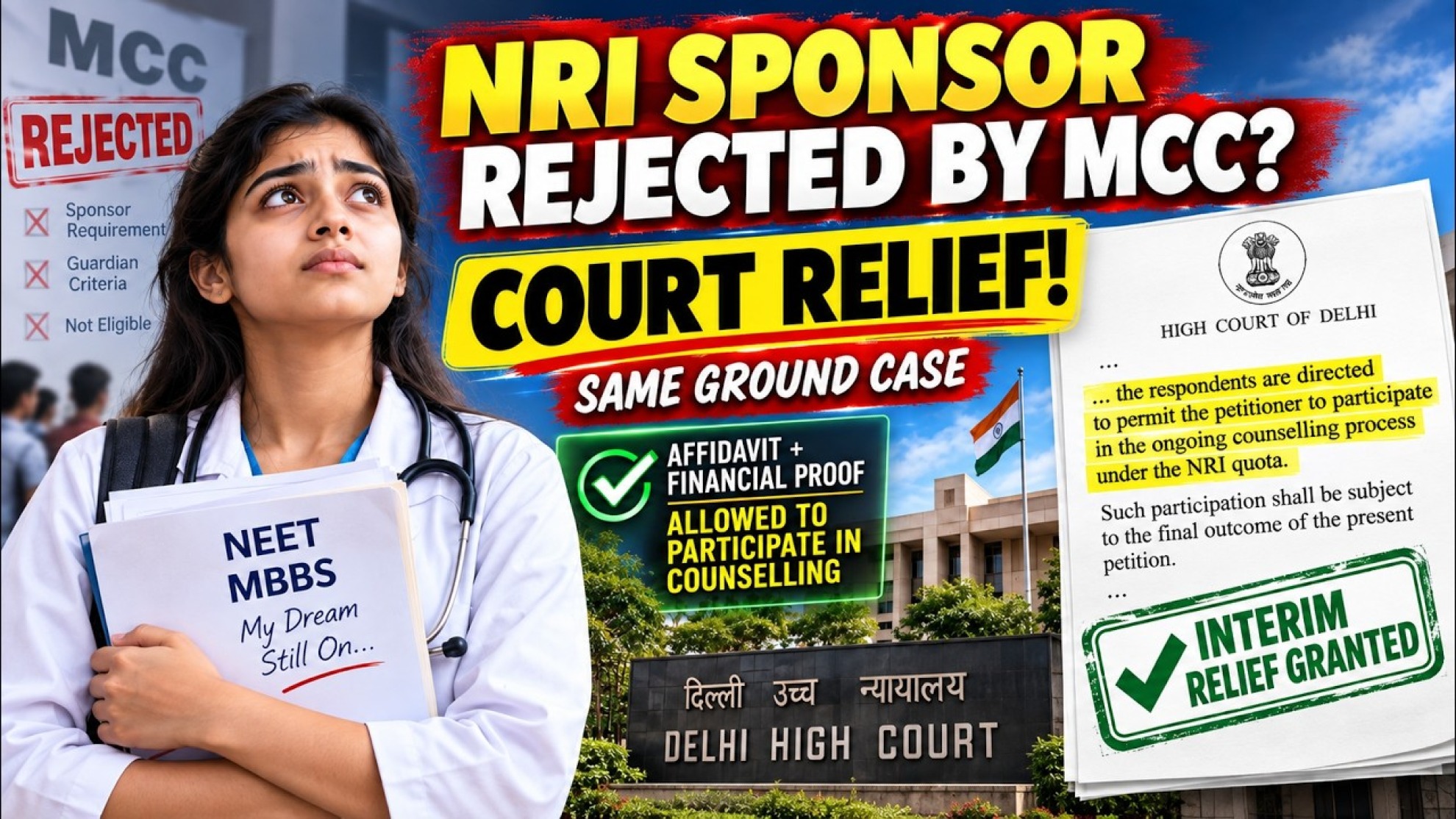
In a recent ruling, the Delhi High Court provided some relief to a petitioner by instructing authorities to allow her to join the ongoing NRI counselling process. She must submit an affidavit from her proposed sponsor and sufficient documentation showing that the sponsor can cover her educational expenses.
This ruling could be crucial for other genuine sponsored candidates who have struggled to participate in counselling due to the inability to produce the newly mandated guardianship documents on time.
What Changed in the NRI Sponsorship Rules for NEET UG 2026?
On May 27, 2026, the MCC issued a notice detailing new requirements for candidates wishing to enter the NRI quota.
Among these stipulations, the notice indicated that the sponsor needs to be an NRI who typically resides abroad, has acted as a guardian for the student, and must provide proof along with an affidavit. Additionally, the notice mentioned that legal documentation confirming bona fide legal guardianship under the Guardians and Wards Act, 1890 could be requested during counselling.
This change posed a significant challenge for some candidates.
Obtaining a formal guardianship order isn’t quick or easy. For students with sponsors who are genuine relatives and have been supporting their education for years, suddenly meeting a newly introduced requirement during or right before counselling can be tough.
This issue was especially pressing for candidates whose sponsors are close relatives, like a maternal or paternal uncle or aunt.
Why Did the Matter Reach the Delhi High Court?
The petitioner in the Delhi High Court case was a minor who had successfully qualified for NEET UG 2026 and was looking to get into a program through the NRI quota.
According to court records, she was being sponsored by her maternal aunt, an OCI/NRI living in Australia. The petitioner mentioned that her aunt had played a significant role in her life, especially after the loss of her father.
The petitioner contested the requirement to produce a court order proving her sponsor’s legal guardianship.
Her argument centered around several key points:
* The sponsor was a genuine close relative.
* The aunt was ready to cover her educational expenses.
* An affidavit could confirm the sponsorship.
* Documentation was available to show the sponsor's financial capability.
* The newly required guardianship rule posed a practical obstacle during the ongoing counselling process.
This case raised a bigger question:
Can a legitimate NRI-sponsored candidate be shut out of counselling just because they can’t get a formal guardianship order within the tight timeline?
What Was MCC's Argument?
MCC’s stance, as laid out in the court proceedings, focused heavily on preventing misuse of the NRI quota.
The authority contended that the extra documentation was necessary to protect against bogus or fabricated sponsorship claims.
This concern is understandable since NRI quota seats are meant for authentic NRI candidates and eligible beneficiaries. Authorities want to ensure that candidates don’t fraudulently acquire NRI status through phony sponsorship deals.
While the goal of tightening verification is generally accepted, the real debate is about how to achieve that aim without excluding legitimate candidates unnecessarily.
What Did the Delhi High Court Say?
The court's reasoning sheds light on the interim relief granted. It pointed out that the main concern of the respondents was to ensure that admission under the NRI quota wasn't secured through fake or fraudulent documents. However, the requirement to prove that a sponsor genuinely acted as a guardian seemed to introduce a subjective criterion at this point.
The court took into account that the proposed sponsor was the petitioner's maternal aunt, and the petitioner had provided material to back this claim. Crucially, the court concluded that an affidavit from the proposed sponsor, along with sufficient documentation showing the sponsor's financial ability to cover the candidate's educational expenses, could effectively address the valid concerns about verifying a genuine sponsorship arrangement.
What Relief Did the Court Grant?
The heart of the order lies in its direction regarding participation in counseling. The court instructed the respondents to allow the petitioner to take part in the ongoing NRI counseling process, provided that the petitioner submits:
* An affidavit from the proposed sponsor; and
* Adequate documentary proof showing the sponsor's financial capacity to cover the petitioner's educational expenses.
This is significant because the petitioner wasn't merely asking for an MBBS seat. The pressing issue was participation in the counseling process. That distinction matters a lot.
Participation ≠ Guaranteed Admission
It's essential to understand that this order shouldn't be seen as granting every sponsored candidate automatic eligibility for an NRI seat. Nor does it ensure that a candidate will receive an MBBS allotment. The order simply offered relief to the petitioner in this particular case, allowing participation contingent on the required documentation.
Why Is This Important for Other NRI-Sponsored Candidates?
This case could have implications for other candidates in similar situations, especially those who:
* Have a genuine NRI sponsor;
* Share a close family connection with that sponsor;
* Can provide evidence of their sponsorship arrangement;
* Can submit an affidavit from the sponsor;
* Can prove the sponsor's financial capacity; and
* Were excluded or unable to participate due to the guardianship-document requirement.
That said, candidates should not assume this order automatically applies to everyone. Each applicant's situation, documents, eligibility, and counseling status can vary widely. Legal remedies and counseling eligibility should be assessed on an individual basis.
Why Could This Matter to Deemed Universities?
This issue directly impacts deemed universities, as NRI quota seats in several institutions reportedly remained vacant during the 2026 counseling process. If genuine sponsored candidates can't participate due to documentation issues, those available NRI seats may end up unfilled.
For deemed universities, ongoing vacancies in NRI seats can have serious consequences, as these seats represent a distinct admission and fee category. For students, it might mean that seats are available despite willing candidates who can financially afford to enroll.
The Delhi High Court's interim intervention, therefore, introduces an important factor into the current NRI counseling landscape.
Does This Mean NRI Sponsorship Rules Have Been Cancelled?
No.
This is perhaps the most critical point for students to grasp. The Delhi High Court order does not imply that the entire NRI sponsorship framework set by the MCC has been invalidated. The case was about providing interim relief for a specific petitioner under unique circumstances. The MCC's goal of verifying genuine NRI sponsorship and preventing fraudulent claims is still very much in play.
The notice from May 27, 2026, was created to establish eligibility and documentation requirements for NRI counseling. Therefore, students shouldn’t see the court's order as a broad easing of all NRI documentation requirements.
What Should a Sponsored Candidate Do Now?
Candidates facing issues related to sponsorship documentation should approach this matter with care.
1. Verify Your Relationship With the Sponsor
Ensure the relationship between you and the sponsor is well-documented. This could include eligible close relatives as permitted by applicable rules.
2. Prepare Sponsorship Documentation
Keep clear evidence showing that the proposed sponsor is genuinely willing and financially able to support your education.
3. Obtain a Sponsor Affidavit
The interim relief from the Delhi High Court underscores the importance of these steps.
4. Keep Financial Evidence Handy
Having documents that show the sponsor's financial ability is really important.
The court took a close look at the paperwork proving that the sponsor could cover the petitioner's educational costs.
5. Stay Updated on MCC Instructions
Counselling requirements can shift as the process unfolds. Students should always check the latest official MCC updates instead of relying on social media or outdated info.
Could This Lead to More NRI Seat Allotments?
Maybe, but it’s still too soon to say for sure.
If genuine sponsored candidates who were left out before can now join in, the competition for vacant NRI seats could definitely rise.
That might mean some of those NRI seats, which might have gone unused otherwise, could finally get filled.
But a bunch of factors will still play a role in how this all turns out:
* The number of eligible NRI candidates
* How many sponsored candidates there are
* The number of available seats
* NEET merit
* Category priorities
* Verification of documents
* MCC counselling guidelines
* Ongoing court cases and their rulings
So, while this court decision offers a great opportunity for affected candidates, it doesn’t guarantee anyone a spot.
What About Candidates Who’ve Already Been Rejected?
This is probably the biggest question after the ruling.
Candidates whose NRI applications got turned down because they couldn’t meet the guardianship requirement should consider whether the reasoning in the Delhi High Court case applies to them.
However, what to do next really depends on their individual situation.
They should start by figuring out:
1. Why their application was rejected.
2. If the sponsor relationship is genuinely valid.
3. What documents were submitted.
4. If the sponsor can provide an affidavit.
5. If they have enough financial proof.
6. Whether their counselling stage is still open.
7. If there are any further legal options available.
A legal expert who knows about education counselling can help determine if a similar solution is suitable.
A Bigger Issue for NEET UG 2026 Counselling
This case brings up a larger challenge for counselling authorities.
On one hand, strict verification is essential to avoid abuse of the NRI quota.
On the other hand, those verification rules need to be practical enough to ensure genuine candidates aren't left out just because they can't get a certain legal document in time.
The Delhi High Court's temporary reasoning captures this dilemma.
The court didn’t dismiss the importance of verification. Instead, it considered an affidavit, backed by solid documentation proving financial capability, as a valid way to address concerns about real sponsorship.
Key Takeaways
The recent Delhi High Court ruling has significant implications for NEET UG 2026 aspirants:
* The MCC rolled out extra documentation requirements for NRI sponsorship in 2026.
* These new rules posed challenges for some candidates with genuine NRI sponsors.
* The court case involved a minor candidate sponsored by her maternal aunt.
* The court found a prima facie case in favor of the petitioner given the circumstances.
* The petitioner was allowed to join the ongoing NRI counselling process with an affidavit and solid proof of the sponsor's financial capacity.
* This ruling does not automatically guarantee an NRI seat for all sponsored candidates.
* It also doesn’t mean that MCC's whole sponsorship verification system is off the table.
* Other candidates in similar situations may need to get legal or administrative advice tailored to their cases.
* Students should keep an eye on official MCC updates and any future court developments.
Final Verdict
The Delhi High Court's recent involvement marks a significant turn in the NEET UG 2026 NRI counselling process. This is especially crucial for candidates whose legitimate NRI sponsorships have been impacted by the new requirements around guardianship documents.
What’s important to remember is that NRI sponsorship rules aren’t gone. The court's order shows that genuine sponsorship, backed by an affidavit and credible proof of financial capacity, can still play a key role in determining a candidate's eligibility for counselling.
For students left out of NRI counselling despite having valid sponsors, this ruling could serve as a vital legal reference. But keep in mind that how this order applies to each individual will depend on their specific circumstances and documentation.
As counselling moves forward, students need to stay alert for MCC notifications, vacancy updates, and any new judicial rulings before making their next move.
Watch the video: