Every year thousands of Indian students leave for foreign medical universities with one goal in mind — becoming a doctor. Most are concerned about returning to India and clearing NEXT. However, an increasing number of students are looking at the bigger picture and posing a question that was not asked ten years ago – Am I able to practice medicine in America after MD?
Yes, you can. But it calls for planning, clarity of thought, and the right preparation right from the time you enter medical school. This article provides an in-depth insight into the US MD pathway for Indian medical students – its components, requirements, and immediate actions to be taken if you have decided to follow this pathway.
What Is the US MD Pathway?
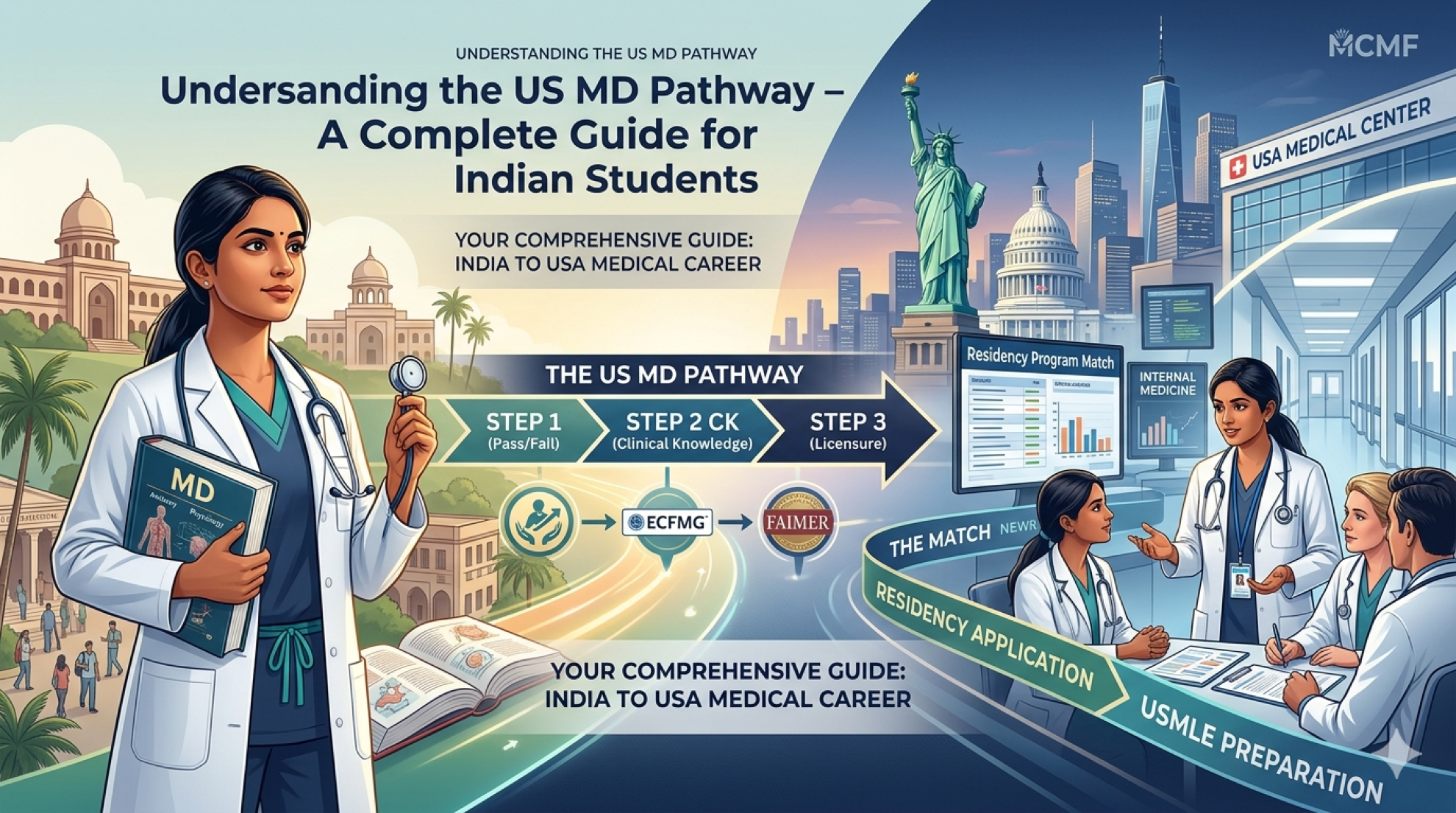
US MD pathway means the process that a foreign medical graduate – in this case, an Indian medical student who earns his/her MD degree from outside India – follows to practice medicine and do a residency in America.
This pathway hinges on the United States Medical Licensing Examination (USMLE). The USMLE consists of three licensing examinations conducted by the ECFMG and the Federation of State Medical Boards. By clearing all three stages of the examination and satisfying certain clinical training and documentation criteria, a foreign medical graduate becomes eligible for residency programs in the USA.
The USMLE — What Each Step Covers
USMLE Step 1 Step 1 covers knowledge of the basics of medical sciences such as anatomy, physiology, biochemistry, pathology, pharmacology, and microbiology, among others. This test is normally done after the pre-clinical stage of the medical degree course. From 2022, the test adopted a pass-fail scoring system. As a result, one's scores would not be provided numerically, although passing this exam would remain non-negotiable.
USMLE Step 2 CK — Clinical Knowledge Step 2 CK - Clinical Knowledge Step 2 CK assesses clinical knowledge and medical knowledge application. This exam covers topics like internal medicine, surgery, pediatrics, obstetrics and gynecology, psychiatry, and preventative medicine. Unlike Step 1, the scores for Step 2 CK are calculated numerically and hold great importance for residency programs.
USMLE Step 3 Step 3 is often done when one is into his/her residency program in the USA. This exam focuses on evaluating how well the candidate can practice medicine independently.
ECFMG Certification – The Key to Entry for Foreign Graduates
Before applying for residency training programs in the USA, the foreign medical graduate needs to become ECFMG-certified – a certificate awarded by the Educational Commission for Foreign Medical Graduates. For this purpose, the medical school you attend should be included in the FAIMER International Medical Education Directory.
The process of ECFMG certification includes the successful completion of Step 1 and Step 2 CK of the USMLE and satisfying the medical school credentialing requirements. ECFMG certification is a sign that you have been recognized as a foreign medical graduate eligible to work in the American medical system.
Applying for Residency — How It Works
Having successfully obtained ECFMG certification, foreign medical graduates apply for their residency training in the USA via the Electronic Residency Application Service – abbreviated as ERAS. The residency application process is quite competitive and is assessed based on many aspects, such as Step 2 CK score, clinical experience, letters of recommendation, research publications, and personal statement.
Observership experience in US clinical settings — where students shadow American physicians in hospital environments — is a significant advantage in residency applications. Students who secure an observership in the US as either medical students or shortly after graduation gain an immense edge over those who apply without having completed a US observership.
The process of matching into a residency program is done through the National Resident Matching Program, better known as 'The Match'. For Indian students the most accessible entry specialities are typically internal medicine, psychiatry, family medicine, and paediatrics — though stronger USMLE scores and research backgrounds open doors to more competitive specialities as well.
What Makes a Strong US MD Applicant
An understanding of what the residency programs require will help the applicant plan his/her six-year period of training more effectively. The key characteristics that distinguish a competitive candidate include:
Strong USMLE Step 2 CK Score: This is by far the most controllable variable in your residency application. The USMLE Step 2 CK compensates for numerous deficiencies in a foreign graduate's application package.
US Clinical Observership or Research Experience: Any legitimate exposure to the US healthcare system — even in an observership capacity — signals to programs that the applicant understands the American clinical environment.
Research and Publications: Even one or two research publications, particularly in indexed journals, meaningfully strengthen a residency application.
Strong Letters of Recommendation: Letters from physicians who know the applicant's clinical work directly — ideally from US-based physicians where possible — carry significant weight.
Clear and Compelling Personal Statement: It is important to know the reason for which the foreign graduate wants to pursue a career in the US and what contribution he/she brings to the field being applied to. Your personal statement plays a crucial role here.
When Should You Begin Planning?
This is the question most students ask too late. The honest answer is — from the day you start your MD program.
Students who eventually match into US residency programs are almost never the ones who decided to pursue the US pathway in their fifth or sixth year. They are the ones who chose a university with a USMLE-integrated curriculum, began Step 1 preparation alongside their pre-clinical studies, sought out research opportunities from the third year onwards, arranged observerships during clinical rotations, and built their application profile systematically over six years.
The MD pathway in the US is not a desperate decision. It is a deliberate, long-term plan that needs to be in place from the beginning of your medical education.
Is the US MD Pathway Right for You?
The MD pathway in the US involves tough competition, dedication, and commitment in the long run. The pathway would be appropriate for candidates who are driven in their studies and can maintain steady commitment to their studies over a period of six years and want to pursue their careers in medicine internationally.
It is not an appropriate choice for candidates who consider it an alternative path. Residency programs can tell the difference.
If you are serious about the US pathway the most important decision you will make is choosing the right university — one with a curriculum that prepares you for USMLE from year one, strong clinical training, and ECFMG and FAIMER recognition. Everything else builds from there.
Talk to MCMF Before You Decide
At MCMF we have been counselling Indian students on MBBS abroad for over 12 years. We understand the US MD pathway in depth — what it takes, what it costs, what universities prepare students well for it, and what students and families need to plan for financially and academically before committing to this route.
If the US MD pathway is something you or your child is seriously considering, speak with our counselling team before making any decisions. A free session with our experts could save you years of misdirection.