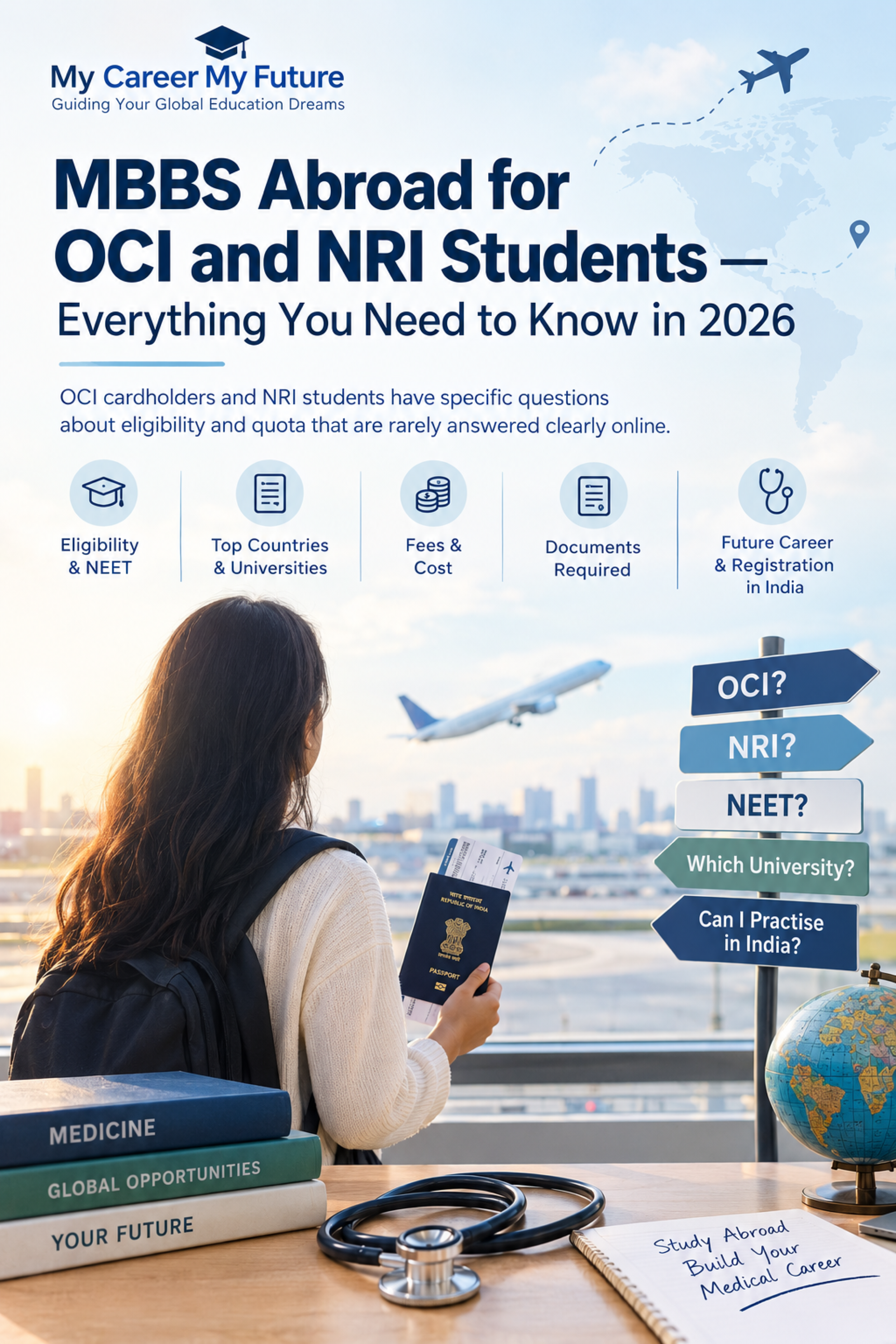
MBBS Abroad for OCI and NRI Students — Everything You Need to Know in 2026
For Indian-origin families living overseas, studying MBBS abroad can raise a different set of questions. Does an OCI card change eligibility? Does an NRI student need NEET? Are OCI students treated differently from Indian citizens? What happens after completing the degree abroad if the student wants to practise medicine in India?
These questions are important because NRI and OCI status does not, by itself, remove the regulatory requirements that apply to students who want to obtain a foreign medical qualification and later seek medical registration in India.
In this guide, My Career My Future (MCMF) explains the key points OCI and NRI students should understand before choosing an MBBS programme abroad in 2026.
Who Is an OCI Student?
An Overseas Citizen of India (OCI) cardholder is a foreign citizen who has been registered as an OCI under India's applicable rules.
For medical education, however, an OCI card should not be treated as equivalent to an unrestricted exemption from medical-admission requirements.
The relevant question is:
What is the student's citizenship/status, where do they intend to study, and do they plan to practise medicine in India after graduation?
These factors can affect the requirements that apply.
Can OCI Students Study MBBS Abroad?
Yes. OCI students can pursue medical education at foreign universities, subject to the admission requirements of the university and the applicable Indian regulatory requirements if they later want registration to practise medicine in India.
The National Medical Commission (NMC) specifically states that Indian citizens and OCI candidates seeking a primary medical qualification from a foreign medical institution are subject to the applicable requirements for foreign medical education.
This makes it important to look beyond just the university's admission criteria.
Does an OCI Student Need NEET for MBBS Abroad?
This is one of the most important questions.
The NMC has stated that Indian citizens/OCI candidates intending to obtain a primary medical qualification from a medical institution outside India are required to qualify NEET, subject to the applicable regulations.
The NEET-UG 2026 examination is conducted as the common entrance examination for undergraduate medical education in India, and the NMC's foreign-medical framework links NEET qualification to candidates seeking primary medical qualifications abroad.
In simple terms:
OCI/NRI status ≠ automatic NEET exemption.
If the student's plan is to obtain a foreign medical degree and potentially pursue medical registration in India, NEET requirements should be checked before admission.
What About NRI Students?
An NRI student should first distinguish between:
- NRI status
- Indian citizenship
- OCI status
- Foreign citizenship
These are not interchangeable categories.
For an NRI student who is an Indian citizen, the Indian regulatory requirements applicable to Indian citizens seeking foreign medical education remain relevant.
For an OCI cardholder, the NMC's foreign-medical guidance also specifically addresses OCI candidates.
Therefore, families should not assume that living abroad automatically changes the medical-education requirements.
The Most Important Question: Do You Want to Practise Medicine in India?
This question should be answered before choosing a university.
There is a major difference between:
Student A
Wants to study medicine abroad and build a medical career in the country where they study.
Student B
Wants to study medicine abroad and eventually return to India to practise.
For Student B, Indian medical-registration requirements become extremely important.
The NMC states that foreign undergraduate medical qualifications are governed by the applicable FMGL and related regulations. NMC's current guidance states that Indian/OCI candidates with foreign undergraduate medical qualifications are required to qualify the applicable FMG examination and then follow the relevant registration/internship process.
What Is FMGL 2021?
The Foreign Medical Graduate Licentiate (FMGL) Regulations, 2021 establish requirements for foreign medical graduates seeking registration in India.
Among the requirements described by NMC are:
- Minimum 54 months of medical education
- Education in the required medium, including English
- Clinical training requirements
- A 12-month internship at the same foreign medical institution/university under the applicable framework
- The foreign qualification must meet the applicable regulatory requirements
NMC's 2026 advisory again warned students to verify the course duration, medium of instruction, curriculum, clinical training and internship arrangements before taking admission abroad.
This is why choosing a foreign medical university based only on tuition fees can create problems later.
Is Every Foreign Medical University Suitable for an OCI/NRI Student?
No.
The NMC does not simply provide a blanket endorsement of foreign universities for Indian/OCI students.
NMC advises students to conduct due diligence and verify details such as the course structure, duration, curriculum and internship directly with the institution.
For 2026, NMC has continued issuing country-specific advisories and warnings regarding foreign medical institutions that may not comply with the requirements applicable to students seeking registration in India.
Before selecting a university, check:
1. Course duration
Is the programme structured in accordance with the applicable NMC requirements?
2. Medium of instruction
Is the required medical education delivered in English?
3. Clinical training
Where and for how long will clinical training take place?
4. Internship
Where will the internship be completed?
5. Recognition in the country of study
Is the qualification recognised for medical practice in that country?
6. Curriculum
Does the programme satisfy the applicable requirements for foreign medical graduates?
Do OCI Students Get an NRI Quota Abroad?
This is another common misunderstanding.
There is no universal "NRI quota" applicable to all foreign medical universities.
A foreign university may have its own admission categories, international-student policies and fee structures.
The term NRI quota is primarily relevant to certain admission processes in India and should not automatically be applied to foreign MBBS admissions.
An OCI student applying to a university in Georgia, Russia, Kazakhstan, Uzbekistan or another country should therefore check the specific university's international admission policy, rather than assuming that an Indian NRI quota applies.
What Documents May OCI/NRI Students Need?
The exact list depends on the university and admission route, but students may commonly need:
Academic Documents
- Class 10 certificate
- Class 12 certificate/marksheet
- NEET scorecard, where applicable
- School leaving/transfer certificate
- Passport-size photographs
Identity & Status Documents
- Valid passport
- OCI card, where applicable
- Proof of citizenship/status
- Birth certificate
Additional Documents
- Medical fitness certificate
- Financial documents, where required
- University application forms
- Visa documentation
- Other documents specified by the university or relevant authorities
Important: The university's requirements and India's regulatory requirements are two different things. Meeting the university's admission criteria does not automatically establish eligibility for future medical registration in India.
How Does the Process Work?
For an OCI/NRI student planning MBBS abroad, the process can be viewed in these stages:
Step 1 — Establish Your Status
Determine whether the student is:
Indian citizen + NRI
or
OCI cardholder
or
Foreign citizen without OCI status.
This distinction matters.
Step 2 — Check NEET Requirements
Do not assume that living abroad means NEET is unnecessary.
The applicable NEET requirement should be verified before admission.
Step 3 — Decide Where You Want to Practise
If India is the intended destination after graduation, check NMC requirements before paying university fees.
Step 4 — Shortlist Universities
Compare:
- Recognition
- Curriculum
- Duration
- Clinical exposure
- Internship
- Language
- Total cost
- Living expenses
- Country-specific regulations
Step 5 — Verify the University's Structure
Ask the university exactly where students complete:
Pre-clinical training → Clinical training → Internship
This is particularly important because NMC has cautioned against programmes whose structure does not meet applicable requirements.
Step 6 — Apply & Complete Visa Formalities
After meeting admission requirements, complete the university's admission process and the applicable student-visa process.
Step 7 — Keep All Records
Students should retain:
- Admission letters
- Fee receipts
- Academic transcripts
- Clinical-training records
- Internship certificates
- University documentation
- Passport/visa records
These documents can become important later.
What Happens After MBBS Abroad?
If an OCI/Indian candidate completes medical education abroad and wants to practise in India, the process does not simply end with receiving the foreign degree.
NMC states that foreign undergraduate medical qualifications are subject to the applicable regulatory framework, and its current guidance refers to the FMG examination followed by the relevant State Medical Council registration and internship requirements.
This means students should think about registration eligibility from the beginning of their MBBS journey, not after graduation.
Can OCI/NRI Students Return to India After MBBS Abroad?
Yes, but the ability to practise medicine in India depends on satisfying the applicable regulatory and registration requirements.
The important distinction is:
Studying medicine abroad ≠ automatically being licensed to practise medicine in India.
The student's foreign qualification must meet the applicable requirements, and the graduate must complete the prescribed licensing/registration pathway.
Common Mistakes OCI & NRI Students Should Avoid
❌ Mistake 1: Assuming OCI means Indian medical rules don't apply
OCI status does not automatically remove the requirements relevant to foreign medical education and registration in India.
❌ Mistake 2: Choosing a university only because it is cheap
Low tuition is not useful if the programme creates problems with future registration.
❌ Mistake 3: Ignoring clinical training
Where and how clinical training is conducted can be crucial.
❌ Mistake 4: Assuming every foreign university is automatically acceptable
NMC specifically advises students to conduct due diligence before admission.
❌ Mistake 5: Confusing admission eligibility with registration eligibility
A university can admit a student under its own rules, while Indian medical registration is governed separately by the applicable Indian regulatory framework.
❌ Mistake 6: Waiting until graduation to check Indian requirements
This is one of the most important mistakes to avoid.
Check the requirements before admission.
OCI vs NRI for MBBS Abroad
| Factor | NRI Student | OCI Student |
|---|---|---|
| Can study MBBS abroad? | Yes, subject to university requirements | Yes, subject to university requirements |
| NEET considerations | Must check applicable Indian requirements | Must check applicable Indian requirements |
| Indian registration after foreign MBBS | Applicable requirements must be fulfilled | Applicable requirements must be fulfilled |
| NRI quota automatically applicable abroad? | No | No |
| Need to verify university/course structure? | Yes | Yes |
| NMC regulations relevant if planning Indian registration? | Yes | Yes |
The exact legal position can depend on the student's citizenship, status, admission date and applicable regulations. Students should therefore verify the current rules before admission.
2026 Checklist for OCI & NRI Students
Before finalising an MBBS abroad admission, ask:
☑ What is my exact citizenship/status?
☑ Do I need NEET?
☑ Is the university properly recognised in its home country?
☑ Does the course satisfy the applicable NMC requirements?
☑ What is the total course duration?
☑ Where will clinical training happen?
☑ Where will the internship happen?
☑ What language is used for instruction?
☑ What is the complete tuition + living cost?
☑ If I return to India, what licensing steps will I need?
Final Takeaway
For OCI and NRI students, MBBS abroad is not simply about getting admission to a foreign university.
The bigger question is whether the chosen programme fits the student's long-term career plan.
If the student plans to practise in India after graduation, NMC requirements should be considered before choosing the university, not after completing the degree.
The NMC's current 2026 information continues to emphasise due diligence for students pursuing medical education abroad, including course duration, curriculum, medium of instruction, clinical training and internship arrangements.
At My Career My Future (MCMF), our team of expert counsellors helps students and families understand their options for MBBS abroad, including eligibility, university selection, documentation and the broader admission process.
Planning MBBS Abroad in 2026?
Don't choose a university only because admission is easy or fees are low. Choose after checking whether the course fits your eligibility, budget and long-term medical career plan.
My Career My Future — Guiding Students Towards the Right Medical Career.