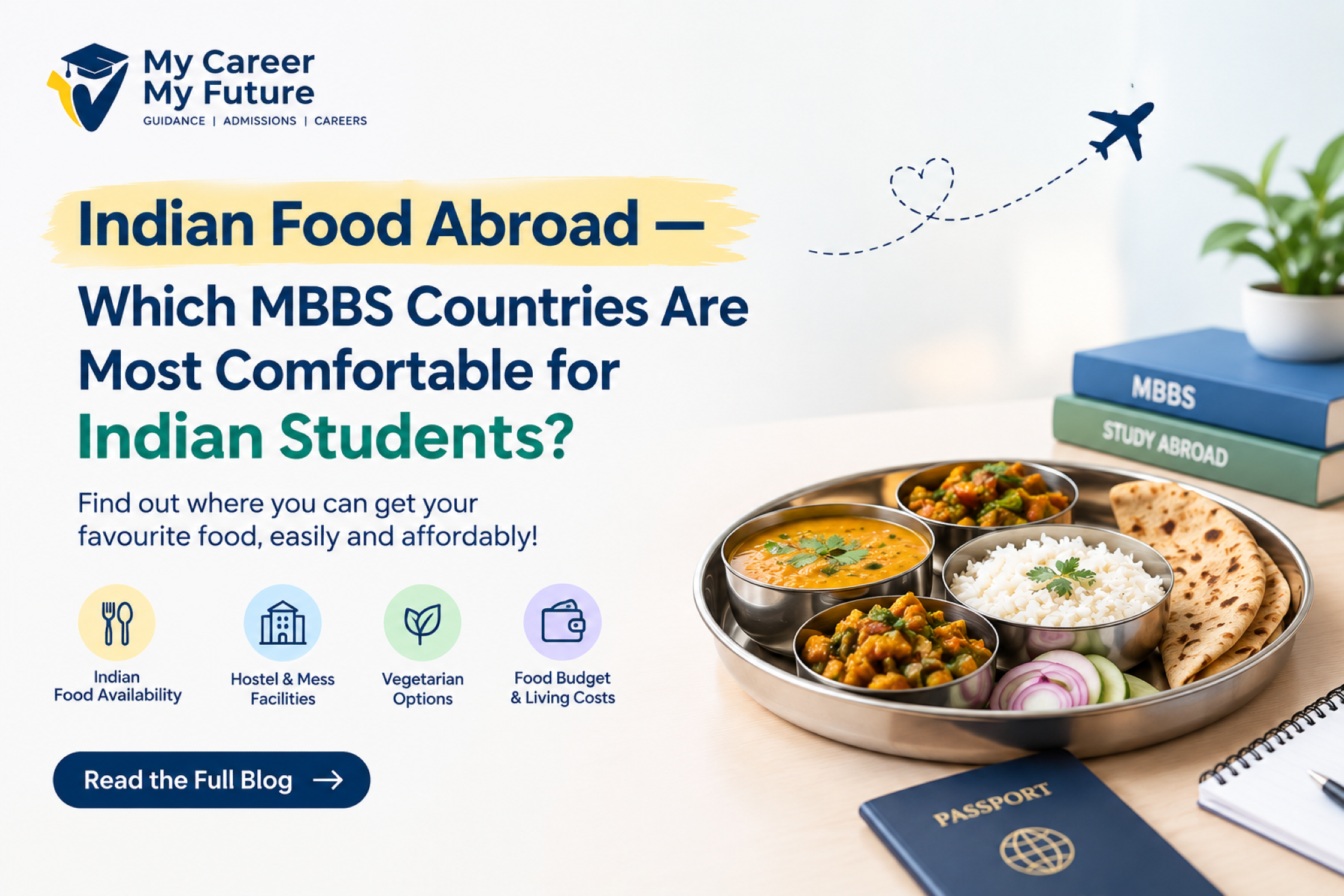
Indian Food Abroad: Which MBBS Countries Are Most Comfortable for Indian Students?
Introduction
Studying MBBS abroad is a dream for many Indian students, but moving to another country comes with several challenges. Apart from choosing the right university, students and parents often worry about accommodation, language, safety, climate, and, most importantly, the availability of Indian food.
For students who eat dal, roti, rice, sabzi, and other familiar meals every day, adjusting to a completely different food culture can take time. Food habits can also influence a student's comfort, daily routine, and overall experience while living abroad.
The good news is that several popular MBBS destinations have Indian restaurants, student mess facilities, Indian grocery stores, and opportunities for students to cook their own meals. However, the availability and affordability of these options vary by city and university.
In this blog, My Career My Future explores the food options available in popular MBBS destinations to help students and parents plan more confidently.
1. MBBS in Russia
Russia is a popular destination for Indian students pursuing medical education. In cities with established Indian student communities, students may find Indian restaurants, Indian grocery stores, and university hostels offering Indian meals.
-
Indian mess: Some universities or local student groups have arrangements for Indian food, but availability varies.
-
Vegetarian food: Rice, lentils, vegetables, and Indian spices may be available through Indian stores or home cooking.
-
Cooking facilities: Students may be able to prepare their own meals if their accommodation permits it.
-
What to check: Whether the university has a functioning Indian mess, its monthly cost, and whether it serves vegetarian and non-vegetarian food.
Important: Food options can differ considerably between large cities and smaller university towns. Confirm the facilities at your specific university before admission.
2. MBBS in Georgia
Georgia, particularly Tbilisi, attracts Indian students because of its international student community and medical universities. Indian restaurants and grocery options are available in some urban areas, although they may not be close to every campus.
-
Indian restaurants: More options may be available in major urban areas than in smaller towns.
-
Indian groceries: Students can look for rice, lentils, spices, and other familiar ingredients at Indian or international stores.
-
Cooking at home: Renting accommodation with a kitchen can make it easier to maintain familiar eating habits.
-
What to check: Whether the hostel provides Indian meals daily or whether students need to arrange their own food.
Students should also ask about meal timings, monthly food expenses, and the availability of suitable options during examinations and holidays.
3. MBBS in Kazakhstan
Kazakhstan is another destination considered by Indian students for medical studies. Food arrangements depend on the university, hostel, and city.
-
Indian food: Indian restaurants and food services may be available in larger cities.
-
Indian ingredients: Students can explore local supermarkets and specialty stores for spices, rice, and lentils.
-
Hostel facilities: Some accommodations may provide meal plans, while others require students to arrange food independently.
-
What to check: Confirm whether cooking is allowed in the hostel and whether Indian meals are served regularly.
Students should clarify food arrangements before travelling, particularly if they follow a strict vegetarian diet.
4. MBBS in Kyrgyzstan
Kyrgyzstan is known as a destination for international medical students, including students from India. Indian student communities in cities such as Bishkek may help newcomers find familiar food options.
-
Indian mess facilities: Some student accommodations have Indian food arrangements, but these are not universal.
-
Vegetarian options: Students can prepare vegetarian meals using locally available ingredients.
-
Budget planning: Compare the cost of hostel mess plans, outside food, and cooking at home.
-
What to check: Ask current Indian students whether the mess operates throughout the academic year and during holidays.
A university's location and the quality of its accommodation can make a considerable difference to a student's daily experience.
5. MBBS in Uzbekistan
Uzbekistan is another option for students exploring medical education abroad. Tashkent and other university cities may offer access to international groceries and Indian food services, although availability differs by location.
-
Indian food availability: Check for nearby Indian restaurants and reliable meal providers.
-
Cooking options: Students living in apartments may find home cooking convenient, subject to accommodation rules.
-
Food preferences: Students following vegetarian or special diets should discuss their requirements before admission.
-
What to check: Ask whether the university or hostel has an established Indian student support system.
Do not assume that every university in Uzbekistan offers an Indian mess simply because Indian students study there.
6. MBBS in Nepal
Nepal shares several food traditions with India, which can make everyday meals more familiar for many Indian students. Rice, dal, roti, vegetables, and other South Asian dishes are commonly found in many areas.
-
Familiar cuisine: Many meals are similar to those eaten in different parts of India.
-
Vegetarian options: Vegetarian meals are widely available in many places.
-
Food adjustment: Students may find it easier to maintain their usual eating habits, depending on the region.
-
What to check: Compare hostel meal plans, food quality, dietary options, and the distance between accommodation and campus.
Food familiarity is one factor to consider, but students should also assess admission eligibility, university recognition, fees, and clinical training.
7. MBBS in the Philippines
The Philippines has an international food culture, particularly in larger cities. Students may find Indian restaurants and grocery stores in urban areas, but options near individual universities can vary.
-
Indian restaurants: Availability is generally more location-dependent.
-
Cooking at home: Students may be able to prepare familiar meals if their accommodation includes a kitchen.
-
Food budgeting: Imported ingredients and restaurant meals can cost more than cooking with locally available products.
-
What to check: Confirm accommodation facilities, food availability near campus, and the total monthly food budget.
Students should also research the medical education pathway and eligibility requirements applicable to their future plans.
Comparison of Indian food facilities
The following table provides a general guide. These are broad observations, not a verified ranking of individual universities.
|
Country |
Familiar Indian meals |
What students should verify |
|---|---|---|
|
Russia |
Available in some cities and student communities |
Campus mess and city-specific availability |
|
Georgia |
Available in some urban areas |
Distance to restaurants and grocery stores |
|
Kazakhstan |
Depends on city and university |
Hostel meal plans and cooking facilities |
|
Kyrgyzstan |
Available through some student food arrangements |
Mess quality and continuity |
|
Uzbekistan |
Varies by city and accommodation |
Indian food providers and grocery access |
|
Nepal |
Many familiar South Asian food options |
Hostel menu and dietary preferences |
|
Philippines |
Available in some urban areas |
Restaurant access and food costs |
What should Indian students check before choosing a university?
Before paying admission or hostel fees, students and parents should ask these important questions:
-
Is an Indian mess available? Request the current menu and meal timings.
-
Are vegetarian meals served daily? Confirm whether Jain or other specific dietary requirements can be accommodated.
-
What is the monthly food cost? Ask whether meals are included in hostel fees or charged separately.
-
Can students cook? Check whether the hostel or apartment allows cooking and provides kitchen facilities.
-
Are Indian groceries nearby? Find out how easily students can purchase rice, lentils, spices, and other essentials.
-
What do current Indian students say? Speak with students already living at the university rather than relying only on promotional claims.
-
What happens during holidays? Confirm whether the mess remains open when the university is closed.
Tips for adjusting to food abroad
Moving abroad does not mean students must completely give up their familiar food habits. A little preparation can make the transition easier.
-
Carry permitted, non-perishable food essentials for the initial days, subject to the destination country's customs regulations.
-
Learn a few simple recipes that can be prepared with locally available ingredients.
-
Coordinate with roommates to share cooking responsibilities and grocery expenses.
-
Maintain a balanced diet instead of depending entirely on instant noodles or packaged food.
-
Join Indian student communities to learn about trusted food stores and meal services.
-
Check food labels and ingredients if you have allergies or dietary restrictions.
Conclusion
Indian food availability is an important practical consideration when choosing an MBBS destination. Countries such as Russia, Georgia, Kazakhstan, Kyrgyzstan, Uzbekistan, Nepal, and the Philippines offer different food environments, and the experience can vary significantly from one city or university to another.
The key is to research the specific university, not just the country. A reliable mess, suitable accommodation, access to groceries, and a manageable food budget can help students settle into their new environment more comfortably.
At the same time, food should be one part of the decision. Students must also evaluate university recognition, eligibility requirements, clinical exposure, total expenses, and the licensing requirements for practising medicine in India.
Plan your MBBS abroad journey with My Career My Future
My Career My Future (MCMF) helps students and parents understand university options, admission requirements, accommodation considerations, and the practical aspects of studying medicine abroad.
📞 Contact us: 8800726626 | 9990425566
Make an informed decision for your medical education journey!
Disclaimer: Food availability, hostel facilities, and living expenses can change. Confirm current arrangements directly with the university and accommodation provider before making any payment.