MD vs MBBS: Understanding the Difference Before Studying Medicine Abroad
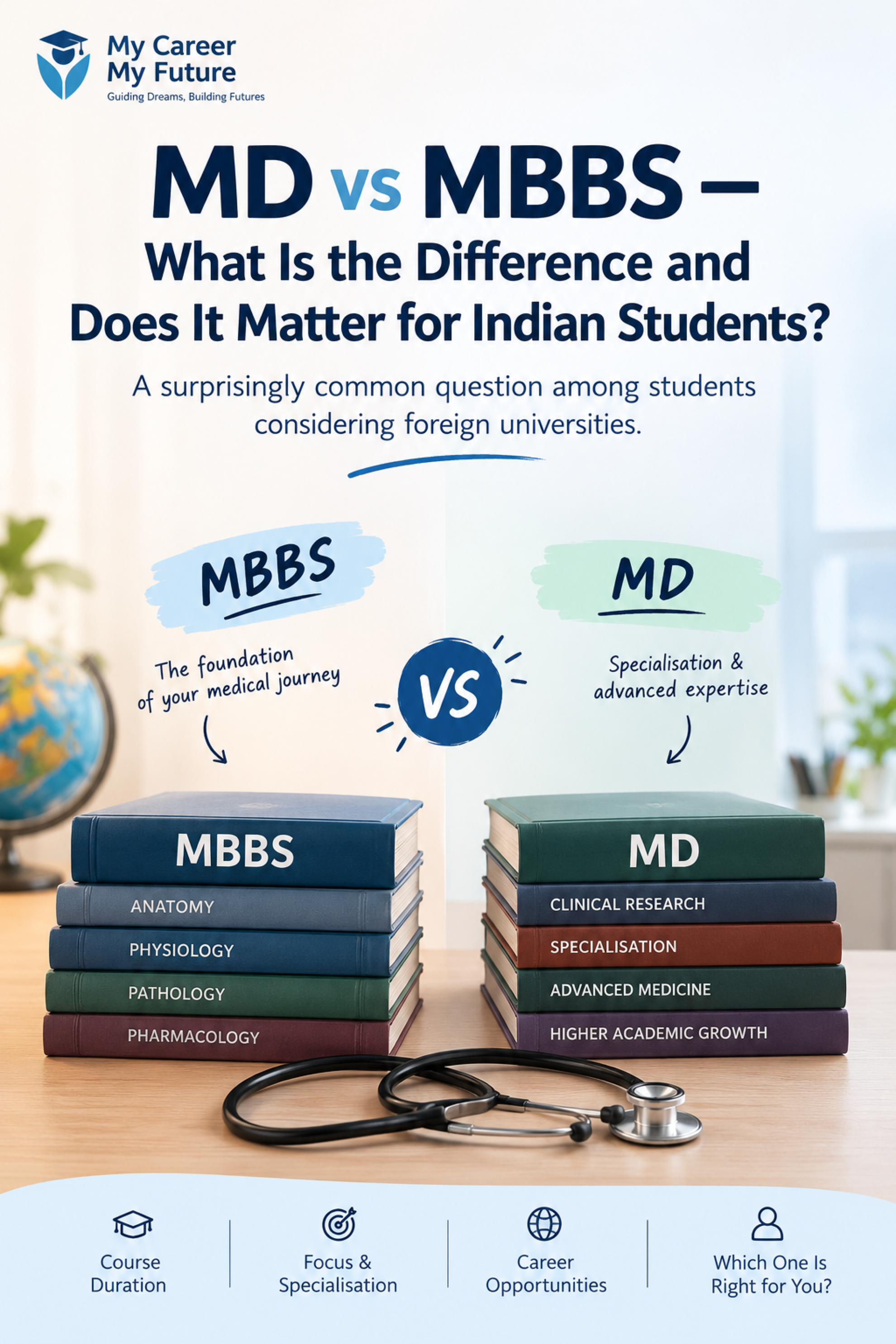
Choosing a medical degree is one of the most important decisions for students planning a career in medicine. For Indian students exploring medical universities abroad, two terms often cause confusion: MBBS and MD.
In India, students generally pursue an MBBS degree to become doctors. However, in countries such as Russia, Georgia and several other destinations, universities may offer a degree called MD (Doctor of Medicine) as the primary medical qualification.
Does this mean an MD degree from abroad is equivalent to an MBBS degree in India? Can Indian students return to India and practise medicine after completing a foreign MD?
Let's understand the key differences and what Indian students should know before choosing a medical university abroad.
1. What Is MBBS?
MBBS stands for Bachelor of Medicine, Bachelor of Surgery. It is the primary medical qualification awarded to students in India after completing an undergraduate medical programme.
The course generally includes:
-
Basic medical sciences, such as anatomy, physiology and biochemistry.
-
Clinical subjects, such as medicine, surgery, paediatrics and obstetrics and gynaecology.
-
Clinical training and supervised practical experience.
-
Compulsory internship requirements under the applicable Indian regulations.
After completing the required training and fulfilling the applicable registration requirements, graduates can pursue medical practice in India.
2. What Is an MD?
MD stands for Doctor of Medicine, but its meaning varies between countries.
In countries such as Russia and Georgia, MD may be the title of the primary medical qualification awarded after completing a medical programme. In the United States, however, an MD is a professional medical degree obtained after undergraduate education and is followed by residency training for specialisation.
Therefore, an MD degree is not automatically a postgraduate specialisation degree, nor is it automatically equivalent to an Indian MBBS. Its status depends on the country, course structure, duration and applicable medical regulations.
3. MD vs MBBS: Key Differences
|
Feature |
MBBS in India |
MD in Russia/Georgia (typically) |
|---|---|---|
|
Degree title |
Bachelor of Medicine, Bachelor of Surgery |
Doctor of Medicine |
|
Course level |
Primary medical qualification |
Primary medical qualification |
|
Admission |
NEET-UG and applicable admission rules |
Country and university-specific requirements, including applicable NEET requirements for Indian students |
|
Duration |
Generally 5.5 years, including internship |
Often 6 years; structure varies |
|
Main objective |
Medical education and clinical training |
Medical education and clinical training |
|
Practice in India |
Requires applicable internship, examination and registration requirements |
Requires compliance with Indian rules for foreign medical graduates |
|
Specialisation |
Pursued after the primary medical qualification |
Usually pursued after the primary qualification and required licensing steps |
Note: Course duration, internship arrangements and degree recognition must be verified for the specific university and admission year.
4. Why Do Foreign Universities Offer MD Instead of MBBS?
Medical degree titles differ because education systems are not identical across countries.
In India, MBBS is the standard undergraduate medical degree title. In some European and other international education systems, the primary medical qualification is awarded as an MD or a similar professional medical degree.
The title alone does not determine the quality of education. Students should examine the university's curriculum, clinical exposure, teaching hospitals, course duration and compliance with the regulations applicable in their intended country of practice.
For example, a six-year MD programme abroad may provide foundational medical education and clinical training comparable in purpose to an undergraduate medical programme. However, the degree title by itself does not establish that it meets India's requirements for foreign medical graduates.
5. Can Indian Students Practise in India After Completing an MD Abroad?
Yes, it may be possible, but the degree title alone does not guarantee eligibility to practise in India.
Indian students planning to study medicine abroad should verify the applicable National Medical Commission (NMC) requirements before admission.
Important factors include:
-
NEET qualification: Indian students intending to pursue a primary medical qualification abroad must meet the applicable NEET requirements.
-
Course duration and structure: The programme must satisfy the applicable requirements for the foreign medical qualification.
-
Internship and clinical training: Students must verify the duration, location and structure of clinical training and internship.
-
Licensing requirements: Graduates must fulfil the applicable screening or licensing examination requirements in India, as well as registration requirements.
-
University eligibility: The institution and qualification should be checked against the relevant regulatory requirements rather than relying only on a counsellor's assurance or the degree title.
India's regulatory framework for foreign medical graduates can change. Students should consult the latest NMC rules and official notifications before paying admission fees.
6. Does the Difference Matter for Indian Students?
Yes. It matters because students need to understand what qualification they will receive and whether it meets the requirements for their intended career.
Before choosing a university abroad, students should consider:
-
Whether the degree is the primary medical qualification in that country.
-
Whether the programme meets the applicable NMC requirements.
-
Whether the course includes adequate clinical exposure and practical training.
-
Whether graduates can pursue the licensing process in India or another country where they intend to practise.
-
Whether the university has suitable teaching hospitals and a recognised academic structure.
Students should avoid selecting a university based solely on the words “MD” or “MBBS” in its course title.
7. Which Degree Should You Choose?
There is no universal answer. The right option depends on your educational background, budget, preferred country and long-term career plans.
-
If you plan to practise in India: Check the current NMC requirements before enrolling in any foreign medical programme.
-
If you plan to practise abroad: Research the destination country's licensing examinations, postgraduate training requirements and registration process.
-
If you want to specialise: Understand the pathway from the primary medical qualification to postgraduate training in your chosen country.
Remember, the degree title is only one part of the decision. The programme's eligibility, clinical training and recognition requirements are equally important.
8. How My Career My Future Can Help
At My Career My Future (MCMF), we help aspiring medical students and their families understand MBBS opportunities abroad, compare universities and review important admission requirements.
Our counselling team can help you explore:
-
Medical universities in Russia, Georgia and other destinations.
-
Course duration, tuition fees and additional expenses.
-
Admission eligibility and documentation.
-
University-specific curriculum and clinical training.
-
The regulatory requirements students should verify before admission.
Our aim is to help students make informed decisions based on their academic goals, budget and future plans.
Conclusion
The difference between MD and MBBS is mainly the degree title and the education system in which it is awarded. In some countries, MD is the primary medical qualification, while in others, including the United States, it represents a professional medical degree obtained after undergraduate study.
For Indian students, the most important question is not simply whether a university offers an MD or MBBS. It is whether the specific programme meets the applicable requirements for the career they want to pursue.
Planning to study MBBS abroad? Contact My Career My Future for guidance on university selection, admission eligibility and medical education pathways.
Contact us: 8800726626 | 9990425566