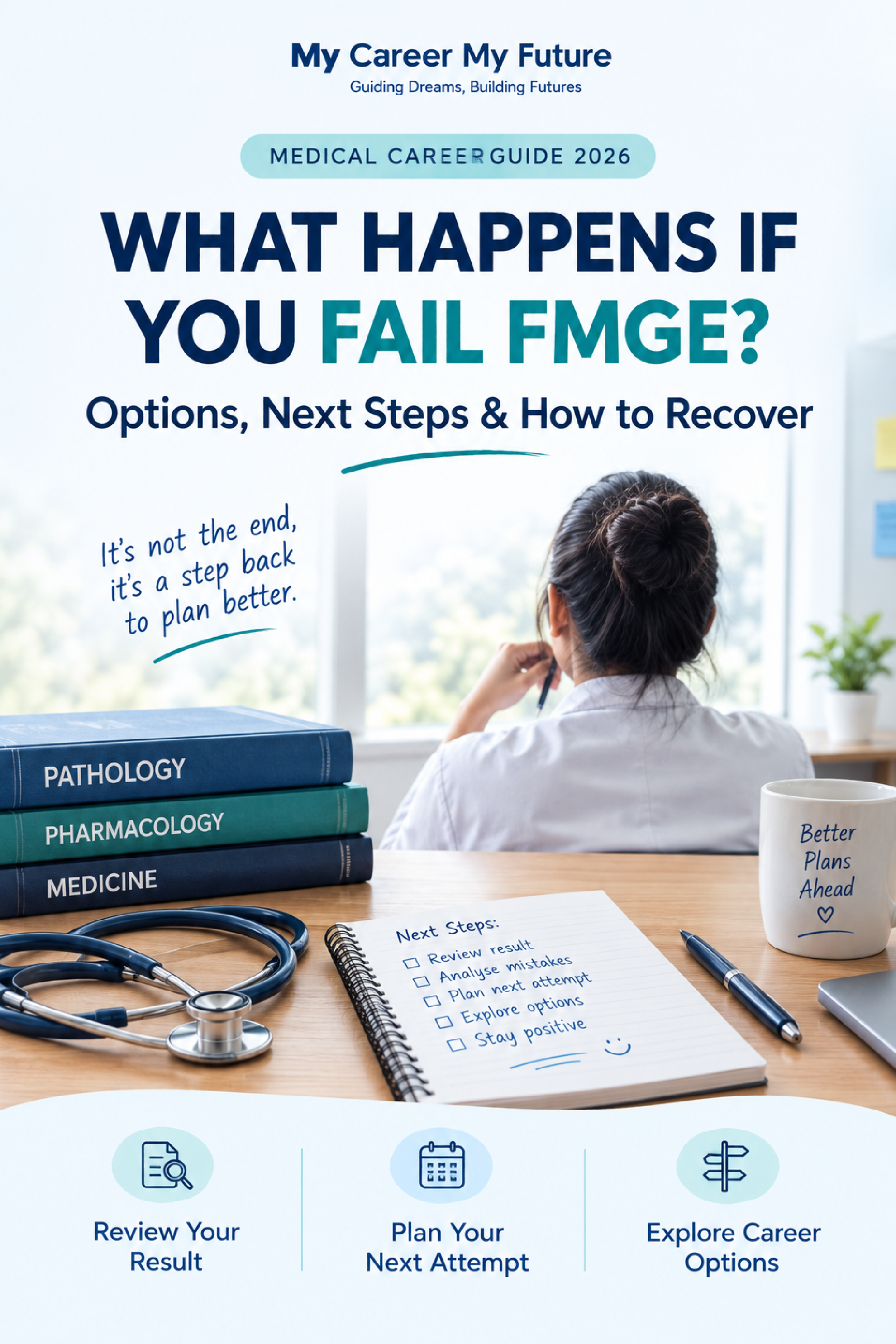
What Happens If You Fail FMGE? Options, Next Steps and How to Recover
Failing the Foreign Medical Graduate Examination (FMGE) can be a difficult experience for Indian students who have completed their medical education abroad. After years of studying medicine, preparing for clinical practice and investing time and money in their education, an unsuccessful result can leave students feeling confused, anxious and uncertain about their future.
Questions naturally arise: Can you appear for FMGE again? Can you practise medicine in India without passing it? Should you join coaching, repeat your preparation or consider other career options?
The important thing to understand is that failing FMGE does not mean your medical career is over. However, you need to understand the examination and registration requirements, identify your preparation gaps and develop a realistic plan for your next attempt.
In this guide, My Career My Future (MCMF) explains what happens after an unsuccessful FMGE result and the practical steps foreign medical graduates can take next.
1. What Is FMGE and Why Does It Matter?
The Foreign Medical Graduate Examination (FMGE) is a screening examination conducted by the National Board of Examinations in Medical Sciences (NBEMS) for eligible Indian citizens and Overseas Citizens of India (OCIs) who obtain their primary medical qualification abroad and seek registration to practise medicine in India.
According to the National Medical Commission (NMC), eligible foreign medical graduates must qualify the applicable screening or licensing examination and fulfil the other requirements for registration. After qualifying FMGE, graduates must follow the applicable provisional registration, Compulsory Rotating Medical Internship (CRMI) and permanent registration process.
National Medical Commission
+1
FMGE is therefore an important step for eligible foreign medical graduates who intend to practise medicine in India.
2. What Happens If You Fail FMGE?
If you do not qualify FMGE, you cannot use that unsuccessful result to obtain medical registration in India through the FMGE qualification route.
Here is what this means in practical terms:
-
Registration: You cannot proceed to registration on the basis of an FMGE pass that you have not obtained.
-
Clinical practice: You cannot independently practise as a registered doctor in India without the required registration.
-
Internship: You should check the applicable rules before making plans for CRMI or any internship linked to registration.
-
Future attempts: You should review the latest official NBEMS information to determine the applicable eligibility, application deadlines and examination requirements for your next attempt.
-
Career planning: You can continue preparing for the examination while exploring lawful, non-practising roles related to your medical education.
Your next steps will depend on your individual circumstances, including your qualification, previous examination history and the current regulations.
3. Can You Give FMGE Again After Failing?
If you fail FMGE, your next step is to check your eligibility for a subsequent examination session and prepare to reappear.
Start by visiting the official NBEMS website and checking the latest FMGE information bulletin, application dates, eligibility conditions and examination notices.
Do not rely on old coaching material or social media posts for rules about the number of attempts. Confirm the current requirements that apply to your case before submitting an application.
Use the time before the next examination to review your previous performance, strengthen weaker subjects and practise questions under timed conditions.
4. How to Analyse Your FMGE Result
One common mistake is to begin studying again using exactly the same strategy that did not work previously.
Instead, use your result as a starting point for a more focused plan.
Step 1: Identify your weak subjects
Review the subjects and topics in which you consistently struggle. Consider whether the problem is a lack of conceptual understanding, difficulty remembering facts or an inability to apply knowledge to clinical questions.
Step 2: Review your previous preparation
Ask yourself:
-
Did I complete the syllabus?
-
Did I revise each subject more than once?
-
Did I practise enough previous-year questions and mock tests?
-
Did I spend too much time watching lectures and too little time solving questions?
-
Did I struggle with time management or examination anxiety?
Honest answers can help you identify what needs to change.
Step 3: Build a realistic revision schedule
Divide your preparation into manageable daily and weekly targets. Give additional time to weaker subjects while continuing to revise the topics you already understand.
Avoid making a timetable that looks impressive but is impossible to follow consistently.
Step 4: Practise mock examinations
Take full-length mock tests in an examination-like environment. After each test, review both incorrect answers and questions you answered correctly through guessing.
Track your accuracy, recurring mistakes and progress over time.
Step 5: Revise consistently
Repeated revision helps reinforce concepts and makes it easier to recall information under examination pressure. Keep concise notes of important facts, frequently confused concepts and mistakes from mock tests.
5. Should You Join FMGE Coaching After Failing?
Coaching can be useful, but it is not compulsory for every student.
The right choice depends on why you did not qualify and how effectively you can study independently.
|
Your situation |
Approach to consider |
|---|---|
|
You struggle to understand core concepts |
Structured classes or subject-specific guidance |
|
You understand concepts but forget them |
Active recall and a regular revision schedule |
|
You know the material but score poorly in tests |
Timed question practice and mock-test analysis |
|
You have difficulty following a study routine |
A structured timetable, mentor or study group |
|
You are close to your target but make repeated errors |
Targeted revision and an error log |
Before paying for a course, check its syllabus coverage, teaching format, faculty, practice resources and suitability for your needs. Coaching alone cannot guarantee that you will pass.
6. What If You Have Failed FMGE More Than Once?
Repeated unsuccessful attempts can be discouraging, but they are also a reason to reassess your strategy rather than simply increase your study hours.
Consider taking the following steps:
-
Review what changed, or did not change, between your previous attempts.
-
Identify the subjects that repeatedly affect your performance.
-
Set measurable weekly goals for question accuracy and revision.
-
Seek help from a qualified teacher or mentor for persistent conceptual gaps.
-
Protect your sleep, health and study breaks to avoid burnout.
-
Verify your eligibility and the rules for the next examination session.
Do not compare your preparation timeline with that of your friends. Your study plan should reflect your own performance, available time and learning needs.
7. Can You Work in the Medical Field Without Passing FMGE?
Yes, there may be opportunities in healthcare-related fields that do not involve practising medicine as a registered doctor. However, the work must remain within the role's legal and professional limits.
Depending on your qualifications, skills and the employer's requirements, you could explore roles such as:
-
Clinical research coordination or research support.
-
Medical writing and healthcare content development.
-
Pharmacovigilance support, subject to role-specific requirements.
-
Healthcare administration and hospital operations.
-
Medical education support or academic content development.
-
Public health programme support.
These are possible career directions, not automatic employment entitlements. Some roles require additional qualifications, training or experience.
Important: Working in a healthcare-related role does not authorise you to diagnose patients, prescribe medicines or represent yourself as a registered medical practitioner in India.
If your main goal is to practise as a doctor in India, preparing for the applicable licensing route remains a separate requirement.
8. Should You Move Abroad to Practise Medicine?
Some foreign medical graduates consider returning to the country where they studied or moving to another country.
Before making this decision, research the destination's medical licensing requirements, language examinations, postgraduate training pathways, immigration rules and employment conditions.
Holding a medical degree from another country does not automatically grant permission to practise there. You may need to complete additional examinations, supervised training or registration procedures.
Compare the time, financial cost and eligibility requirements carefully before committing to another pathway.
9. How to Recover Emotionally After Failing FMGE
An unsuccessful result can affect your confidence, particularly when family members have invested heavily in your education or you feel pressure to start working.
Give yourself time to process the result. Speak with a trusted friend, family member, mentor or counsellor if you feel overwhelmed.
Try to focus on what you can control: your preparation, your routine, the resources you use and your next decision.
Avoid spending all your time comparing scores or reading discouraging posts online. Take a short break if needed, then return to your preparation with a specific and manageable plan.
Remember: An examination result is an outcome, not a complete measure of your potential. At the same time, a recovery plan works best when it is based on honest assessment and consistent action.
10. A Practical 30-Day Plan After an Unsuccessful FMGE Attempt
Use this framework to begin rebuilding your preparation. Adjust it according to your next examination date and your individual needs.
Days 1–3: Review
Review your result, previous mock tests, preparation method and weak areas. Confirm the latest examination requirements.
Days 4–10: Plan and rebuild
Create a realistic timetable, organise your study resources and begin revising difficult concepts.
Days 11–20: Practise
Solve subject-wise questions, revise high-priority topics and maintain a log of recurring mistakes.
Days 21–30: Evaluate
Take mock tests, analyse your performance and refine your study schedule based on the results.
Thirty days is a starting framework, not a guarantee of success or a complete preparation timeline. Your overall preparation period should be based on your knowledge gaps and the official examination schedule.
11. How My Career My Future Can Help Medical Students
At My Career My Future (MCMF), we understand that medical education involves important academic, financial and career decisions.
Our counselling team helps students and families understand medical education pathways, foreign university options, admission requirements and the steps involved in planning a medical career.
For foreign medical graduates who have not qualified FMGE, the priority should be to understand the applicable rules, assess their next steps and make informed decisions about their future.
Whether you are exploring medical education abroad or planning your next move after graduation, seek guidance based on your individual circumstances and verify regulatory information through official sources.
Conclusion
Failing FMGE can be disappointing, but it does not mean you must abandon every career goal connected to medicine.
Start by checking your eligibility for the next examination session, reviewing your preparation and identifying the changes needed to improve your performance. Consider coaching if it addresses a specific need, and explore alternative healthcare-related careers only within the limits of your qualifications and applicable regulations.
Most importantly, do not make rushed decisions because of one result. A clear plan, consistent preparation and accurate information can help you decide what to do next.
Need guidance on your medical career?
Connect with My Career My Future (MCMF) to explore medical education pathways and plan your next steps.
Contact: 8800726626 | 9990425566