- MADHYA PRADESH - Reopening of Willingness for Upgradation Link
- Telangana Management Quota 2026 – CMR Institute of Medical Sciences Seat Removed from Vacancy
- MCC Round 3 (MBBS/BDS) – SEAT MATRIX UG Counselling 2026
- KEA UGNEET 2026: 3rd Round Online Seat Allotment Note
- Jharkhand Combined Entrance Competitive Examination Board (JCECEB) Counseling Schedule 2026
- Tamil Nadu NEET UG 2026 Round 1 Counselling Schedule Revised
- BFUHS MBBS/BDS Admission 2026 Schedule Out
- TN-Guidelines for MCC
- Gujarat NEET UG 2026 Counselling: ACPUGMEC Begins Online Registration & Document Verification Schedule
- MCC Issues Important Notice for PwBD Candidates Applying for NEET UG Counselling 2026
- KEAM 2026: Kerala Opens Fresh Applications for MBBS & Medical Allied Courses
- Dr. NTRUHS AP MBBS/BDS Counselling 2026-27: Online Registration & Documents List Released
- Tamil Nadu MBBS & BDS 2026 Registration Deadline Announced
- NTA Declares NEET (UG) 2026 Results: 11.21 Lakh Candidates Qualify
- KEA Opens Fresh Registration for MBBS, BDS & AYUSH Admissions 2026
- NTA NEET (UG) 2026 Exam Fee Refund: Bank Account Update Deadline Extended to 31 July
- NEET UG 2026 Refund Update: Last Date to Confirm Bank Details Extended
- Tamil Nadu MBBS 2026 Registration Started
- Tamil Nadu GQ MBBS 2026 – Important Dates Announced
- TN MBBS 2026 MQ Prospectus Released – Important Dates Announced
University of Georgia Tbilisi MBBS 2026 – Fees, Admission & Eligibility
Study MBBS/MD at the University of Georgia (UG), Tbilisi – Explore 2026 tuition fees, eligibility, NEET requirements, admission process, course details, accommodation and guidance for Indian students.
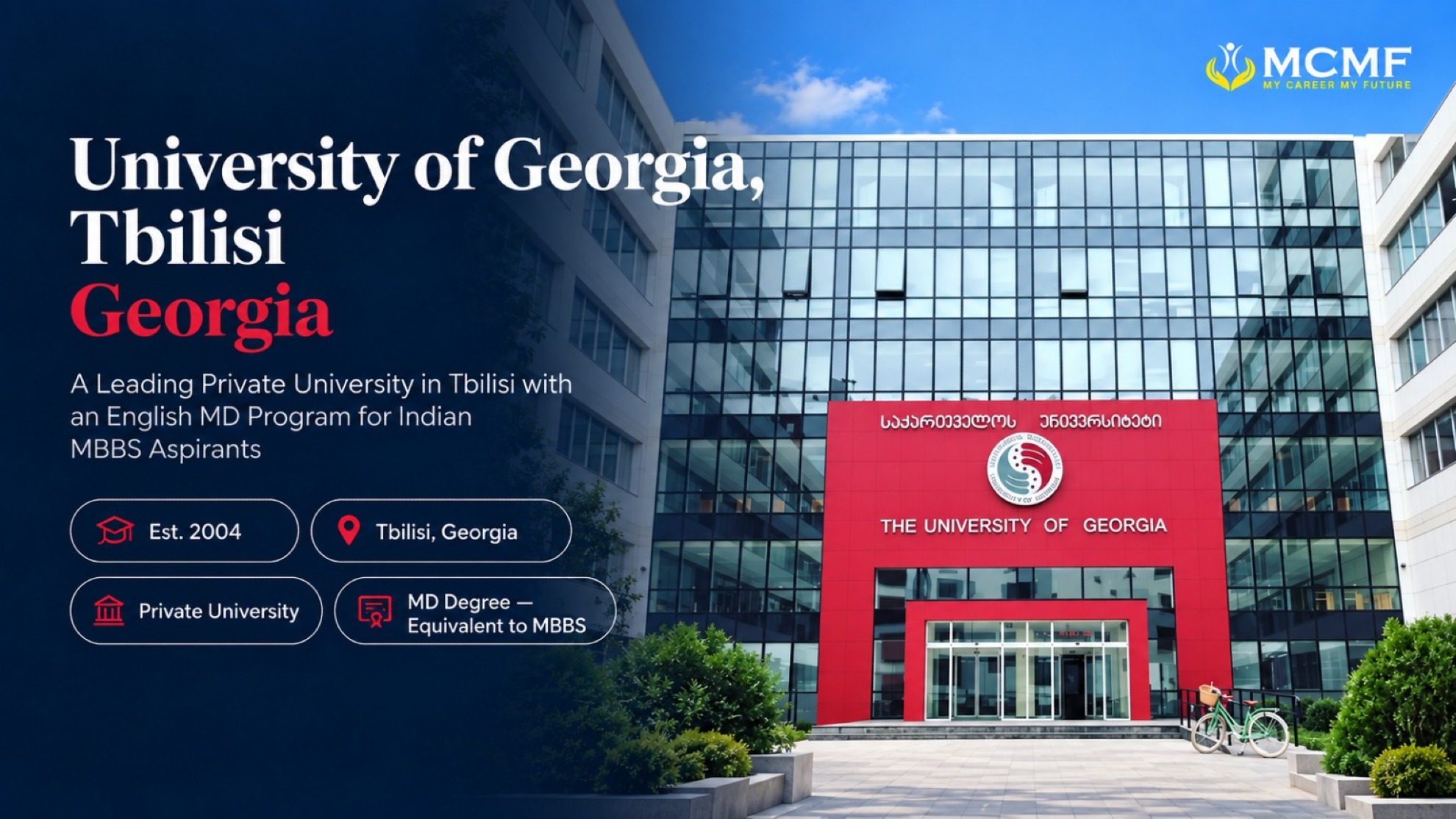
About University of Georgia (UG), Tbilisi
The UG, Tbilisi is one of the best private universities in Georgia and has proved to be one of the popular options for students across the globe who seek to complete their education in medicine in Europe. Being located in the capital city of Georgia, Tbilisi, this university attracts students from India and several other nations due to its English-taught medical course program.
Founded in 2004, University of Georgia has evolved as one of the top private universities in the country. The University of Georgia offers courses in various streams of studies, and its School of Health Sciences is particularly famous amongst international students.
For aspiring medics, the university offers a 6-year Medicine program in English that leads to the degree of Medical Doctor (MD). This course comprises of 360 ECTS credits covering basic medical science subjects, clinical courses, practice learning, simulation-based learning, and hospital experience.
When Indian students are looking for MBBS in Georgia, they often consider this University of Georgia because of its 6-year MD program in English language medium.
Recognition & Accreditation
Recognition is one of the most important factors Indian students should check before choosing a medical university abroad. The University of Georgia has several important national and international credentials associated with its medical program.
Georgian Government Authorisation & Accreditation
The University of Georgia is authorised within Georgia's national higher education quality assurance system. Its Medicine program is accredited through the country's National Center for Educational Quality Enhancement (NCEQE), the official quality assurance authority responsible for higher education institutions and programs in Georgia.
World Directory of Medical Schools (WDOMS)
The University of Georgia School of Health Sciences is listed in the World Directory of Medical Schools (WDOMS). Its medical program is shown as a 6-year program leading to the Medical Doctor qualification.
ECFMG Eligibility
The University of Georgia's medical school is included among schools relevant to the ECFMG certification pathway. This is particularly important for students who may plan to pursue the USMLE and postgraduate medical training in the United States after graduation, subject to meeting the applicable ECFMG requirements at that time.
ASIIN / AMSE Accreditation
The University's English-language Medicine program has received international accreditation from ASIIN, a German accreditation agency, together with accreditation standards associated with the Association of Medical Schools in Europe (AMSE).
The accreditation evaluates areas such as curriculum quality, learning outcomes, educational standards, teaching methodology and alignment with international medical education benchmarks.
For Indian Students
Indian students planning to return to India after completing their medical education abroad must comply with the prevailing National Medical Commission (NMC) Foreign Medical Graduate regulations, including NEET and other applicable eligibility, course, internship and licensing requirements.
Students should evaluate the complete medical program against the latest NMC regulations rather than relying only on claims that a foreign university is "NMC approved."
Why Does the University of Georgia Appeal to Indian Students?
The University of Georgia has gained popularity among Indian students who wish to do their MBBS in Georgia. There are many practical and academic reasons for this popularity.
Medicine Program in English
Medicine program is conducted in English language, thus making it more convenient for Indian and other international students to study medicine without studying in Georgian.
6-Year Medicine Program
University of Georgia provides a 6-year medicine program that includes 360 ECTS credits. It results in a Medical Doctor qualification. This medicine program includes theoretical medical education as well as practical and clinical training.
University Located in Tbilisi
This university is situated in the capital of Georgia where students have easy access to hospital, transport, accommodation, dining, shopping, international community and other facilities.
International Student Community
University of Georgia hosts students from various nations, providing Indian students an opportunity to study in multicultural academic environment.
Modern Medical Education System
University of Georgia focuses on practical medical education through laboratory training, clinical skills training and simulation training.
Clinical Education Possibilities
Clinical education becomes a more significant part of the medical school curriculum as one progresses through the program, and helps one link what he or she learns in class to practice medicine in the real world.
International Medical School Curriculum
The medical program is based on contemporary standards for medical education and employs integrated learning, clinical reasoning, and skill development rather than mere theoretical studies.
License to Practice Medicine in Various Countries
UG graduates have the possibility of choosing a pathway towards medical licensure in various countries depending on the specific requirements of the country where they intend to practice medicine. Hence, one can consider attending UG in case one intends to take FMGE/NExT in India or USMLE in the United States, among others.
Indian Medical Students Studying in Tbilisi
Many Indian students studying medicine are currently enrolled in various universities in Tbilisi. Having access to Indian food, groceries, and even places of lodging specifically for Indian students can help new Indian students studying medicine adjust faster to their new surroundings.
Why to Opt University of Georgia for MBBS? – Top Reasons
The selection of the best medical university outside of India depends on more than just a comparative analysis of tuition fee. It is also necessary to consider the academic quality, clinical exposure, global reputation, location, infrastructure, and future career prospects of the university. The University of Georgia (UG), Tbilisi has all these things that make it an excellent choice for Indians pursuing MBBS in Georgia.
1. 6-Year English Medium MBBS Course
The University of Georgia offers a 6-year MBBS course which concludes with awarding the degree of Medical Doctor (MD).
This course comprises 360 ECTS credits and includes all aspects of theoretical knowledge, clinical subjects, practical and hospital-based learning.
Learning medicine in English becomes very convenient for Indian students.
2. Internationally Accredited Medical Program
UG's Medicine program has international accreditation associated with ASIIN and the Association of Medical Schools in Europe (AMSE).
The university is also authorised within Georgia's national higher education system, while its medical school is listed in the World Directory of Medical Schools (WDOMS).
These credentials are important for students who want their medical education to meet recognised international academic standards.
3. Modern Medical Infrastructure
One of the key advantages of studying medicine at the University of Georgia is access to modern educational infrastructure.
Students learn through a combination of:
- Medical laboratories
- Clinical skills training
- Simulation-based education
- Practical demonstrations
- Interactive classroom teaching
- Clinical and hospital-based learning
Simulation and practical training allow students to develop essential medical skills in a controlled environment before applying them during clinical rotations.
4. Emphasis on Clinical Education
Medical education would be incomplete without proper clinical exposure to patients.
As students advance in their undergraduate medicine course, they graduate from the basic sciences subjects to more clinical sciences subjects and clinical teaching hospitals.
Clinical education allows the students to learn valuable skills like:
- Patient history taking
- Physical examinations
- Clinical reasoning
- Diagnosis
- Treatment planning
- Effective patient communication
- Clinical practices
The transition from theoretical education to practical medicine is an essential part of medical education.
5. University of Georgia – Located in Tbilisi, Georgia’s Capital City
University of Georgia is located in Tbilisi, and this happens to be the greatest strength for foreign medical students.
Tbilisi is the capital of Georgia and its largest city, offering more options of:
- Medical institutions and hospitals
- Student housing
- Transportation
- Cafés and supermarkets
- Indian grocery stores
- International communities
- Airport and traveling
- Student neighborhoods
It is much easier for Indian students studying in a new country for the first time if they have access to a large city.
6. Multicultural Student Environment
The University of Georgia attracts students from different countries, creating an international and multicultural academic environment.
Studying alongside students from different nationalities helps medical students develop communication skills and cultural awareness — both of which become increasingly important in modern healthcare.
For Indian students, the presence of other international and Indian students can also make settling into life in Georgia easier.
7. Opportunities for International Medical Career Pathways
Students graduating from the University of Georgia may explore medical licensing and postgraduate pathways in different countries, provided they meet the regulations and eligibility requirements of the respective medical authorities.
Depending on their long-term career goals, graduates may prepare for pathways such as:
India – FMGE/NExT and NMC requirements
Indian graduates planning to practise medicine in India must fulfil the Foreign Medical Graduate regulations applicable at the time of graduation and clear the required licensing examination.
United States – USMLE Pathway
Students interested in postgraduate medical training in the United States may explore the USMLE and ECFMG certification pathway, subject to meeting all applicable eligibility requirements.
Other Countries
Graduates may also explore postgraduate education or licensing pathways in other countries depending on the regulations of the respective medical councils.
This flexibility makes an internationally oriented medical education particularly valuable for students who have not yet decided where they ultimately want to practise.
8. Modern Teaching Methodology
The medical curriculum at the University of Georgia focuses on more than simply memorising textbooks.
Students are exposed to teaching approaches that encourage:
Integrated Learning – Connecting basic medical sciences with clinical applications.
Clinical Reasoning – Developing the ability to analyse symptoms, investigations and medical cases.
Practical Training – Building essential medical and procedural skills through laboratories and clinical environments.
Simulation-Based Learning – Practising clinical situations in a controlled educational setting.
Continuous Assessment – Evaluating student progress throughout the program rather than depending only on final examinations.
This approach helps students gradually develop both theoretical knowledge and practical medical competence.
9. Growing Indian Student Ecosystem in Tbilisi
Georgia has become an increasingly popular destination for Indian students pursuing medical education abroad, and Tbilisi has developed a significant international student ecosystem.
Indian students can find:
- Indian restaurants
- Indian grocery stores
- Private hostels catering to Indian students
- Shared apartments
- Indian student groups
- Cultural communities
- Online and offline FMGE/NExT preparation resources
Having access to a familiar student community can be especially valuable during the first few months of living abroad.
10. Competitive Cost Compared to Private MBBS in India
For many families, the cost of a private or deemed university MBBS seat in India can become extremely high when tuition fees and other expenses are combined.
The University of Georgia provides students with an alternative where the complete medical education cost can be planned more predictably.
Although UG is not necessarily the cheapest medical university in Georgia, students and parents should evaluate it based on the overall combination of:
Academic quality + clinical exposure + location + infrastructure + international recognition + total cost
rather than selecting a university purely because it offers the lowest tuition fee.
For students who want to study medicine in Tbilisi and are looking for a modern, internationally oriented medical university, the University of Georgia is one of the options worth seriously considering.
University of Georgia Rankings & Recognition
Recognition should be one of the first things students and parents verify before choosing a medical university abroad. A university may have attractive fees and infrastructure, but students also need to understand whether the medical program is properly accredited and whether it supports the licensing pathway they plan to pursue after graduation.
The University of Georgia (UG), Tbilisi has national and international credentials associated with its Medicine program. Here is a clear breakdown.
National Center for Educational Quality Enhancement (NCEQE), Georgia
The University of Georgia operates within Georgia's official higher education quality assurance framework.
Its medical program has been evaluated through the National Center for Educational Quality Enhancement (NCEQE), Georgia's national body responsible for the authorisation of higher education institutions and accreditation of academic programs.
NCEQE is also recognised by the World Federation for Medical Education (WFME) as an accrediting agency.
For students, this is important because the university's medical program is not simply operating as an unregulated foreign medical course — it forms part of Georgia's recognised higher education system.
World Directory of Medical Schools (WDOMS)
The University of Georgia School of Health Sciences is included in the World Directory of Medical Schools (WDOMS).
The WDOMS entry for this university indicates that the institution is a private medical school located in Tbilisi and the medical qualification issued by it is:
Medical Doctor (MD)
The WDOMS listing for the current program at this institution includes a duration of study of:
6 Years
with English as the language of instruction.
Being included in the WDOMS is one of the important criteria for checking the international standing of the medical school.
However, students should realize that being listed in WDOMS is not the same as being "WHO approved," which is an important distinction to make.
ECFMG Eligibility for the United States
Students intending on pursuing their medical careers in the United States should definitely pay attention to ECFMG eligibility.
According to the current WDOMS sponsor notes the graduates and students of the University of Georgia School of Health Sciences are eligible to apply for ECFMG Certification, provided they meet the necessary ECFMG requirements.
The current eligible graduation years according to the WDOMS sponsor notes include:
2016 – Current
This can allow eligible graduates to pursue the pathway toward the United States Medical Licensing Examination (USMLE) and postgraduate medical training in the United States, subject to meeting all ECFMG and US licensing requirements.
ASIIN & AMSE International Accreditation
The University of Georgia's English-language Medicine program has received international accreditation through ASIIN, a German accreditation agency.
The program has also received accreditation based on joint standards involving the Association of Medical Schools in Europe (AMSE).
According to the university, the accreditation process evaluated the Medicine program against international standards relating to:
- Medical curriculum
- Learning outcomes
- Teaching quality
- Assessment systems
- Clinical education
- Academic infrastructure
- European higher education standards
- International standards for basic medical education
The university announced full international accreditation for its Medicine program in 2023 after previously receiving conditional accreditation.
For students comparing medical universities in Georgia, this represents an additional international quality-assurance credential beyond Georgia's national accreditation system.
WFME-Recognised Accreditation Framework
The Georgian accrediting authority responsible for evaluating the medical program is recognised by the World Federation for Medical Education (WFME).
This distinction has become increasingly important internationally because medical education accreditation standards are now closely connected with eligibility requirements for various postgraduate and licensing pathways.
It is important to distinguish this correctly:
UG itself is not "WFME approved."
Rather, its medical program is accredited through an accreditation system whose responsible Georgian authority is recognised by WFME.
This wording is more accurate and avoids misleading students.
National Medical Commission (NMC), India
Indian students frequently search for whether the University of Georgia is "NMC approved."
Technically, the National Medical Commission does not maintain a simple list of foreign universities that students should treat as permanently "NMC-approved."
Instead, Indian students who study medicine abroad must ensure that their medical education satisfies the requirements laid down under the prevailing NMC Foreign Medical Graduate regulations.
These requirements may relate to areas such as:
- NEET qualification
- Duration of the medical program
- Medium and mode of study
- Clinical training
- Internship requirements
- Eligibility to obtain medical registration in the country where the degree is awarded
- Licensing requirements applicable in India after graduation
Therefore, Indian students considering MBBS at the University of Georgia Tbilisi should evaluate the complete program against the latest NMC regulations applicable to their admission batch.
Ranking of University of Georgia
There may be great differences in the ranking of universities based on different organisations and methodologies employed.
In accordance with the 2026 uniRank Georgian University Ranking, University of Georgia ranks:
#3 amongst universities in Georgia
It is also ranked amongst the top universities situated in Tbilisi under the same methodology.
Nevertheless, it needs to be kept in mind that uniRank assesses universities primarily through web visibility and institutional metrics. Therefore, it cannot be taken as a ranking regarding the standard of medical education, clinical exposure or FMGE or teaching standards.
For an aspiring MBBS, ranking of the university holds less value compared to factors such as recognition, syllabus, infrastructure and compliance with licensing norms.
Quick Recognition Summary
| Recognition / Body | Status |
|---|---|
| Georgian Higher Education System / NCEQE | Authorised / Accredited |
| World Directory of Medical Schools (WDOMS) | Listed |
| Medical Qualification | Medical Doctor (MD) |
| Program Duration | 6 Years |
| Medium of Instruction | English |
| ECFMG Certification Pathway | Eligible, subject to applicable requirements |
| ASIIN | Internationally Accredited Medicine Program |
| AMSE / ASIIN Standards | Accredited |
| WFME | Georgian accrediting authority is WFME-recognised |
| NMC, India | Students must individually comply with prevailing FMG regulations |
What Does This Mean for Indian Students?
For Indian students, the most important takeaway is that the University of Georgia has a recognised medical education framework, a WDOMS-listed medical school, international program accreditation, and an established ECFMG pathway.
However, recognition alone should never be the only reason to choose a university.
Students planning to return to India should also examine:
NMC compliance + course structure + internship + clinical exposure + total fees + FMGE/NExT preparation + long-term career goals.
Taken together, the University of Georgia's accreditation profile makes it one of the notable medical universities for students researching MBBS in Georgia for Indian students.
University of Georgia MD Program Details
The Medicine program at the University of Georgia (UG), Tbilisi is a 6-year single-cycle medical degree designed to provide students with a combination of biomedical knowledge, clinical skills, practical training, and professional competencies required for a career in medicine.
For Indian students searching for MBBS at the University of Georgia, it is important to understand that the qualification awarded in Georgia is Medical Doctor (MD) rather than MBBS. The program serves as the primary medical qualification offered by the university.
Course Name & Duration
| Particular | Details |
|---|---|
| Program | Medicine |
| Qualification Awarded | Medical Doctor (MD) |
| Duration | 6 Years |
| Total Credits | 360 ECTS |
| Study Level | Single-Cycle Medical Degree |
| Medium of Instruction | English |
| Location | Tbilisi, Georgia |
The entire medical program requires students to complete 360 ECTS credits over six years.
Unlike a conventional bachelor's and master's structure, Medicine in Georgia is offered as a single-cycle degree program, meaning students enter the medical program after completing secondary education and progress through the full medical curriculum within one integrated course.
Medium of Instruction
The Medicine program is taught in English, making it suitable for international students, including those from India.
Lectures, academic material, examinations, laboratory sessions, and the primary medical curriculum are conducted in English.
This allows Indian students to study medicine without having to complete their academic subjects in Georgian.
However, students may also learn basic Georgian medical communication during their studies because interacting effectively with local patients becomes useful during clinical training.
Curriculum Structure
The University of Georgia medical curriculum combines:
- Basic and biomedical sciences
- Clinical sciences
- Behavioural and social sciences
- Laboratory education
- Clinical skills
- Medical communication
- Research and evidence-based medicine
- Practical training
- Hospital-based clinical rotations
The curriculum gradually moves students from fundamental medical sciences into clinical medicine and real-world patient care.
A simplified understanding of the six-year structure is given below.
Phase 1 – Basic & Biomedical Sciences
Primarily Years 1 and 2
The initial years of the medical program focus on developing a strong understanding of the human body and the scientific foundations of medicine.
Students study areas such as:
- Anatomy
- Physiology
- Histology
- Embryology
- Biochemistry
- Molecular Biology
- Genetics
- Medical Physics
- Microbiology
- Basic clinical and communication skills
Laboratory sessions and practical classes are integrated alongside theoretical teaching.
Rather than studying medicine only through lectures, students gradually begin developing the practical and analytical skills needed for later clinical subjects.
Phase 2 – Disease Processes & Introduction to Clinical Medicine
Primarily Years 3 and 4
As students progress, the curriculum increasingly focuses on understanding diseases, their causes, diagnosis, and treatment.
Important areas of study typically include:
- Pathology
- Pathophysiology
- Pharmacology
- Microbiology
- Immunology
- Internal Medicine
- Surgery
- Diagnostics
- Epidemiology
- Public Health
- Medical Ethics
- Clinical Communication
Students begin connecting the basic sciences studied during the initial years with actual clinical conditions.
Clinical skills training becomes increasingly important during this stage, helping students understand how theoretical medical knowledge is applied to patients.
Phase 3 – Advanced Clinical Training
Primarily Years 5 and 6
The later stages of the Medicine program focus heavily on clinical education.
Students participate in rotations across different medical specialties and gain supervised exposure to clinical environments and patient care.
Major clinical areas may include:
- Internal Medicine
- General Surgery
- Paediatrics
- Obstetrics & Gynaecology
- Neurology
- Psychiatry
- Emergency Medicine
- Family Medicine
- Ophthalmology
- ENT
- Dermatology
- Infectious Diseases
- Orthopaedics
- Other medical and surgical specialties
During these years, students are expected to apply knowledge gained throughout the course to actual clinical cases.
The objective is to develop clinical reasoning, patient assessment, communication, diagnostic thinking, and professional medical decision-making.
Clinical Rotations
Clinical education forms an important component of the University of Georgia medical program.
The university's curriculum includes clinical rotations in different medical specialties, which may be conducted at the university and at affiliated medical institutions.
During these rotations, students learn under the supervision of medical professionals and gradually develop experience in:
- Taking patient histories
- Conducting physical examinations
- Understanding laboratory investigations
- Interpreting diagnostic findings
- Developing differential diagnoses
- Understanding treatment plans
- Patient communication
- Clinical documentation
- Working within a healthcare team
The level of student involvement naturally increases as they progress through the program.
Practical & Laboratory Training
UG's Medicine program is not based solely on classroom lectures.
The teaching process incorporates:
Laboratory Training
Students use practical laboratory sessions to understand biomedical sciences and diagnostic concepts.
Clinical Skills Training
Students develop skills required for examining patients and performing basic clinical procedures.
Simulation-Based Learning
Clinical scenarios can be practised within a controlled educational environment before students encounter similar situations with real patients.
Hospital-Based Education
Clinical rotations allow students to observe and participate in real healthcare environments under supervision.
This combination helps bridge the gap between textbook-based medical knowledge and practical medicine.
Small Practical & Clinical Groups
An important feature mentioned in the university's medical program structure is the use of relatively small groups for practical education.
Laboratory and practical groups may contain up to 15 students, allowing for more direct interaction during practical and clinical training compared with very large lecture-based classes.
Smaller practical groups can be particularly useful when students are developing clinical examination, communication, procedural, and diagnostic skills.
Teaching Methodology
The University of Georgia uses a combination of different teaching methods throughout the medical program.
These include:
Lectures – Structured teaching of fundamental and clinical medical concepts.
Practical Classes – Applying theoretical knowledge through exercises, demonstrations, and medical skills training.
Laboratory Sessions – Practical learning in biomedical and diagnostic subjects.
Clinical Rotations – Supervised learning within hospitals and healthcare institutions.
Case-Based Learning – Understanding medical problems through clinical scenarios and patient cases.
Integrated Learning – Connecting different medical disciplines rather than studying each subject completely in isolation.
Simulation Training – Developing clinical and professional skills within simulated healthcare situations.
Independent Study – Students are also expected to develop the ability to research, revise, analyse medical literature, and learn independently.
Assessment & Examinations
Students are evaluated throughout the medical program rather than being assessed only through one final examination.
Depending on the subject, assessment may involve:
- Written examinations
- Multiple-choice examinations
- Oral assessments
- Practical examinations
- Clinical skills assessments
- Presentations
- Assignments
- Case discussions
- Laboratory assessments
Clinical and professional competencies can also be assessed through structured practical and clinical evaluation methods.
This continuous assessment system helps track whether students are developing both academic knowledge and practical medical skills.
Focus on Competency-Based Medical Education
The University of Georgia's medical curriculum is designed around the development of professional competencies rather than simply completing individual subjects.
By graduation, students are expected to develop abilities in areas such as:
- Medical knowledge
- Patient examination
- Clinical reasoning
- Diagnosis
- Patient management
- Medical communication
- Professionalism
- Medical ethics
- Evidence-based medicine
- Research
- Public health
- Teamwork
- Lifelong learning
This competency-based approach is particularly important because modern medical licensing examinations increasingly evaluate the ability to apply medical knowledge, rather than simply memorise facts.
What Indian Students Should Understand
For Indian students, the University of Georgia's 6-year MD program provides an English-medium medical education with theoretical, laboratory, practical, and clinical components.
However, students planning to practise medicine in India after graduation should separately ensure that the complete course structure, clinical training, internship requirements, and licensing eligibility comply with the NMC Foreign Medical Graduate regulations applicable to their admission batch.
The degree title may be MD in Georgia, but for an Indian student, the more important questions are whether the course provides adequate medical education, clinical training, and eligibility for the pathway required to obtain medical registration in India.
University of Georgia MBBS Fees Structure 2026
The University of Georgia (UG), Tbilisi offers its 6-year Medicine program at a tuition fee that remains competitive when compared with the overall cost of private medical education in India.
For the 2026 intake, the annual tuition fee for the Medicine program at the University of Georgia is approximately 6,500 USD per year.
Students and parents should remember that tuition is only one part of the total MBBS abroad budget. Accommodation, food, travel, insurance, visa-related expenses, and personal living costs should also be considered while planning the complete six-year expenditure.
University of Georgia Tuition Fees 2026
| Academic Year | Tuition Fee |
|---|---|
| Year 1 | 6,500 USD |
| Year 2 | 6,500 USD |
| Year 3 | 6,500 USD |
| Year 4 | 6,500 USD |
| Year 5 | 6,500 USD |
| Year 6 | 6,500 USD |
| Total Tuition Fee for 6 Years | 39,000 USD |
Therefore, based on the current fee structure, the approximate total tuition cost of completing the 6-year MD program at the University of Georgia is 39,000 USD.
Actual payable amounts should always be reconfirmed before admission because universities may revise their fee structure for future batches.
Hostel & Accommodation Fees
Students studying at the University of Georgia have access to different accommodation options in Tbilisi, ranging from shared student hostels to more comfortable private or semi-private arrangements.
Depending on the type of accommodation selected, students should budget approximately:
| Accommodation Type | Approximate Annual Cost |
|---|---|
| Shared / Standard Accommodation | 3,000 – 4,000 USD |
| Upgraded / Semi-Private Accommodation | 4,000 – 5,000 USD |
| Private / Premium Accommodation | Up to 6,000 USD |
| Expected Range | 3,000 – 6,000 USD/year |
The exact cost depends on factors such as:
-
Location
-
Room type
-
Number of students sharing
-
Facilities provided
-
Meal arrangement
-
Utilities
-
Distance from the university
Students who share apartments or rooms with batchmates can usually keep their accommodation costs lower.
Estimated Accommodation Cost for 6 Years
Based on an annual accommodation budget of 3,000 to 6,000 USD, the approximate six-year accommodation expense can be:
| Expense | Approximate 6-Year Cost |
|---|---|
| Budget / Shared Accommodation | 18,000 USD |
| Mid-Range Accommodation | 24,000 – 30,000 USD |
| Premium / Private Accommodation | Up to 36,000 USD |
Accommodation preferences can therefore make a significant difference to the overall cost of studying MBBS at the University of Georgia.
Tuition + Accommodation Cost for 6 Years
Before adding food and other living expenses, families can use the following estimate for basic financial planning:
| Expense Head | Approximate Cost for 6 Years |
|---|---|
| Tuition Fees | 39,000 USD |
| Accommodation | 18,000 – 36,000 USD |
| Tuition + Accommodation | 57,000 – 75,000 USD |
This gives parents a clearer idea of the core expenditure involved before considering additional personal and living expenses.
Other Expenses to Consider
Apart from tuition and accommodation, students should also keep a separate budget for:
-
Food and groceries
-
Medical insurance
-
Visa and residence-related expenses
-
Local transportation
-
Books and study materials
-
SIM card and internet
-
Personal expenses
-
Flight tickets between India and Georgia
-
Winter clothing and initial setup expenses
-
Licensing and documentation expenses, where applicable
The amount spent on these items depends heavily on the student's lifestyle.
Students who cook their own meals, share accommodation, and use public transportation can generally manage their living expenses much more economically than students choosing private accommodation and frequent dining outside.
Is the University of Georgia Affordable for Indian Students?
At 6,500 USD per year, the University of Georgia is positioned in the mid-range among popular medical universities in Georgia.
It may not be the cheapest MBBS option available abroad, but students should avoid selecting a medical university purely on the basis of the lowest tuition fee.
When comparing universities, families should evaluate:
Tuition Fee + Accommodation + Clinical Exposure + Infrastructure + Accreditation + Location + Course Structure + Career Opportunities
The University of Georgia provides the advantage of studying in Tbilisi, an English-medium 6-year medical program, modern medical infrastructure, international accreditation, and access to a large international student environment.
For families comparing the cost of MBBS abroad with private MBBS in India, a six-year tuition expense of approximately 39,000 USD can make the University of Georgia an option worth considering.
University of Georgia MBBS Fees – Quick Summary
| Particular | Cost |
|---|---|
| Annual Tuition Fee | 6,500 USD |
| Total Tuition – 6 Years | 39,000 USD |
| Accommodation per Year | 3,000 – 6,000 USD |
| Accommodation – 6 Years | 18,000 – 36,000 USD |
| Tuition + Accommodation – 6 Years | 57,000 – 75,000 USD |
| Program Duration | 6 Years |
Note: The above figures are intended for financial planning. Tuition fees, accommodation charges, exchange rates, and other expenses may change. Students should verify the latest applicable fee structure before making any payment.
Eligibility Criteria for University of Georgia Admission 2026
Before applying for the Medicine program at the University of Georgia (UG), Tbilisi, students should understand both the university's admission requirements and, for Indian students, the eligibility conditions applicable under Indian medical regulations.
The requirements are relatively straightforward, but students planning to return to India after graduation should ensure compliance with NEET and the prevailing NMC Foreign Medical Graduate regulations before taking admission.
Academic Eligibility
Applicants must have completed their Class 12 or equivalent secondary education from a recognised board or educational authority.
For Indian medical aspirants, the qualifying education should include the required subjects:
-
Physics
-
Chemistry
-
Biology / Biotechnology
-
English
The NEET-UG 2026 eligibility framework also permits students who complete the required subjects as additional subjects after Class 12 from a duly recognised board, subject to fulfilling the applicable requirements.
Students from international boards or foreign education systems may also be required to establish the equivalence of their school qualification where applicable.
Is NEET Required for University of Georgia?
Yes, NEET qualification is mandatory for Indian students who intend to pursue their primary medical qualification abroad and later remain eligible under the Indian regulatory pathway.
Indian citizens and Overseas Citizens of India (OCI) intending to pursue an undergraduate medical course in a foreign medical institution are required to qualify NEET-UG.
Students should therefore not take admission on the basis of claims such as:
"MBBS in Georgia without NEET"
if they intend to return to India and seek medical registration.
The University of Georgia may admit international students according to its own admission rules, but Indian students must separately satisfy the requirements applicable in India.
Is a High NEET Score Required?
Admission to the University of Georgia is not conducted through Indian MBBS counselling or an Indian NEET rank-based seat allotment system.
Therefore, students do not generally need the kind of high NEET score required to obtain a government MBBS seat in India.
For Indian students, the critical requirement is to have qualified NEET for the relevant admission pathway.
This makes the University of Georgia an option worth exploring for students who have qualified NEET but may not be able to obtain an affordable medical seat in India.
English Language Requirement
Since the Medicine program is taught in English, applicants are expected to demonstrate an appropriate level of English proficiency.
The University of Georgia specifies approximately B2-level English proficiency for admission to its English-medium Medicine program.
English proficiency may be demonstrated through accepted documentation or recognised English-language qualifications.
If an applicant does not have an acceptable English proficiency certificate, the University of Georgia may assess the student's English level through its own examination.
This ensures that students are capable of understanding lectures, medical terminology, examinations, and clinical instruction conducted in English.
Biology, Chemistry & Physics Assessment
The University's published admission criteria for the Medicine program provide for an admission examination/interview covering basic concepts of Biology, Chemistry and Physics for applicable international applicants.
The purpose is to assess whether the student has the basic scientific foundation required to begin medical education.
Students should therefore revise their Class 11 and Class 12 fundamentals before appearing for the university's admission assessment or interview.
Age Requirement for Indian Students
According to the NEET-UG 2026 eligibility criteria, a student must have completed 17 years of age on or before December 31 of the year in which they appear for NEET-UG.
For the 2026 admission cycle, this means the student should satisfy the applicable minimum-age requirement under NEET regulations.
There is currently no upper age limit for NEET-UG.
Documents Required for University of Georgia Admission
The University of Georgia currently asks international applicants to submit key academic and identification documents during the application process.
Students should generally keep the following documents ready:
-
Valid Passport
-
Class 12 / High School Certificate
-
Class 12 Academic Transcript / Marksheet
-
Passport-size photograph
-
Completed University Application
-
Required university application documents
-
Application fee payment receipt
-
English proficiency document, if available
-
University admission video / interview requirements, where applicable
For Indian students, it is also important to keep the following ready:
-
Class 10 Marksheet / Certificate
-
Class 12 Marksheet and Passing Certificate
-
NEET-UG Scorecard / Result
-
Valid Passport
-
Recent Passport-size Photographs
Additional documents may be required later for Georgian education recognition, visa processing, residence formalities, medical insurance, or university registration.
Documents issued in a language other than English or Georgian may also require certified translation or other formalities depending on the applicable requirement.
Students from International Boards
Students who have completed their schooling outside India or through an international curriculum should take additional care when checking eligibility.
The NEET-UG 2026 framework states that candidates educated through a foreign or international board should ensure that their qualification is equivalent in scope and standard to the prescribed qualifying examination.
Where required, students may need to obtain an equivalence certificate from the Association of Indian Universities (AIU) or another competent authority.
This is particularly important for students who completed school in countries such as:
-
UAE
-
Saudi Arabia
-
Qatar
-
Oman
-
Kuwait
-
Australia
-
United Kingdom
-
United States
-
Canada
-
African countries
-
Other international education systems
Students in this category should ideally have their academic eligibility checked before paying the university fee.
Can Students with Biology as an Additional Subject Apply?
Under the current NEET framework, students who have studied the required subjects — Physics, Chemistry, Biology/Biotechnology and English — as additional subjects after passing Class 12 from a duly recognised boardmay be eligible to appear for NEET and consequently pursue the applicable medical admission pathway.
However, such cases should be evaluated individually because university admission rules, board recognition, documentation, and NMC requirements must all be satisfied.
Students with non-standard academic backgrounds should therefore get their documents assessed before beginning the admission process.
Quick Eligibility Summary
| Requirement | University of Georgia / Indian Student Requirement |
|---|---|
| Class 12 / Equivalent | Required |
| Physics | Required for Indian medical eligibility |
| Chemistry | Required for Indian medical eligibility |
| Biology / Biotechnology | Required for Indian medical eligibility |
| English | Required |
| NEET | Mandatory for Indian/OCI students under the Indian pathway |
| English Proficiency | B2 level / University assessment |
| Science Admission Assessment | May include Biology, Chemistry & Physics |
| Minimum Age | 17 years as per applicable NEET requirements |
| Upper Age Limit for NEET | No upper age limit |
| Passport | Required |
| Program Language | English |
Important Advice for Indian Students
Do not judge eligibility only on whether the University of Georgia is willing to issue an admission letter.
For an Indian student, there are two separate questions:
1. Am I eligible to get admission to the University of Georgia?
and
2. Will my complete foreign medical education satisfy the requirements for medical registration in India after graduation?
Both must be checked before admission.
Students planning to return to India should verify their NEET eligibility, academic subjects, course structure, clinical training, internship arrangement, medium of instruction, and other prevailing NMC Foreign Medical Graduate requirements before committing to any foreign medical university.
Admission Process for University of Georgia – Step by Step
The admission process for the University of Georgia (UG), Tbilisi is relatively straightforward for international students. However, Indian students should complete each stage carefully because university admission, document recognition, immigration formalities, and Indian medical eligibility are separate parts of the process.
Below is a practical step-by-step overview for students planning to pursue MBBS/MD at the University of Georgia in 2026.
Step 1 – Check Your Eligibility
Before submitting an application, the student should first confirm that they meet the academic and regulatory requirements for medical education abroad.
Indian students should check:
-
Class 12 or equivalent qualification
-
Physics, Chemistry and Biology/Biotechnology requirements
-
English as a qualifying subject
-
NEET qualification
-
Minimum age requirement
-
Valid passport
-
Eligibility under prevailing NMC Foreign Medical Graduate regulations
Students with international qualifications, additional Biology, gap years, or unusual academic backgrounds should have their documents assessed before making any university payment.
Step 2 – Submit the University Application
Once eligibility has been confirmed, the student can begin the application process for the University of Georgia Medicine program.
The application generally requires basic personal information along with academic and identification documents.
Commonly required documents include:
-
Passport copy
-
Class 10 academic documents
-
Class 12 marksheet and certificate
-
NEET scorecard for Indian students
-
Passport-size photograph
-
High school transcript
-
English proficiency document, where applicable
-
Completed university application
Students should ensure that the name, date of birth, passport details, and academic information are consistent across all documents.
Even small discrepancies can create delays later during admission, document recognition, or visa processing.
Step 3 – University Assessment / Interview
Applicants to the Medicine program may be required to complete an admission assessment or interview.
For international medical applicants, the assessment may include basic concepts from:
-
Biology
-
Chemistry
-
Physics
The university may also evaluate the student's English-language proficiency.
UG specifies approximately B2-level English proficiency for its English-medium Medicine program. Students who do not have an accepted English-language certificate may be assessed directly by the university.
The purpose of this stage is to ensure that the applicant has sufficient scientific knowledge and English proficiency to begin medical studies.
Step 4 – Receive the Admission / Offer Confirmation
After the university evaluates the application and the student successfully completes the required assessment, the university may issue an official admission or offer confirmation.
This document confirms that the student has been accepted for the Medicine program, subject to completing the remaining admission formalities.
Students should carefully check:
-
Student name
-
Passport number
-
Program name
-
Academic intake
-
Tuition fee
-
Any payment deadline
-
Conditions mentioned by the university
Any incorrect information should be corrected before proceeding further.
Step 5 – Pay the University Tuition Fee
After receiving the required admission confirmation, the student proceeds with the university fee payment according to the instructions provided for that admission cycle.
For the University of Georgia Medicine program, the current tuition fee used for 2026 planning is:
6,500 USD per year
Payments should always be made through the officially prescribed university payment channel.
Students and parents should retain:
-
Bank transfer receipt
-
SWIFT/payment confirmation
-
University payment acknowledgement
-
Fee invoice, where issued
These documents may also be required during later immigration or university-registration procedures.
Step 6 – Educational Document Recognition in Georgia
International students studying in Georgia may need their foreign educational documents to undergo the applicable recognition and verification process in Georgia.
This is an important stage because the Georgian authorities need to establish that the student's previous educational qualification is valid and sufficient for admission to higher education.
Depending on the student's country and documents, the process may involve:
-
Verification of academic certificates
-
Translation of documents where required
-
Notarisation or certification
-
Recognition of foreign education
-
Submission to the relevant Georgian authorities
Students should complete this process according to the instructions applicable to their admission batch.
Step 7 – Complete Immigration / Visa Formalities
Once admission documentation and the required educational formalities are in place, students proceed with the immigration requirements applicable for studying in Georgia.
The exact visa or entry procedure can depend on the student's:
-
Citizenship
-
Passport
-
Existing visas or residence permits
-
Current immigration rules
-
Duration and purpose of stay
Indian students should therefore follow the latest Georgian immigration and student-entry requirements applicable at the time of travel.
Typical supporting documents may include:
-
Valid passport
-
University admission documents
-
Tuition fee payment proof
-
Accommodation details
-
Financial documents
-
Travel or medical insurance
-
Academic documents
-
Photographs
-
Other documents requested by the Georgian authorities
Students should avoid relying on old visa checklists because immigration requirements can change.
Step 8 – Arrange Accommodation in Tbilisi
Before travelling to Georgia, students should preferably finalise their accommodation.
University of Georgia students generally have options such as:
-
Shared student hostels
-
Private student accommodation
-
Shared apartments
-
Private apartments
For financial planning, students can expect accommodation to cost approximately:
3,000 – 6,000 USD per year
The actual amount depends on the location, room type, number of students sharing, facilities, and whether meals or utilities are included.
Confirming accommodation before departure makes the initial transition to Tbilisi much easier.
Step 9 – Pre-Departure Preparation
Once admission and travel formalities are complete, students can begin preparing for departure.
Important preparations include:
-
Booking flight tickets
-
Arranging foreign currency / forex card
-
Confirming accommodation
-
Purchasing travel and medical insurance
-
Keeping university documents in hand baggage
-
Carrying original academic certificates
-
Arranging an international debit/credit card
-
Packing suitable winter clothing
-
Carrying essential medicines with prescriptions
-
Preparing photocopies and digital backups of documents
Students should keep all original admission, academic, and travel documents easily accessible during immigration.
Step 10 – Travel to Tbilisi & Complete University Registration
After arriving in Tbilisi, Georgia, students complete the remaining university registration formalities.
This may include:
-
Original document verification
-
Student registration
-
Submission of pending documents
-
Fee confirmation
-
Orientation
-
Student ID formalities
-
Academic registration
-
Local residence or immigration procedures, where applicable
Once registration is completed, the student can officially begin the 6-year Medicine program at the University of Georgia.
University of Georgia Admission Process at a Glance
| Stage | Process |
|---|---|
| Step 1 | Check academic, NEET & NMC eligibility |
| Step 2 | Submit application and documents |
| Step 3 | Complete university assessment / interview |
| Step 4 | Receive admission / offer confirmation |
| Step 5 | Pay applicable tuition fee |
| Step 6 | Complete educational document recognition |
| Step 7 | Complete visa / immigration formalities |
| Step 8 | Arrange accommodation |
| Step 9 | Complete pre-departure preparation |
| Step 10 | Travel to Tbilisi & complete university registration |
How Long Does the Admission Process Take?
The complete timeline depends on factors such as:
-
How quickly documents are submitted
-
University assessment scheduling
-
Document recognition
-
Tuition payment
-
Immigration processing
-
Availability of seats for the selected intake
Students should therefore begin the process well before their intended intake rather than waiting until the final weeks.
Starting early also gives families enough time to resolve document discrepancies, arrange finances, organise accommodation, and complete immigration requirements without unnecessary pressure.
Important Advice for Indian Students
Receiving an admission letter from a foreign university is only one part of the process.
Before finalising admission to the University of Georgia, Tbilisi, Indian students should make sure that:
NEET eligibility + academic eligibility + NMC compliance + university admission + document recognition + immigration requirements
are all properly checked.
A structured admission process helps prevent problems that could otherwise arise after the student has already paid fees or travelled abroad.
Accommodation in Georgia for University of Georgia Students
For Indian students moving to Tbilisi for the first time, accommodation is one of the most important practical decisions after admission.
Students studying at the University of Georgia (UG), Tbilisi generally choose between private student hostels, shared apartments, and private apartments depending on their budget, comfort level, and preference.
For financial planning, accommodation expenses can typically be estimated at around:
3,000 – 6,000 USD per year
The actual cost depends on the type of room, location, number of students sharing, facilities provided, and whether food or utilities are included.
How Accommodation Works for UG Students
Unlike the traditional residential-campus model found at some universities, international students in Tbilisi often live in private student accommodation or rented apartments located within convenient travelling distance of the university.
This gives students flexibility to choose accommodation based on:
-
Budget
-
Room sharing preference
-
Distance from the university
-
Access to public transport
-
Food arrangements
-
Indian student community
-
Facilities and privacy
For first-year students, a managed student hostel or shared accommodation is often the easiest option because it provides a more structured environment while they adjust to living abroad.
Private Student Hostels
Private student hostels are a common choice among Indian medical students in Tbilisi.
They generally offer shared rooms and basic facilities required for student life.
Depending on the property, facilities may include:
-
Furnished rooms
-
Beds and study tables
-
Wi-Fi
-
Common kitchen
-
Laundry facilities
-
Heating
-
Shared or attached bathrooms
-
Housekeeping of common areas
-
Security or controlled entry
-
Indian food or mess arrangements in selected hostels
Students should always confirm exactly what is included in the quoted hostel fee before booking.
Shared Apartments
Many students prefer renting an apartment with two or three batchmates.
This can provide greater independence while keeping costs manageable.
A shared apartment may offer:
-
More privacy
-
Personal kitchen
-
Living room
-
Better study environment
-
Flexible meal timings
-
Ability to cook Indian food
-
Greater freedom compared with hostel rules
Sharing rent and utility costs among multiple students can make apartments financially practical.
This option becomes particularly popular once students are familiar with Tbilisi and have developed a reliable group of friends.
Private Apartments
Students who prefer more privacy can also choose a private apartment.
This is generally the more expensive option, especially in central or premium areas of Tbilisi.
Private apartments may be suitable for:
-
Students who prefer living alone
-
Students staying with a parent temporarily
-
Siblings studying together
-
Students who want greater privacy and flexibility
However, families should factor in additional expenses such as:
-
Electricity
-
Gas
-
Heating
-
Water
-
Internet
-
Building maintenance
-
Security deposit
These expenses may or may not be included in the monthly rent.
Estimated Accommodation Cost
| Accommodation Type | Approximate Annual Cost |
|---|---|
| Shared Student Hostel | 3,000 – 4,000 USD |
| Upgraded / Semi-Private Accommodation | 4,000 – 5,000 USD |
| Private / Premium Accommodation | 5,000 – 6,000 USD |
| Expected Overall Range | 3,000 – 6,000 USD/year |
These figures are intended for financial planning and can vary according to location and market conditions.
What Should Students Check Before Booking?
Students and parents should avoid choosing accommodation only on the basis of photographs or the cheapest quoted price.
Before finalising a hostel or apartment, check:
Distance from University
A cheaper property located far away may increase daily transport costs and travel time.
Public Transport Access
Being close to a metro station or reliable bus route can make daily travel considerably easier.
Room Occupancy
Confirm whether the quoted rate is for a single, double, triple, or larger shared room.
Heating
Tbilisi winters can be cold, so reliable heating is important.
Kitchen Facilities
Indian students who prefer home-cooked meals should make sure that proper cooking facilities are available.
Utilities
Confirm whether electricity, gas, water, heating, and internet are included in the rent.
Security Deposit
Apartments commonly require an advance or security deposit.
Food / Mess
If Indian food is included, clarify whether the charge is included in the accommodation fee or payable separately.
Contract Terms
Students should understand the rent period, notice requirements, refund terms, and responsibility for damages before signing any rental agreement.
Indian Food & Cooking Facilities
Food is usually one of the biggest concerns for Indian parents.
Tbilisi has a growing international and Indian student population, so students can find:
-
Indian restaurants
-
Indian grocery stores
-
Rice, lentils and pulses
-
Indian spices
-
Flour and basic cooking ingredients
-
Vegetarian food options
-
Indian student mess services in selected areas
Many students choose accommodation with a kitchen and cook together with their roommates.
This can make daily food both more familiar and more affordable.
Best Option for First-Year Students
For students travelling abroad for the first time, a shared student hostel or managed accommodation is generally the easiest starting point.
It can provide:
-
Other students nearby
-
Less responsibility for managing a property
-
Easier settling-in
-
Basic facilities already arranged
-
A ready-made social environment
-
Guidance from senior students
Once students become familiar with Tbilisi, they can later decide whether moving into a shared apartment better suits their lifestyle.
Accommodation Cost for the Complete 6-Year Program
If accommodation costs approximately 3,000 – 6,000 USD per year, the estimated expense over six years can range between:
| Accommodation Budget | Approximate 6-Year Cost |
|---|---|
| Budget / Shared | 18,000 USD |
| Mid-Range | 24,000 – 30,000 USD |
| Premium | Up to 36,000 USD |
The student's choice of accommodation therefore has a significant impact on the overall University of Georgia MBBS cost.
MCMF Accommodation Support
Students taking admission through MCMF can also receive guidance in identifying suitable accommodation options in Tbilisi.
Our aim is to help families understand:
-
Available room types
-
Approximate costs
-
Location
-
Distance from the university
-
Food arrangements
-
Facilities
-
Student-sharing options
Having accommodation arranged before departure allows students to arrive in Georgia with greater clarity and reduces unnecessary stress during their first few days in a new country.
Practical Advice for Parents
Parents should not automatically choose the most expensive accommodation believing that it will necessarily be the safest or best option.
For most students, the ideal choice is a balance between:
Safety + Location + Cleanliness + Transport + Food + Student Environment + Budget
A well-managed shared property close to the university or public transport can often be more practical than an expensive private apartment located far from the student's daily academic routine.
Life in Georgia for Indian Students
Studying medicine abroad is not only about academics and tuition fees. Students spend six years living in another country, so factors such as safety, food, climate, transportation, accommodation, and the local student community become equally important.
For students studying at the University of Georgia (UG), Tbilisi, the advantage is that they live in Georgia's capital city, where international students have access to comparatively better transport, healthcare facilities, supermarkets, restaurants, accommodation options, and student communities.
For Indian students considering MBBS in Georgia, Tbilisi generally offers a comfortable environment for adapting to life abroad.
Climate in Tbilisi
Tbilisi experiences four distinct seasons.
Summer
Summers are generally warm, particularly during July and August.
Winter
Winters can be cold, with temperatures dropping considerably compared with most parts of India. Students should carry proper winter jackets, thermal clothing, waterproof shoes, and other cold-weather essentials.
Spring & Autumn
Spring and autumn are generally pleasant and are often among the most comfortable months of the year.
Students from North India may find the seasonal variation relatively familiar, while students from warmer regions of India may require some time to adjust to the winter climate.
Good heating is therefore an important factor to check when selecting accommodation.
Indian Food in Tbilisi
Food is usually one of the first concerns parents have when their child moves abroad.
Fortunately, Tbilisi has developed a growing international student ecosystem, and Indian students can find:
-
Indian restaurants
-
Indian grocery stores
-
Rice and flour
-
Lentils and pulses
-
Indian spices
-
Vegetables
-
Vegetarian food options
-
Indian mess services in selected student accommodations
Students living in apartments or hostels with kitchen facilities can also cook their own meals.
Cooking together with roommates is common among Indian medical students and can significantly reduce monthly food expenses.
Georgian Food
Students who want to explore local cuisine will also find a wide variety of Georgian dishes.
Common Georgian foods include:
-
Bread
-
Cheese-based dishes
-
Rice
-
Vegetables
-
Soups
-
Grilled meats
-
Dumplings
-
Salads
One of the best-known Georgian dishes is Khachapuri, a traditional cheese-filled bread.
Vegetarian students may need to check ingredients more carefully, but cooking at home and access to supermarkets make maintaining an Indian vegetarian diet manageable.
Safety for Indian Students
Safety is understandably one of the biggest concerns for parents sending their child abroad for medical education.
Tbilisi is a major European-style capital city with a substantial international student population.
Indian students generally live in areas with access to:
-
Public transportation
-
Supermarkets
-
Hospitals
-
Student accommodation
-
Universities
-
Restaurants
-
Other international students
However, students should follow the same basic precautions they would in any major city.
These include:
-
Avoiding isolated areas late at night
-
Keeping passports and important documents secure
-
Avoiding carrying unnecessary amounts of cash
-
Using trusted transportation
-
Keeping family informed about travel
-
Saving local emergency numbers
-
Being careful with rental agreements and financial transactions
Students should also maintain valid insurance, immigration documentation, and residence-related documents throughout their stay.
Indian Student Community in Tbilisi
One of the biggest advantages of studying medicine in Tbilisi is the established international student environment.
A large number of students from India study medicine across universities in the city.
This gives new students access to:
-
Indian student groups
-
Senior-student guidance
-
Cultural communities
-
Indian restaurants
-
Indian grocery stores
-
Shared accommodation networks
-
Study groups
-
FMGE/NExT preparation communities
Senior students can often help juniors understand practical aspects of life in Tbilisi, such as finding accommodation, using public transport, purchasing SIM cards, managing groceries, and adjusting to the university system.
Having an established student community can make the first few months abroad significantly easier.
Language in Georgia
The official language of Georgia is Georgian.
The University of Georgia's Medicine program is taught in English, so students do not need Georgian to understand their academic lectures.
However, learning basic Georgian can be extremely useful during everyday life and clinical training.
Students may eventually interact with Georgian-speaking:
-
Patients
-
Taxi drivers
-
Shopkeepers
-
Landlords
-
Hospital staff
-
Local residents
Basic phrases and medical terminology can therefore make communication easier, particularly during clinical rotations.
For medical students, learning enough Georgian to communicate effectively with patients can also improve the overall clinical learning experience.
Cost of Living in Tbilisi
The cost of living depends heavily on the student's lifestyle.
Apart from tuition fees and accommodation, common monthly expenses include:
-
Food and groceries
-
Transportation
-
Mobile data
-
Internet
-
Utilities
-
Personal expenses
-
Study materials
-
Occasional entertainment
Students living in shared accommodation, cooking regularly, and using public transportation can generally keep their expenses significantly lower than students living alone and frequently eating outside.
Parents should therefore create a realistic monthly budget rather than simply calculating tuition and hostel fees.
Transportation in Tbilisi
Tbilisi has an established public transportation system that students can use for daily travel.
Common options include:
Metro
The metro is useful for travelling quickly between major parts of the city.
City Buses
Buses connect residential areas with universities, hospitals, commercial districts, and metro stations.
Taxis / Ride-Hailing Services
Students also use app-based taxis when public transport is inconvenient or when travelling with luggage.
Living close to a metro station or major bus route can make student life much easier and should be considered when choosing accommodation.
Mobile Network & Internet
Mobile connectivity and internet access are important for students living abroad, especially for staying connected with family in India.
Students can purchase local Georgian SIM cards after arrival and choose from available mobile data packages.
Most hostels and rented apartments also offer Wi-Fi or allow students to arrange a home internet connection.
Reliable internet is especially useful for:
-
Online lectures
-
Research
-
Medical learning platforms
-
FMGE/NExT preparation
-
USMLE preparation
-
Video calls with family
-
Banking and university communication
Banking & Managing Money
Students should ideally travel with more than one method of accessing money.
Useful options include:
-
International debit card
-
Credit card
-
Forex card
-
Local Georgian bank account, where applicable
-
Limited emergency cash
Students should also understand foreign transaction charges and currency conversion fees before travelling.
It is advisable not to carry large amounts of cash and to keep emergency funds separate from daily spending money.
Healthcare & Medical Insurance
International students should maintain appropriate medical insurance throughout their stay in Georgia.
Medical insurance may be required for immigration, university, or residence-related formalities and also provides important financial protection in case of illness or emergency.
Students should keep both digital and physical copies of their insurance details and know how to contact their insurer if medical care is required.
Festivals & Cultural Life
Living abroad does not mean students lose touch with Indian culture.
Indian students in Tbilisi often organise or participate in celebrations around festivals such as:
-
Diwali
-
Holi
-
Eid
-
Gurpurab
-
Christmas
-
Regional cultural festivals
Universities with international student populations may also organise multicultural events where students from different countries share their traditions.
This helps students maintain a connection with home while also experiencing Georgian culture.
Weekend & Student Life
Tbilisi offers students opportunities to explore the city outside university hours.
Students can visit:
-
Historical areas of Tbilisi
-
Parks
-
Cafés
-
Museums
-
Shopping centres
-
Cultural attractions
-
Nearby mountain and nature destinations
Georgia is known for its scenic landscapes, and students often explore different parts of the country during holidays or semester breaks.
However, medical students should remember that the Medicine program is academically demanding, and travel should be balanced with regular attendance and study commitments.
Staying Connected with Family in India
With widely available internet access, students can easily remain in contact with their families through:
-
WhatsApp
-
Video calls
-
Email
-
Social media
-
Other messaging platforms
Regular communication is especially useful during the first few months when students are adapting to a new country.
Parents should also keep copies of important documents such as:
-
Passport
-
University admission letter
-
Accommodation details
-
Insurance documents
-
Local contact number
-
Emergency contacts
Overall Student Experience
For Indian students, living in Tbilisi offers a combination of:
International exposure + modern city infrastructure + established student community + access to Indian food + affordable public transport + opportunities to experience European and Georgian culture.
The first few weeks may require adjustment, particularly with weather, food, language, and independent living.
However, students who plan their accommodation properly, manage their finances responsibly, stay connected with their community, and focus consistently on academics generally find it much easier to settle into life in Georgia.
For students pursuing MBBS at the University of Georgia, Tbilisi, living in the capital provides the additional advantage of access to a large healthcare, educational, and international student ecosystem throughout their six-year medical journey.
Why Choose MCMF for MBBS Admission?
Trusted by thousands of NEET aspirants every year for guidance, accuracy and results.
Expert Guidance
Experienced MBBS admission counsellors guide you at every step — from NEET result to final seat allotment.
Personalized Support
Guidance tailored to your NEET score, category, state, budget and preferences.
Complete Counselling
AIQ, State Quota, Deemed Universities and NRI Quota — all in one place.
Latest Updates
Real-time NEET UG counselling notices, important dates and admission alerts via MedTrackr.
Accurate Tools
MBBS College Predictor built on the latest NEET UG data for reliable predictions.
Trusted Pan-India
Thousands of aspirants from every state have secured MBBS seats with our help.
At MCMF, we are committed to making your MBBS admission process smooth, transparent, and stress-free — because your career comes first.
Start your MBBS journey with MCMF