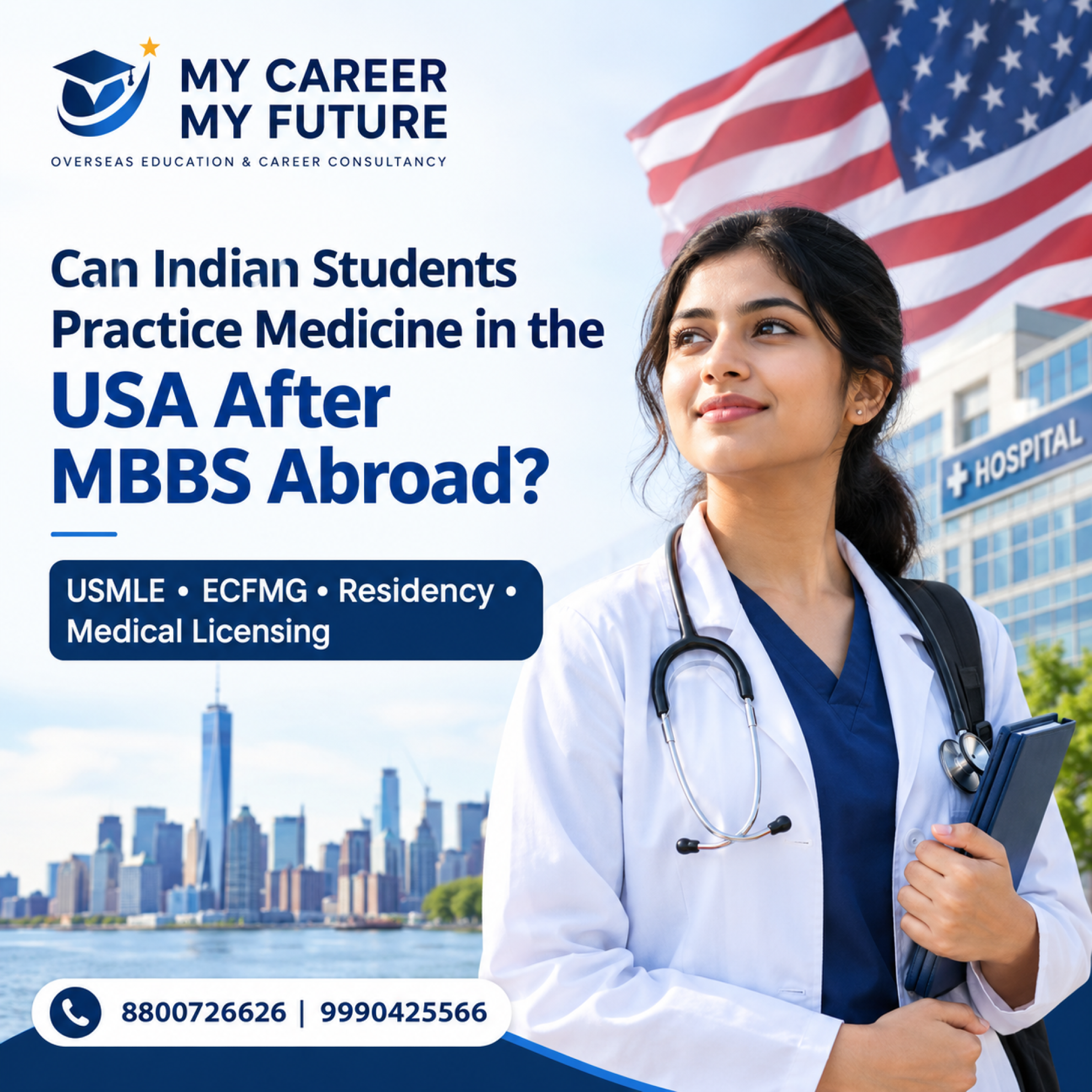
Can Indian Students Practice Medicine in the USA After MBBS Abroad?
For many Indian medical students, pursuing MBBS abroad is not the end goal—it can be the beginning of a global medical career. One of the most frequently asked questions is:
“If I complete my MBBS from a foreign medical university, can I practice medicine in the USA?”
The answer is yes, it can be possible, but an MBBS degree from abroad does not by itself give you the right to practice medicine in the United States.
Indian students who graduate from eligible foreign medical schools are generally considered International Medical Graduates (IMGs) for the U.S. pathway. They need to meet the requirements for ECFMG Certification, clear the required USMLE examinations, obtain a U.S. residency position, complete postgraduate training, and satisfy the licensing requirements of the state where they intend to practice.
Let's understand the complete pathway step by step.
What Is an International Medical Graduate (IMG)?
An International Medical Graduate is generally a physician who graduated from a medical school located outside the United States, regardless of the student's citizenship.
Therefore, an Indian student who completes an eligible medical degree in countries such as Georgia, Russia, Uzbekistan, or other countries outside the U.S. may be considered an IMG when pursuing U.S. medical training.
However, the medical university you choose matters significantly.
For ECFMG Certification, your medical school must be listed in the World Directory of Medical Schools (WDOMS) with an appropriate ECFMG Sponsor Note, and your graduation year must fall within the years specified in that Sponsor Note. ECFMG also has requirements concerning the medical education completed by the applicant.
This means students should investigate U.S. eligibility before selecting an overseas medical university, rather than assuming that every foreign MBBS automatically provides a pathway to the USA.
Can an MBBS Abroad Graduate Take USMLE?
Yes, eligible international medical students and graduates can pursue the United States Medical Licensing Examination (USMLE) pathway.
For IMGs, ECFMG eligibility remains an important part of the process. Under the current 2026 system, international medical students and graduates register for USMLE examinations through the Federation of State Medical Boards (FSMB), following the January 2026 transition of USMLE services.
The major examinations relevant to an IMG's journey include:
- USMLE Step 1
- USMLE Step 2 CK
- USMLE Step 3
Step 1 and Step 2 CK are required as part of the medical science examination requirement for ECFMG Certification.
Step 3 comes later and has additional eligibility requirements, including ECFMG Certification for IMGs.
Step 1: Build Your Medical Foundation
USMLE Step 1 assesses whether a medical student understands important foundational sciences and their application to medicine.
For students studying MBBS abroad, preparation should ideally begin well before graduation.
Subjects such as:
- Anatomy
- Physiology
- Biochemistry
- Pathology
- Pharmacology
- Microbiology
- Immunology
- Behavioral sciences
- Basic clinical concepts
form an important part of medical education and can contribute to USMLE preparation.
A student should not think of USMLE preparation as something that begins only after completing MBBS. Early preparation can make it easier to integrate medical school learning with U.S.-style examination preparation.
Step 2 CK: Clinical Knowledge
USMLE Step 2 Clinical Knowledge (CK) focuses more heavily on clinical knowledge and the application of that knowledge to patient care.
For an aspiring IMG, Step 2 CK is particularly important because it forms part of the ECFMG Certification examination requirements.
Students should focus on:
- Clinical diagnosis
- Patient management
- Preventive medicine
- Pharmacotherapy
- Clinical decision-making
- Medical ethics and professionalism
- Interpretation of clinical information
Strong clinical understanding is important not only for the examination but also for adapting to the expectations of U.S. residency training.
Step 3: The Next Stage
USMLE Step 3 is the final examination in the three-step USMLE sequence.
For international medical graduates, eligibility for Step 3 includes passing Step 1 and Step 2 CK and obtaining ECFMG Certification, along with other requirements. The USMLE program also recommends that applicants have completed, or be close to completing, at least one year of postgraduate training in an accredited U.S. graduate medical education program that meets applicable state-board requirements.
Therefore, Step 3 generally comes later in the pathway, rather than immediately after completing an overseas MBBS.
What Is ECFMG Certification?
ECFMG Certification is one of the most important steps for an international medical graduate who wants to enter U.S. graduate medical education.
ECFMG evaluates whether IMGs meet the requirements to enter ACGME-accredited residency or fellowship programs. ACGME requires IMGs entering its accredited residency or fellowship programs to be ECFMG-certified.
The certification process involves requirements related to:
1. Medical School Eligibility
Your medical school must satisfy ECFMG's requirements and have the appropriate Sponsor Note in the World Directory of Medical Schools.
2. Medical Education Credentials
Your medical education credentials must meet ECFMG requirements and undergo the required verification process.
3. USMLE Examinations
Applicants must pass USMLE Step 1 and Step 2 CK to satisfy the medical science examination requirement.
4. Clinical and Communication Skills
The current ECFMG pathway includes clinical and communication requirements, including the applicable ECFMG Pathway and a satisfactory performance on OET Medicine, where required. Requirements can change, so applicants should check the current ECFMG guidance for their application cycle.
Step 4: Apply for U.S. Residency
Passing USMLE examinations and obtaining ECFMG Certification does not automatically mean that you will receive a residency position.
Residency is a crucial stage because it provides structured postgraduate medical training in the United States.
IMGs apply to residency programs through the U.S. residency application and matching system. Applications can involve components such as:
- USMLE performance
- Medical school performance
- Clinical experience
- Letters of recommendation
- Personal statement
- Research and academic experience
- Interview performance
- Program-specific requirements
ECFMG itself specifically notes that certification does not guarantee acceptance into a residency program, because the number of applicants exceeds the number of available positions.
This is why students should think about the U.S. pathway as a multi-stage process, rather than simply “MBBS abroad → USMLE → doctor in America.”
Step 5: Complete Residency Training
Once matched into a residency program, the student undergoes postgraduate clinical training in the selected specialty.
Residency length varies according to specialty.
For example, training pathways can include areas such as:
- Internal Medicine
- Family Medicine
- Pediatrics
- Psychiatry
- General Surgery
- Neurology
- Anesthesiology
- Radiology
The exact duration and requirements depend on the specialty and program.
Residency is where an IMG develops practical experience within the U.S. healthcare environment under the supervision and structure of an accredited training program.
Step 6: Obtain a Medical License
Completing residency is not the final universal step.
To independently practice medicine, physicians must meet the medical licensing requirements of the state in which they intend to practice.
State medical boards can have their own requirements concerning:
- Examination requirements
- Postgraduate training
- ECFMG Certification for IMGs
- Documentation
- Background checks
- Character and fitness requirements
- Additional state-specific conditions
Therefore, students should always check the medical board requirements of the specific state where they intend to practice.
ECFMG states that U.S. medical licensing authorities require IMGs to have ECFMG Certification, among other requirements, for an unrestricted medical license.
The Complete MBBS Abroad to USA Pathway
A simplified pathway looks like this:
MBBS Abroad
↓
Choose an ECFMG-eligible medical school
↓
USMLE Step 1
↓
USMLE Step 2 CK
↓
Meet ECFMG Certification requirements
↓
Apply for U.S. Residency
↓
Residency / Graduate Medical Education
↓
USMLE Step 3 and applicable requirements
↓
State Medical Licensing Requirements
↓
Practice Medicine in the USA
The exact timing can vary depending on the student's medical school, examination progress, residency application cycle, specialty and state requirements.
Is Every MBBS Abroad University Suitable for the U.S. Pathway?
No.
This is one of the most important points students should understand before applying abroad.
A foreign medical university should not be selected only because of:
- Low tuition fees
- Easy admission
- Attractive location
- Hostel facilities
- Large Indian student population
- Marketing claims
Students who have a long-term goal of practicing in the USA should investigate whether the university meets the relevant ECFMG eligibility requirements.
The ECFMG Sponsor Note and applicable graduation years in the World Directory are particularly important.
This should be checked before admission, not after spending several years completing medical education.
Can Students From Georgia or Russia Pursue the U.S. Pathway?
Students graduating from medical schools outside the United States can potentially pursue the IMG pathway, but eligibility is tied to the specific medical school and applicable ECFMG requirements, not simply the country where the university is located.
For example, saying “Georgia is accepted” or “Russia is accepted” is too broad.
The correct approach is to check the individual medical university's listing, ECFMG Sponsor Note and applicable graduation years in the World Directory.
This is particularly important because eligibility policies can change.
Does MBBS Abroad Automatically Mean You Can Practice in America?
No.
An overseas MBBS degree is a medical qualification, but practicing independently in the United States requires additional steps.
Think of it as:
Medical Degree ≠ U.S. Medical License
Instead:
Medical Degree → ECFMG Eligibility/Certification → USMLE → Residency → State Licensing Requirements → Medical Practice
This distinction is important for students and parents planning an international medical career.
What Should Indian Students Do Before Choosing MBBS Abroad?
If your long-term goal is to keep the USA pathway open, consider these points before selecting a university:
1. Check the university's ECFMG eligibility
Don't rely only on an agent's statement. Verify the medical school's listing and Sponsor Note.
2. Check your graduation year
ECFMG eligibility can depend on whether your graduation year is included in the Sponsor Note.
3. Understand the USMLE pathway early
Learn about Step 1, Step 2 CK, Step 3 and ECFMG Certification before beginning your medical education.
4. Focus on academic performance
A strong academic foundation can help with both medical education and future examination preparation.
5. Understand clinical exposure
Look beyond tuition fees. Understand where and how clinical training takes place and what opportunities are available.
6. Research residency requirements
Different specialties and programs may have different expectations for applicants.
7. Keep documentation organized
Medical transcripts, degree documents, identity documentation and other records can become important during certification and residency applications.
Is the USA Pathway Easy?
The U.S. pathway should be viewed as competitive and multi-step.
Completing MBBS abroad does not guarantee USMLE success, ECFMG Certification, residency admission or a medical license.
At the same time, an overseas medical degree does not automatically close the door to the U.S. pathway. Eligible IMGs can pursue the established route through examinations, certification, residency and licensing requirements.
The key is to plan the pathway before choosing your medical university.
Frequently Asked Questions
Can an Indian student practice medicine in the USA after MBBS abroad?
Yes, an Indian student who graduates from an eligible foreign medical school can potentially pursue medical practice in the USA, but additional requirements must be completed. These include ECFMG Certification, required USMLE examinations, U.S. residency training and applicable state licensing requirements.
Is USMLE enough to become a doctor in the USA?
No. Passing USMLE examinations alone does not automatically provide a license to independently practice medicine. IMGs generally need to complete the relevant certification, postgraduate training and state licensing requirements.
Is ECFMG Certification compulsory for IMGs?
ECFMG Certification is required for IMGs entering ACGME-accredited residency or fellowship programs and is also among the requirements relevant to U.S. medical licensure.
Can I take USMLE after studying MBBS in Russia or Georgia?
Potentially, yes—but eligibility depends on the specific medical school, its World Directory listing, ECFMG Sponsor Note and applicable graduation year. Students should verify the individual university rather than relying on country-level assumptions.
Do I need residency in the USA?
For physicians seeking to enter U.S. graduate medical education and subsequently pursue independent medical practice, residency/postgraduate training is a central part of the pathway. Specific licensing requirements vary by state.
Can I return to India after MBBS abroad?
That is a separate licensing pathway governed by Indian rules. Students planning to keep both India and the USA as possible career destinations should research the requirements for each pathway before selecting their university.
Final Takeaway
For Indian students, MBBS abroad can be a starting point for a U.S. medical career, but it is important to understand that the journey does not end with the foreign medical degree.
The broad pathway involves:
Eligible Medical School → USMLE Step 1 → USMLE Step 2 CK → ECFMG Certification → U.S. Residency → Further USMLE/Licensing Requirements → Medical Practice
The most important decision may actually come before you start MBBS abroad: selecting a medical school whose eligibility and curriculum support the pathways you may want to pursue later.
At My Career My Future, our team of expert counsellors helps students understand international medical education options, eligibility requirements and long-term career pathways before they make an admission decision.
My Career My Future
Overseas Education & Career Consultancy
📞 8800726626 | 9990425566
Disclaimer: U.S. medical education, examination and licensing requirements can change. Students should verify the latest requirements with official bodies such as ECFMG, USMLE and the relevant U.S. state medical board before making decisions.