- AFMC Pune MBBS Admission Process – Step-by-Step Flow Chart
- Extension of Last Date for Submission of Online Application Form – Academic Session 2026-27
- CMC Ludhiana College Sponsorship 2026 – Application Open for Christian Minority Candidates
- CMC Ludhiana UG College Sponsorship 2026 – Online Application Process & Instructions Released
- NEET UG 2026 Application Correction Window Open — Last Chance to Fix Your Form
- CMC Ludhiana MBBS BDS BPT Admission 2026 — Full Guide for NEET Qualified Candidates
- KARNATAKA PG COUNSELLING LATEST UPDATE 2025- ROUND 4 SEAT ALLOTMENT EXTENDED
- NTA NEET UG LATEST UPDATE 2026- REGISTRATION DATE EXTENDED TILL 11TH MARCH 2026
- CBSE LATEST UPDATE 2026- 10TH & 12TH BOARD EXAM POSTPONED
- KARNATAKA UGCET COUNSELLING LATEST UPDATE 2026- FEE PAYMENT DATE EXTENDED
- KARNATAKA PG COUNSELLING LATEST UPDATE 2025- FEE PAYMENT DATE EXTENDED ROUND3
- KARNATAKA PG COUNSELLING LATEST UPDATE 2025- ROUND4 CAUTION DEPOSIT LINK ACTIVE
- CBSE LATEST UPDATE 2026- BOARD EXAM POSTPONED IN MIDDLE EAST REGION
- BIHAR PG COUNSELLING LATEST UPDATE 2025- DOCUMENT VERIFICATION ROUND4
- KARNATAKA PG COUNSELLING LATEST UPDATE 2025- ROUND4 SCHEDULE & STAGES
- KERALA UG COUNSELLING LATEST UPDATE 2026- OPPORTUNITY TO ADD COURSES
- HIMACHAL PG COUNSELLING LATEST UPDATE 2025- MERIT LIST 2ND STRAY ROUND
- HIMACHAL PG COUNSELLING LATEST UPDATE 2025- SCHEDULE & VACANCY FOR 2ND STRAY ROUND
- KARNATAKA PG COUNSELLING LATEST UPDATE 2025- SCHEDULE & STAGES ROUND 3
- JHARKHAND PG COUNSELLING LATEST UPDATE 2025- SEAT MATRIX ROUND4
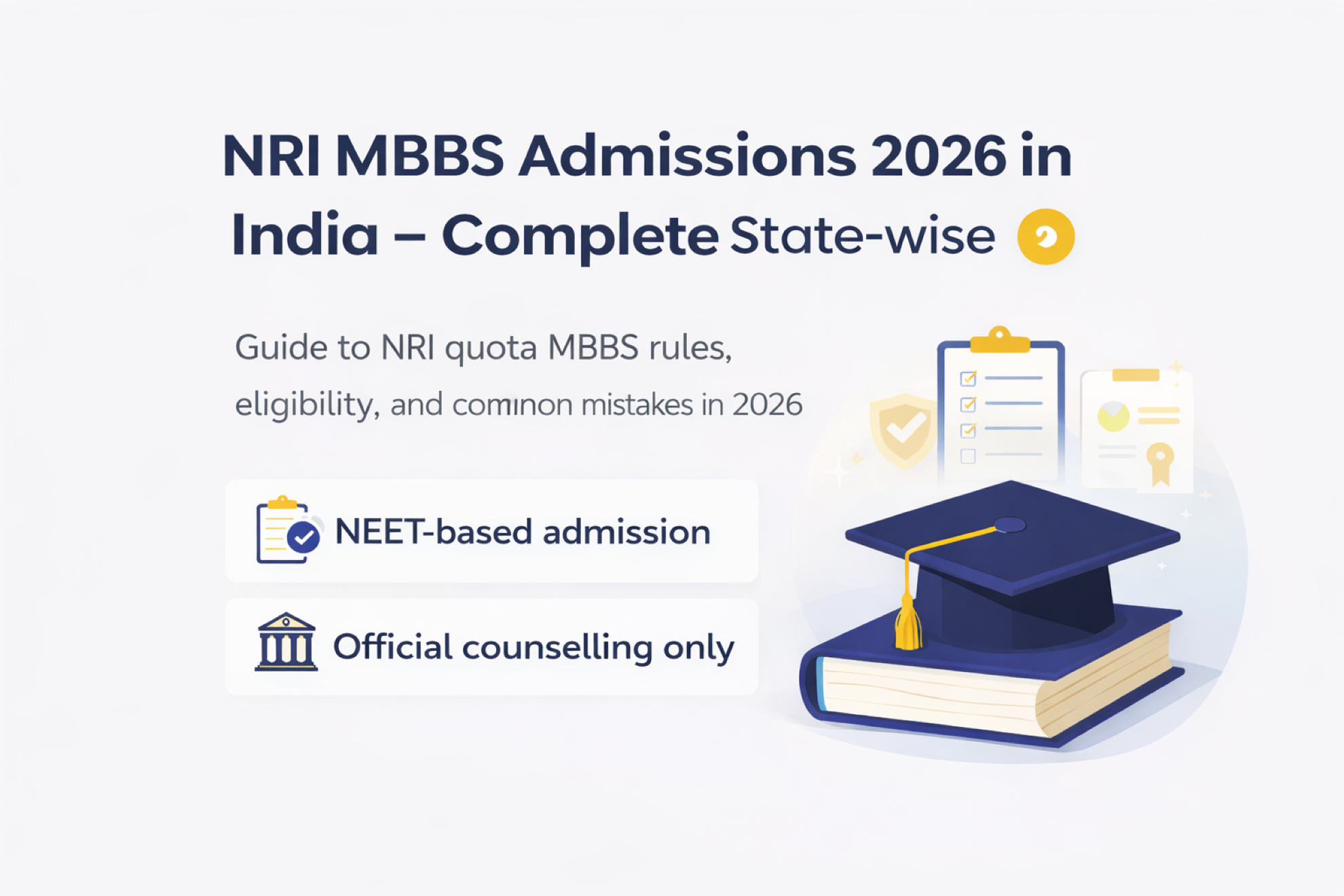
NRI MBBS Admissions 2026 in India – Complete State-wise Guide
A clear, reliable guide for NRI parents and students to understand MBBS admission through NRI quota in India — including eligibility, counselling process, state-wise rules, and common mistakes to avoid.
What is NRI Quota in MBBS?
The NRI quota in MBBS is a specific category of seats reserved for Non-Resident Indians (NRIs) and their eligible wards in selected medical colleges across India for the 2026 admission cycle.
These seats are meant for:
-
Students who hold NRI status, or
-
Students sponsored by an eligible NRI sponsor, as per prescribed rules
Admission under the NRI quota is strictly based on NEET qualification and is conducted only through official counselling authorities such as MCC or respective state counselling bodies.
It is not a donation-based or direct admission route.
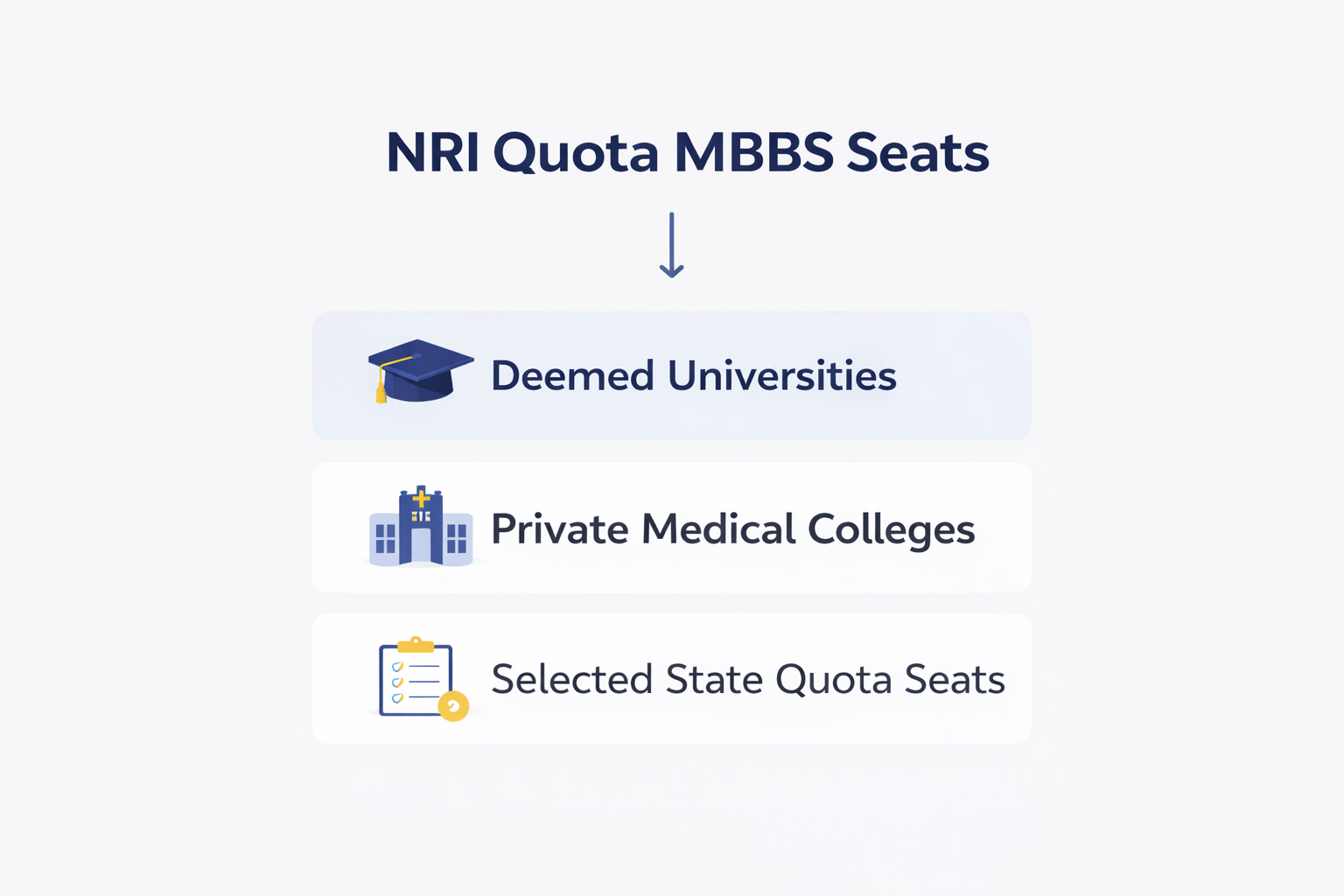
Where Does NRI Quota Exist?
NRI quota seats are available only in specific categories of medical colleges and not uniformly across all institutions.
Deemed Universities
-
NRI quota is clearly defined and officially approved
-
Counselling is conducted at the national level through MCC
-
A significant number of NRI MBBS admissions in 2026 are expected through Deemed Universities
Private Medical Colleges (State Counselling)
-
Some states allow NRI quota seats in private medical colleges
-
Admission rules, documentation, and sponsor eligibility vary from state to state
-
Counselling is conducted by the respective state authorities
State-Specific NRI Quota Policies
-
Certain states have separate and well-defined NRI quota policies
-
Eligibility conditions and document requirements differ across states
-
Rules applicable in one state cannot be assumed to apply in another
This is why state-wise clarity is essential for NRI quota MBBS admissions in 2026.
Difference Between NRI Quota and Management Quota
NRI quota and Management quota are often confused, but they are fundamentally different admission categories.
NRI Quota
-
Reserved for NRIs or NRI-sponsored candidates
-
NEET qualification is mandatory for 2026 admissions
-
Admission takes place through official counselling channels
-
Requires valid NRI documents and relationship proof
-
Subject to strict verification and compliance checks
Management Quota
-
Generally applicable to Indian resident students
-
Does not require NRI status
-
Availability and fee structure depend on college and state policies
-
Often misunderstood as an easier admission route, which can lead to serious mistakes
Applying under the wrong quota category is one of the most common reasons for counselling issues or loss of an MBBS seat.
Why Understanding NRI Quota Matters for 2026
MBBS admission through the NRI quota in 2026 is not limited to fee payment alone.
It is a regulated, rule-driven process where:
-
Correct category selection is critical
-
Counselling authority matters
-
Documentation accuracy is essential
-
State-specific rules must be followed carefully
Understanding these fundamentals before applying helps families avoid errors and make informed, secure admission decisions for MBBS admission in 2026.
Who is Eligible for NRI Quota MBBS Admission in 2026?
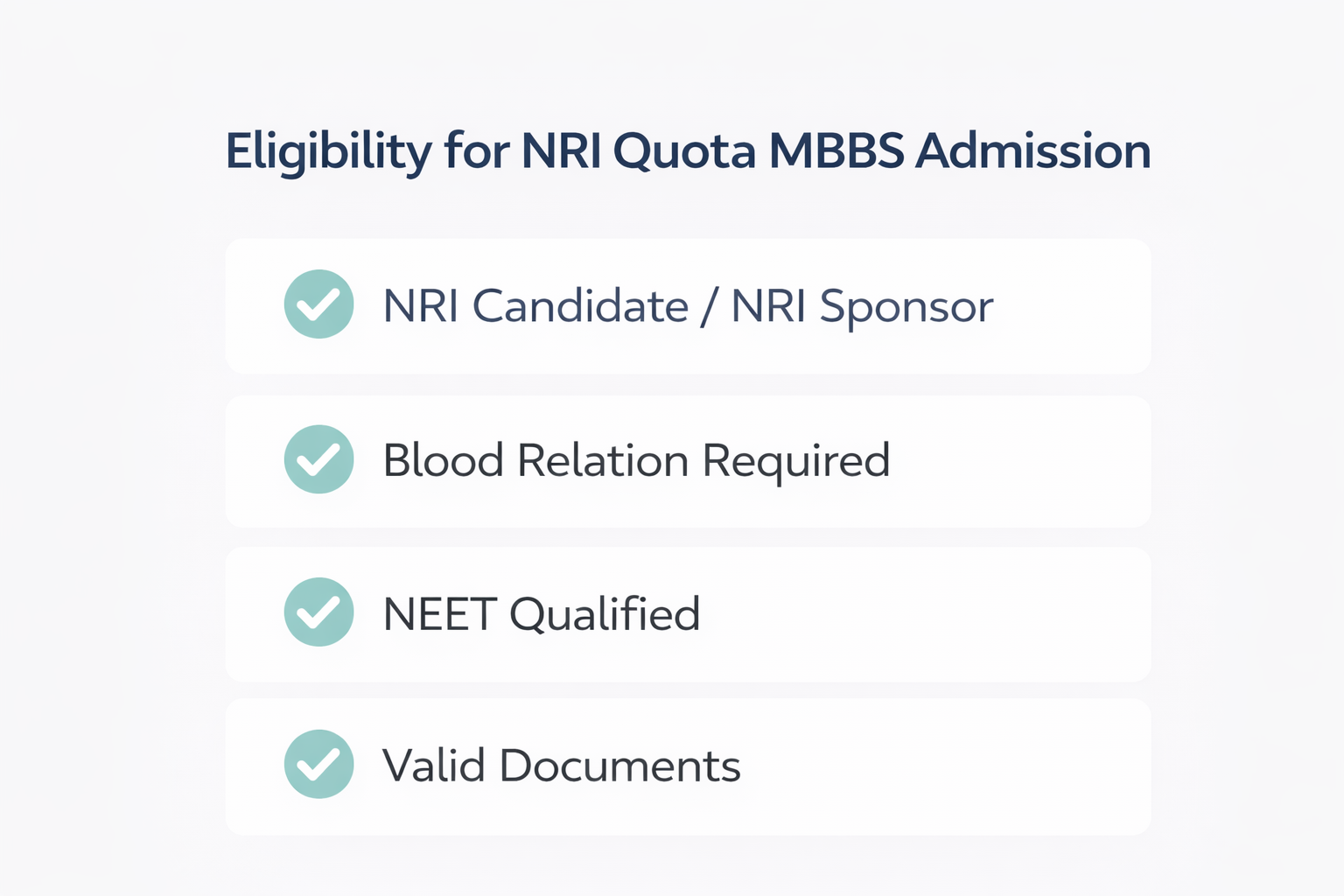
Eligibility under the NRI quota is strictly defined and varies slightly depending on the counselling authority and state. Not every applicant who is willing to pay NRI fees automatically qualifies.
Understanding eligibility clearly before applying is essential to avoid rejection during counselling or document verification.
Who Qualifies as an NRI Candidate?
A student can apply under the NRI quota if either of the following conditions is satisfied:
-
The candidate is a Non-Resident Indian (NRI), meaning:
-
The student is an Indian citizen residing outside India, and
-
Holds valid proof of NRI status as per official guidelines
-
OR
-
The candidate is a ward of an NRI, where:
-
The sponsor meets the NRI definition, and
-
The relationship between the sponsor and the student is clearly established
-
In both cases, NEET qualification for 2026 is mandatory.
Who Can Apply as a Sponsor-Based NRI Candidate?
In many states and Deemed Universities, students who are not NRIs themselves may still be eligible under the NRI quota if they are sponsored by an eligible NRI sponsor.
However, sponsor-based admission is allowed only when:
-
The sponsor is a genuine NRI with valid proof of overseas residence and income, and
-
The sponsor falls under permitted blood relations as defined by counselling authorities
Third-party sponsors, distant relatives, or unrelated sponsors are not accepted.
Blood Relation Rules (High-Level Overview)
NRI quota sponsorship is generally restricted to close blood relations.
While exact rules may vary by state, commonly accepted relations include:
-
Father or Mother
-
Real Brother or Real Sister
-
Legal Guardian (only in specific cases, subject to proof)
Relationships such as:
-
Friends
-
Family acquaintances
-
Business partners
-
Non-blood relatives
are not considered valid for NRI sponsorship in MBBS admissions.
State-specific rules should always be checked before registration.
Common Eligibility Misconceptions to Avoid
Many applicants face rejection due to incorrect assumptions. Some common misconceptions include:
-
Paying NRI fees automatically guarantees eligibility
-
Any overseas relative can act as an NRI sponsor
-
Sponsor documents can be arranged later during counselling
-
OCI or foreign passport holders do not require NEET
-
Rules are the same across all states
In reality, eligibility is verified at multiple stages, and even small errors can lead to disqualification.
Important Note on Eligibility Verification
NRI quota eligibility is checked during counselling and document verification, not after seat allotment.
Incorrect category selection, weak sponsor proof, or mismatched documents can result in:
-
Cancellation of allotted seats
-
Loss of counselling opportunity
-
Disqualification from further rounds
This is why eligibility confirmation before registration is a critical step in NRI quota MBBS admissions for 2026.
NEET Requirement for NRI Quota MBBS Admission 2026
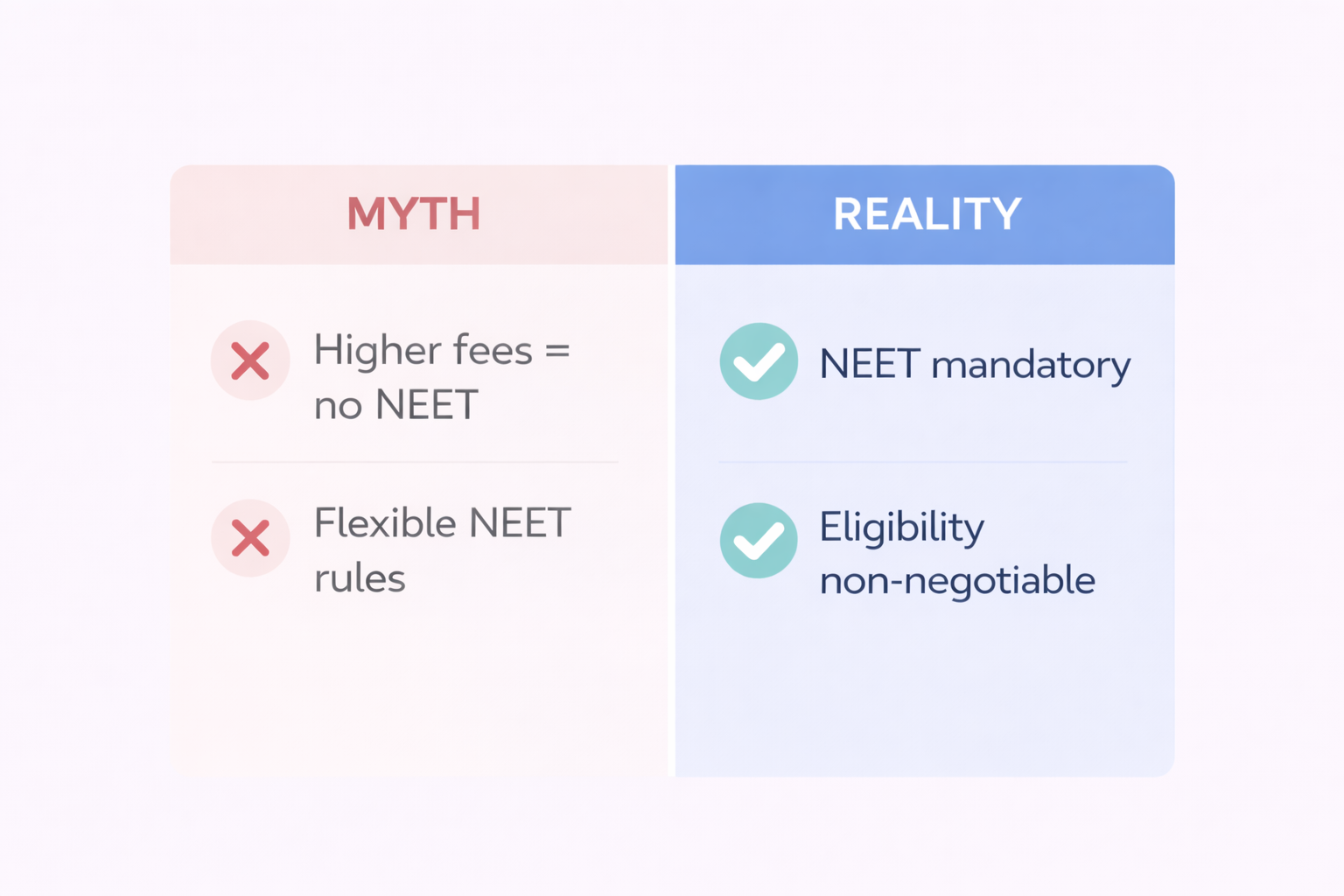
NEET is the single most important requirement for MBBS admission under the NRI quota in India.
No student can claim an MBBS seat under NRI quota in 2026 without meeting the NEET eligibility criteria.
Is NEET Mandatory for NRI Quota MBBS Admission?
Yes. NEET qualification is mandatory for all candidates applying under the NRI quota for MBBS admission in 2026.
This requirement applies to:
-
Students holding NRI status
-
Students applying under NRI sponsorship
-
OCI and foreign passport holders (where applicable)
Admission under the NRI quota is permitted only through official counselling conducted by MCC or state counselling authorities, all of which require NEET qualification.
There is no exemption from NEET for NRI quota MBBS admission in India.
Minimum NEET Eligibility: Qualifying Marks vs Cut-off
It is important to understand the difference between qualifying marks and cut-off ranks.
NEET Qualifying Marks
-
These are the minimum marks required to be considered eligible for MBBS counselling
-
Qualifying marks are decided by NTA each year
-
For NRI quota candidates, meeting the qualifying criteria is compulsory
NEET Cut-off Ranks
-
Cut-off ranks determine seat availability, not basic eligibility
-
Cut-offs vary depending on:
-
State policies
-
Type of college (Deemed or Private)
-
Number of applicants
-
-
NRI quota cut-offs are usually lower than general category, but they are not fixed
Meeting only the qualifying marks does not guarantee a seat, but not meeting them guarantees disqualification.
State-wise Variation in NEET Requirements
While NEET qualification is mandatory across India, how NEET scores are applied can differ by state.
Examples of variation include:
-
Some states consider only qualifying marks, while others apply rank-based preferences
-
Certain counselling authorities may impose additional conditions during choice filling
-
Deemed Universities follow MCC counselling norms, which differ from state counselling rules
Because of these variations, NEET eligibility must always be assessed in the context of the specific state or counselling authority.
Detailed, state-wise NEET application rules are explained in the respective state NRI quota pages linked below.
Why NEET Clarity is Critical for NRI Quota Applicants
Many NRI families assume that:
-
Higher fees can compensate for low NEET scores, or
-
NEET rules are flexible under NRI quota
These assumptions are incorrect.
NEET is a non-negotiable eligibility condition, and misunderstanding this requirement is one of the most common reasons for counselling rejection in NRI quota MBBS admissions.
NRI Quota MBBS Admission Process 2026 – Step by Step
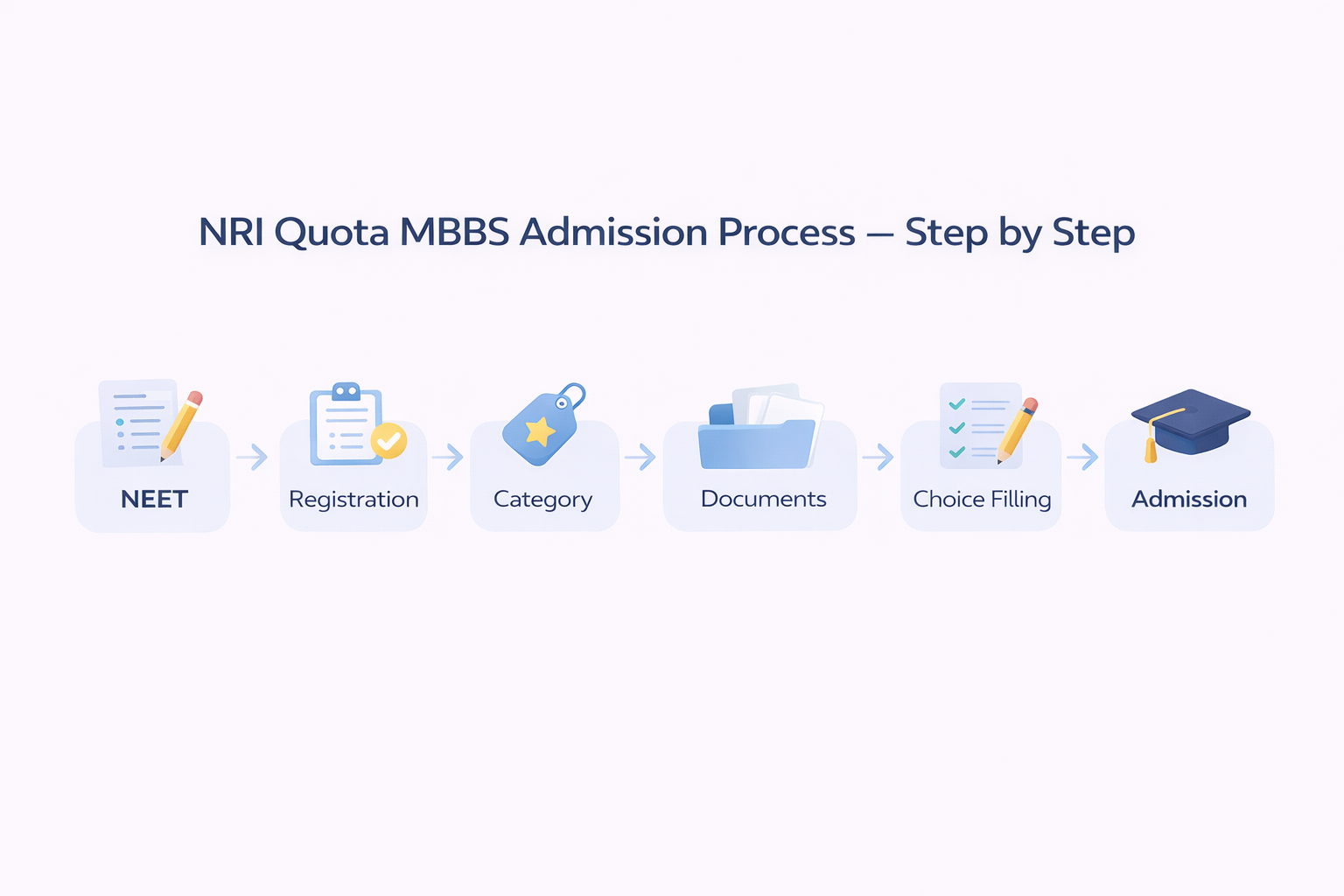
MBBS admission under the NRI quota follows a defined counselling process governed by official authorities.
While the exact portal may differ (MCC or state counselling), the core steps remain the same.
Understanding and following each step correctly is essential to avoid errors that can affect seat allotment.
Step 1: NEET Qualification
The first and non-negotiable requirement is qualifying NEET 2026.
Only candidates who:
-
Have appeared in NEET 2026, and
-
Have met the minimum qualifying criteria
are eligible to participate in NRI quota counselling.
Without NEET qualification, a candidate cannot register for MBBS admission under NRI quota.
Step 2: Counselling Registration (MCC or State Authority)
After NEET results are declared, candidates must register for counselling through the appropriate authority, depending on the type of college:
-
MCC Counselling for:
-
Deemed Universities
-
All India level seats
-
-
State Counselling Authorities for:
-
Private medical colleges with NRI quota
-
State-specific NRI quota seats
-
Registration must be done within the official timeline and on the correct counselling portal.
Step 3: Category Selection (Critical Step)
Selecting the correct category during registration is one of the most crucial steps in NRI quota admission.
Candidates must clearly choose:
-
NRI category, or
-
NRI-sponsored category (where applicable)
An incorrect category selection can:
-
Make the candidate ineligible during verification
-
Lead to cancellation of allotted seats
Category errors are often irreversible after registration, making this step extremely sensitive.
Step 4: Document Upload and Verification
During registration or counselling, candidates are required to upload mandatory documents, including:
-
NEET scorecard and admit card
-
NRI status or sponsor documents
-
Relationship proof
-
Passport, visa, and residency proof
Documents are verified by counselling authorities, and any mismatch or deficiency can result in rejection.
Step 5: Choice Filling
Once registration and document verification are complete, candidates must participate in choice filling, where they:
-
Select colleges and courses in order of preference
-
Choose eligible NRI quota seats only
Choice filling must be done strategically, keeping in mind:
-
NEET score
-
State rules
-
Fee structure
-
Seat availability
Incorrect or rushed choice filling can significantly affect allotment outcomes.
Step 6: Seat Allotment
Based on:
-
NEET rank
-
Category eligibility
-
Choices filled
-
Seat availability
the counselling authority releases seat allotment results.
Candidates must carefully check:
-
Allotted college
-
Category mentioned
-
Reporting instructions
Failure to act within the stipulated timeline can lead to automatic forfeiture of the seat.
Step 7: Reporting and Admission Confirmation
After seat allotment, candidates must:
-
Report to the allotted medical college within the given timeframe
-
Complete document verification at the institute
-
Pay the prescribed fees
Only after successful reporting and fee payment is the MBBS admission confirmed.
Missing reporting deadlines or incomplete documentation can result in loss of the allotted seat.
asdas
Why Following the Process Correctly Matters
NRI quota MBBS admission is a process-driven system, not a flexible or negotiable one.
Each step is interconnected, and an error at any stage can affect the final outcome.
This is why understanding the complete admission workflow in advance is critical for safe and successful MBBS admission under NRI quota in 2026.
State-wise NRI Quota MBBS Admissions 2026 (India)
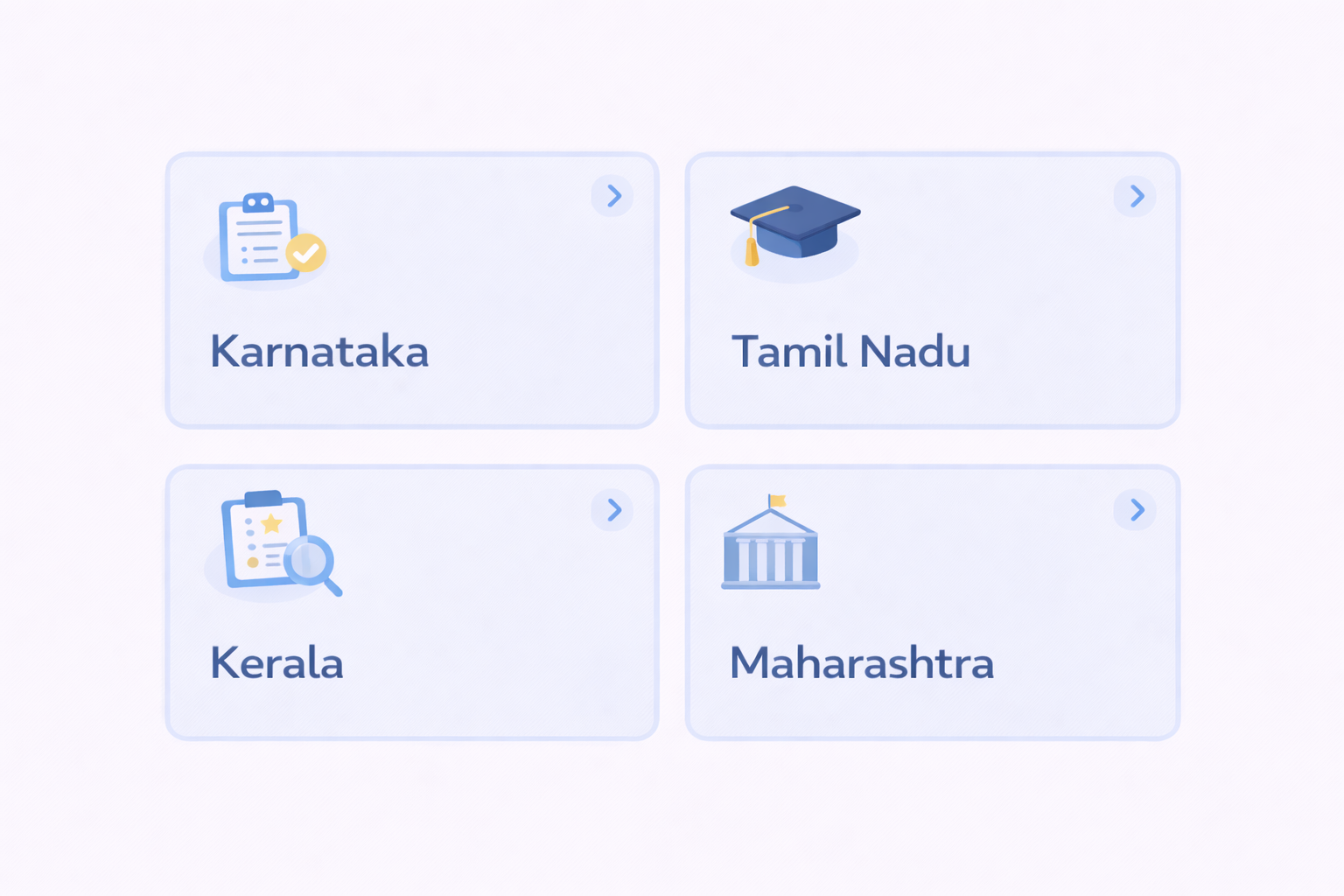
NRI quota MBBS admission rules in India are not uniform.
Each state follows its own counselling authority, eligibility conditions, document requirements, and seat policies.
This means that:
-
NRI quota eligibility in one state does not automatically apply to another
-
Sponsor rules, fee structures, and counselling procedures can differ significantly
-
Understanding state-specific guidelines is essential before registration
To help parents and students make informed decisions, MCMF provides dedicated, state-wise NRI quota MBBS admission guides for the 2026 admission cycle.
State-wise NRI Quota MBBS Admission Guides (2026)
Select your preferred state below to view detailed eligibility, counselling process, documents, fees, and important rules specific to that state:
Each state page covers:
-
Applicable counselling authority
-
NRI eligibility and sponsor rules
-
NEET requirements and cut-offs
-
Document checklist
-
Fee structure overview
-
Common mistakes specific to that state
Why State-wise Guidance is Critical for NRI Quota Admissions
Many NRI applicants face counselling issues because they assume:
-
All states follow the same NRI rules
-
Sponsor eligibility is identical everywhere
-
One counselling strategy works across India
In reality, NRI quota MBBS admission is state-sensitive, and applying without state-level clarity can lead to rejection or seat loss.
This hub section is designed to help families navigate state-specific rules safely and move forward with confidence in the 2026 admission process.
Deemed Universities & NRI Quota MBBS Admission 2026
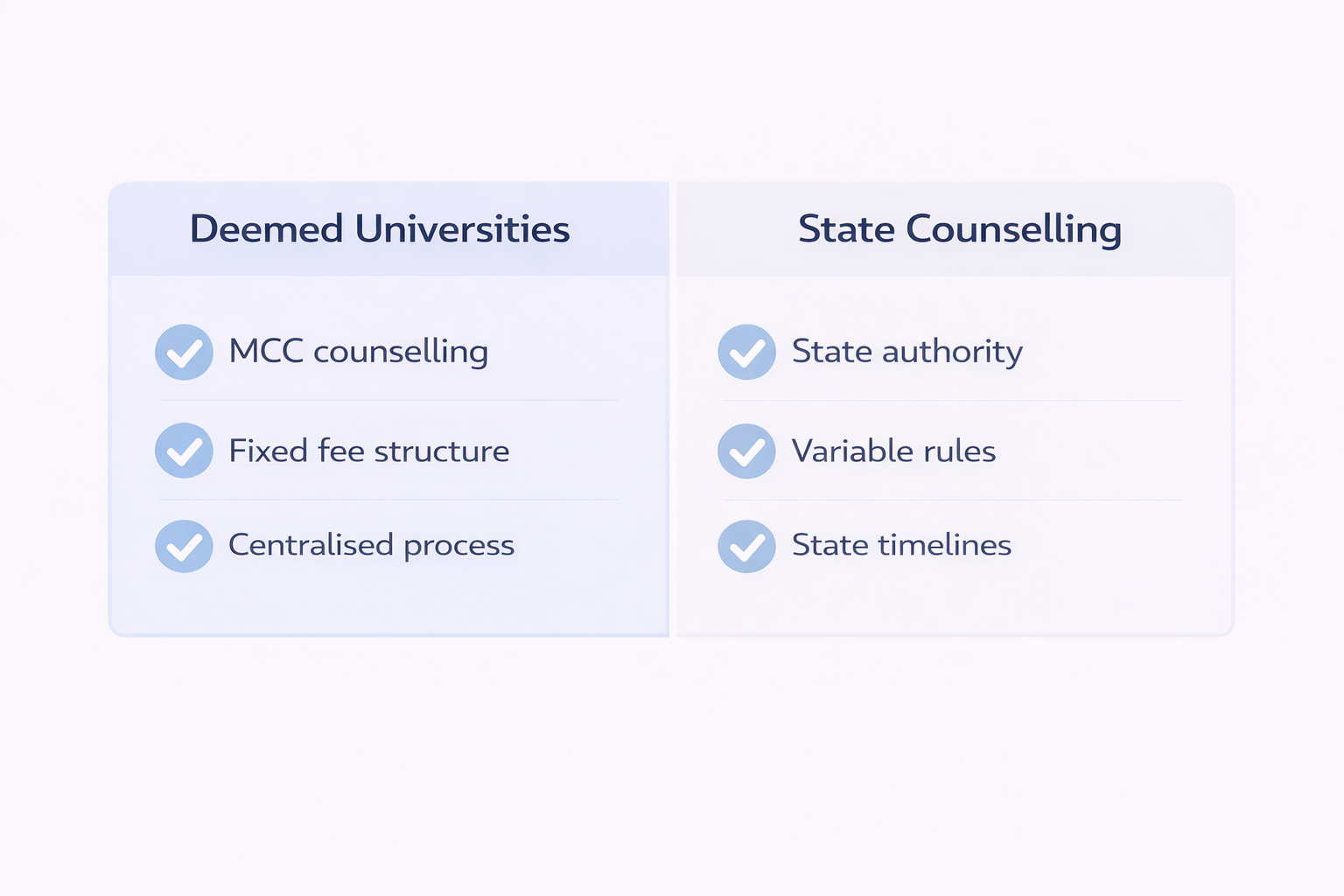
Deemed Universities play a major role in NRI quota MBBS admissions in India.
A significant portion of NRI students secure MBBS seats through Deemed Medical Universities due to clearer rules, centralized counselling, and predictable seat availability.
Understanding how NRI quota works specifically in Deemed Universities is essential before applying.
How NRI Quota Works in Deemed Universities
In Deemed Medical Universities:
-
NRI quota seats are officially defined and approved
-
Admission is based on NEET qualification
-
Seat allotment happens through centralized counselling
NRI quota seats in Deemed Universities are available only to:
-
Candidates with valid NRI status, or
-
Candidates sponsored by an eligible NRI sponsor, as per MCC norms
All documents and eligibility conditions are strictly verified during the counselling and reporting stages.
Role of MCC Counselling in Deemed University Admissions
All MBBS admissions under the NRI quota in Deemed Universities are conducted through Medical Counselling Committee (MCC) at the national level.
MCC counselling governs:
-
Registration and category selection
-
Document submission and verification
-
Choice filling and seat allotment
-
Reporting and admission confirmation
Unlike state counselling, MCC follows uniform national guidelines, making Deemed University admissions comparatively more standardized.
Why Deemed University NRI Rules Differ from State Counselling
NRI quota rules for Deemed Universities are different from state counselling due to:
-
Centralized counselling under MCC instead of multiple state authorities
-
Uniform eligibility and document guidelines across India
-
Separate fee structures approved by the respective Deemed Universities
-
Independent seat matrices that do not depend on state policies
Because of these differences, strategies that work for state NRI quota admissions may not apply to Deemed Universities, and vice versa.
When Deemed Universities are Preferred for NRI Quota MBBS
Deemed Universities are often preferred by NRI families when:
-
Predictable counselling timelines are required
-
State-level rule complexity needs to be avoided
-
Centralized counselling is considered safer
-
Transparent seat availability is a priority
However, even within Deemed Universities, proper category selection, document accuracy, and choice filling strategy remain critical.
Documents Required for NRI Quota MBBS Admission 2026
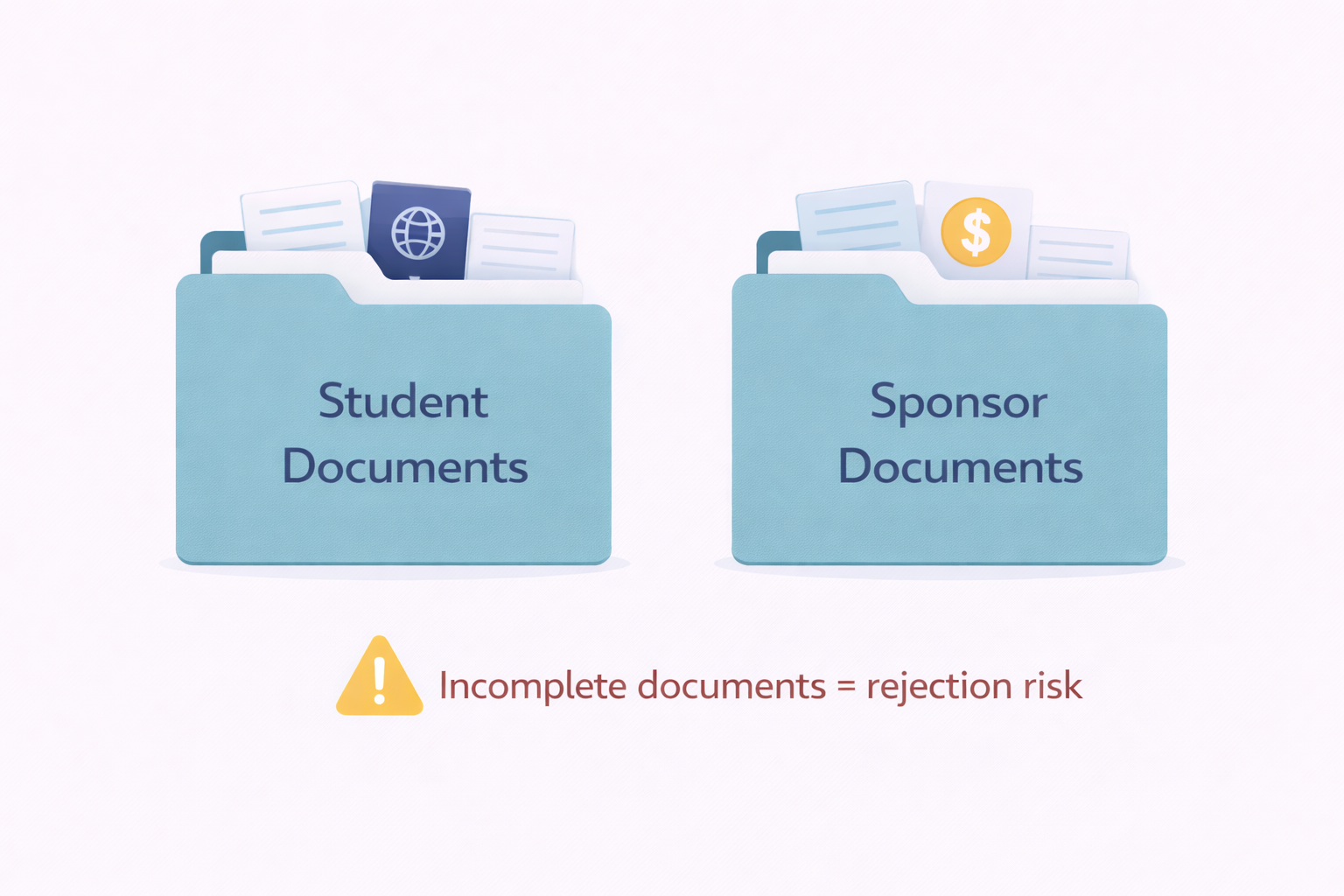
Documentation is the most critical component of NRI quota MBBS admission.
Even candidates with valid NEET scores can lose eligibility due to incorrect, incomplete, or weak documents.
All documents submitted under the NRI quota are formally verified by counselling authorities and medical colleges. There is no flexibility once verification is complete.
Student Documents (Mandatory)
Every candidate applying under the NRI quota must submit the following student documents:
-
NEET 2026 Admit Card
-
NEET 2026 Scorecard
-
Class 10 Marksheet and Certificate
-
Class 12 Marksheet and Certificate
-
Date of Birth Proof (if not covered in Class 10 certificate)
-
Passport (candidate)
-
Recent passport-size photographs (as per counselling guidelines)
All student documents must be clear, legible, and consistent across names, dates, and spellings.
NRI Sponsor Documents
For candidates applying under NRI sponsorship, the following sponsor documents are required:
-
Sponsor’s Passport (front and back pages)
-
Valid Visa and Residence Permit of sponsor
-
Proof of overseas residence (work permit / residence certificate)
-
Proof of NRI status as per counselling authority norms
-
Sponsor’s bank statement or income proof (if required by the authority)
Documents must establish that the sponsor is a genuine Non-Resident Indian at the time of counselling.
Relationship Proof Between Student and Sponsor
Relationship proof is mandatory for NRI-sponsored candidates and is one of the most scrutinized areas.
Accepted documents may include:
-
Birth certificate of the candidate
-
Family tree certificate issued by competent authority
-
Legal affidavit establishing relationship
-
Any other document specified by the counselling authority
Only close blood relations are accepted as valid sponsors. Relationship claims without strong documentary proof are commonly rejected.
Common Reasons for Document Rejection
Many NRI quota applications fail due to avoidable document issues, such as:
-
Uploading expired or invalid visa documents
-
Mismatch in names across passports and certificates
-
Weak or unclear relationship proof
-
Sponsor not qualifying as an NRI under rules
-
Submitting incorrect or incomplete affidavits
-
Poor-quality or unreadable document uploads
Once documents are rejected during verification, correction opportunities are limited or unavailable, depending on the counselling authority.
Important Note on Document Verification
Document verification happens:
-
During counselling registration, and
-
Again at the time of reporting to the allotted college
Any discrepancy found at a later stage can lead to cancellation of the allotted MBBS seat, even after provisional allotment.
This is why document validation before counselling registration is strongly recommended for NRI quota MBBS admission in 2026.
Fees Structure Under NRI Quota MBBS Admission 2026 (General Overview)
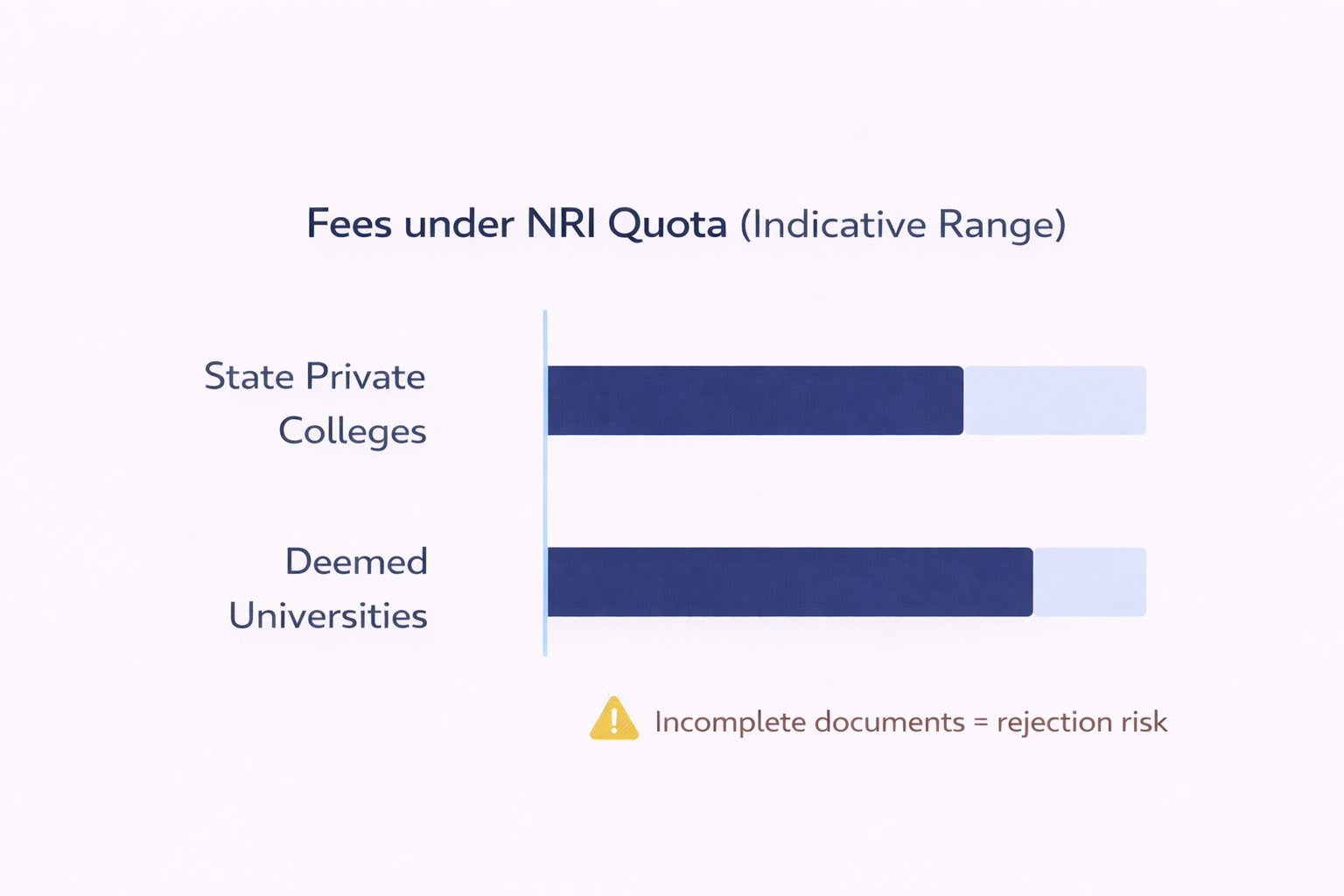
Fees under the NRI quota for MBBS admission are significantly higher than general category fees, but they are not uniform across India.
The exact fee depends on multiple factors, including the state, type of college, and counselling authority.
Understanding how NRI quota fees work at a broad level helps families plan realistically and avoid last-minute surprises.
Why NRI Quota Fees Vary by State and College
NRI quota MBBS fees are not fixed nationally because:
-
Each state has its own fee approval mechanism
-
Deemed Universities have independent fee structures approved by statutory bodies
-
Seat availability under NRI quota differs across colleges
-
Counselling authority norms (MCC vs state) influence payment structure
As a result, fees for NRI quota MBBS admission in 2026 can vary widely even within the same state.
Broad Fee Ranges Under NRI Quota (Indicative)
While exact figures are declared only during counselling, NRI quota MBBS fees generally fall within broad ranges, depending on the institution:
-
State private medical colleges: Higher than general quota, but usually lower than Deemed Universities
-
Deemed Medical Universities: Typically at the higher end of the NRI fee spectrum
These ranges are indicative only and should not be treated as final or guaranteed figures.
Actual fees are officially notified by counselling authorities and colleges during the admission cycle.
Deemed Universities vs State Private Colleges (Fee Perspective)
There is a clear structural difference between NRI quota fees in Deemed Universities and state private medical colleges.
Deemed Universities
-
Fees are decided at the institutional level
-
Payment structure is governed through MCC counselling
-
Total cost is usually higher but more predictable
-
Seat availability under NRI quota is clearer
State Private Medical Colleges
-
Fees are regulated by state policies
-
Payment norms vary by state
-
Additional state-level conditions may apply
-
NRI fee structures may differ across colleges within the same state
Because of these differences, fee planning must always be done college- and state-specifically.
Currency and Payment Notes (General Guidance)
NRI quota MBBS fees are generally:
-
Quoted in Indian Rupees
-
Paid to the medical college as per counselling instructions
In some cases:
-
Colleges may accept payments originating from overseas NRI accounts
-
Currency conversion rates and banking timelines can affect payment processing
It is advisable to plan:
-
Fund availability in advance
-
Banking documentation where required
-
Timely payment to avoid seat cancellation
Important Fee-Related Clarification
Paying NRI quota fees does not override eligibility rules.
Admission is confirmed only when:
-
NEET eligibility is satisfied
-
Category selection is correct
-
Documents are approved
-
Counselling procedures are followed correctly
Fee payment alone cannot compensate for errors in eligibility, documentation, or counselling steps.
Common Mistakes in NRI Quota MBBS Admissions (2026)
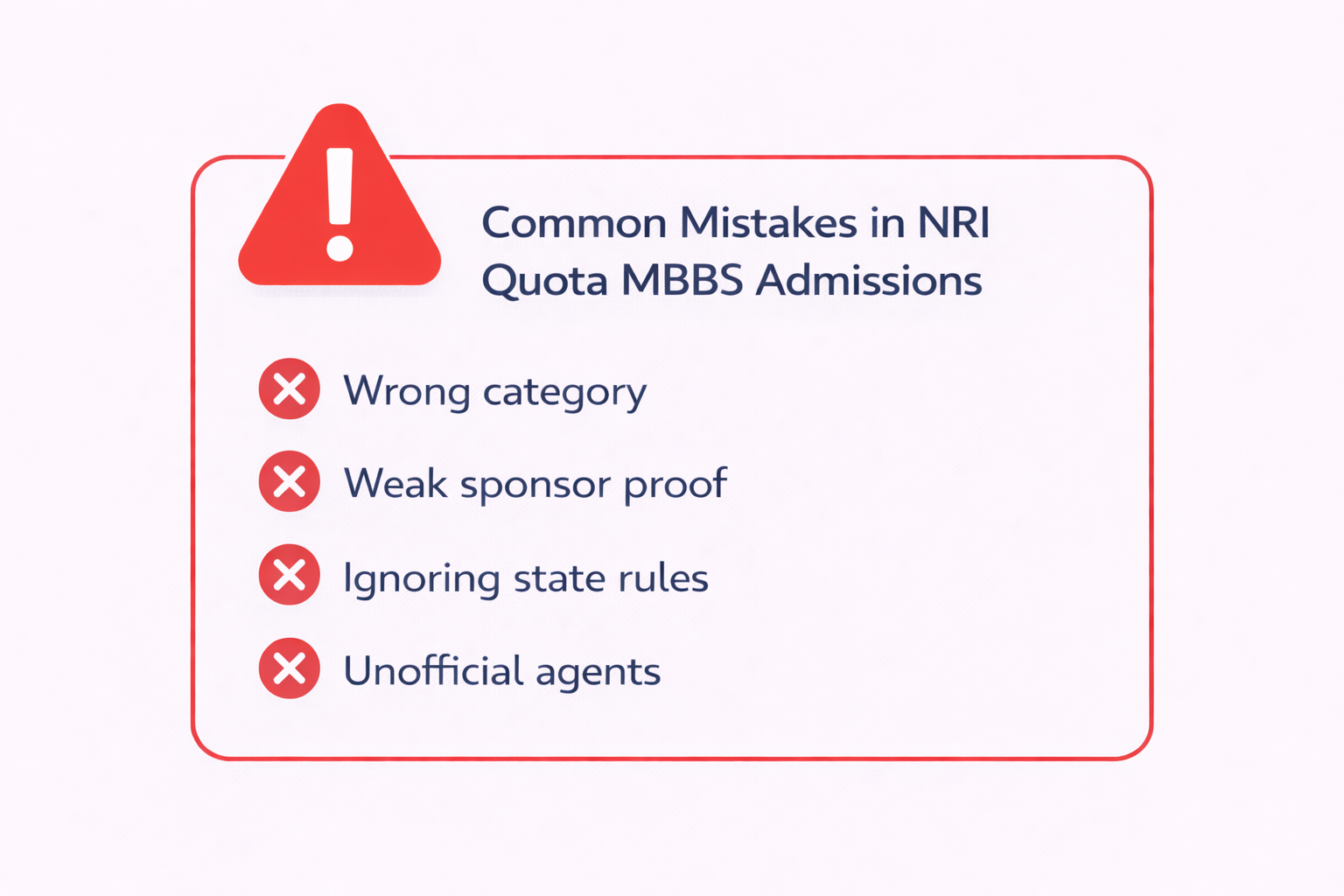
A large number of NRI quota MBBS applications fail not due to lack of seats, but due to avoidable mistakes made during counselling and documentation.
Most of these errors occur because families underestimate the complexity of NRI quota rules or rely on incomplete or incorrect information.
Wrong Category Selection During Counselling
One of the most common and irreversible mistakes is selecting the wrong category at the time of counselling registration.
Examples include:
-
Selecting General or Management quota instead of NRI
-
Selecting NRI category without valid NRI eligibility
-
Confusing NRI quota with Management quota
Once counselling registration is completed, category changes are usually not allowed.
This single mistake can make a candidate ineligible despite having NEET qualification.
Weak or Invalid NRI Sponsor Proof
For sponsor-based NRI applications, documentation strength is critical.
Common issues include:
-
Sponsor not qualifying as a valid NRI
-
Insufficient overseas residence proof
-
Invalid or expired visa documents
-
Inadequate financial proof
-
Relationship proof not meeting counselling authority norms
Even small gaps in sponsor documentation can result in rejection during verification, regardless of NEET score.
Ignoring State-Specific NRI Quota Rules
A frequent mistake is assuming that NRI rules are the same across all states.
In reality:
-
Each state has its own counselling authority
-
Sponsor eligibility and relationship rules may differ
-
Document formats and verification standards vary
-
Counselling timelines and procedures are state-specific
Applying the rules of one state to another can lead to registration errors or seat cancellation.
Depending on Unofficial Agents or Verbal Assurances
Many families rely on:
-
Unverified agents
-
Informal consultants
-
Verbal guarantees without written confirmation
Such sources often:
-
Misrepresent eligibility
-
Promise “easy admission”
-
Downplay documentation risks
Official counselling systems do not recognise verbal commitments or unofficial assurances.
Decisions made on such advice can result in financial loss and missed admission opportunities.
Last-Minute Decisions and Rushed Applications
NRI quota counselling follows strict timelines.
Common consequences of rushed applications include:
-
Incorrect document uploads
-
Poor choice filling strategy
-
Missing counselling deadlines
-
Incomplete fee planning
NRI quota MBBS admission requires advance planning, not last-minute action.
Why These Mistakes Are Costly
Unlike general counselling, NRI quota errors often:
-
Cannot be corrected in later rounds
-
Lead to permanent disqualification for that counselling cycle
-
Result in loss of eligible seats
Most of these mistakes are preventable with proper guidance.
Why Expert Counselling Matters in NRI Quota MBBS Admissions
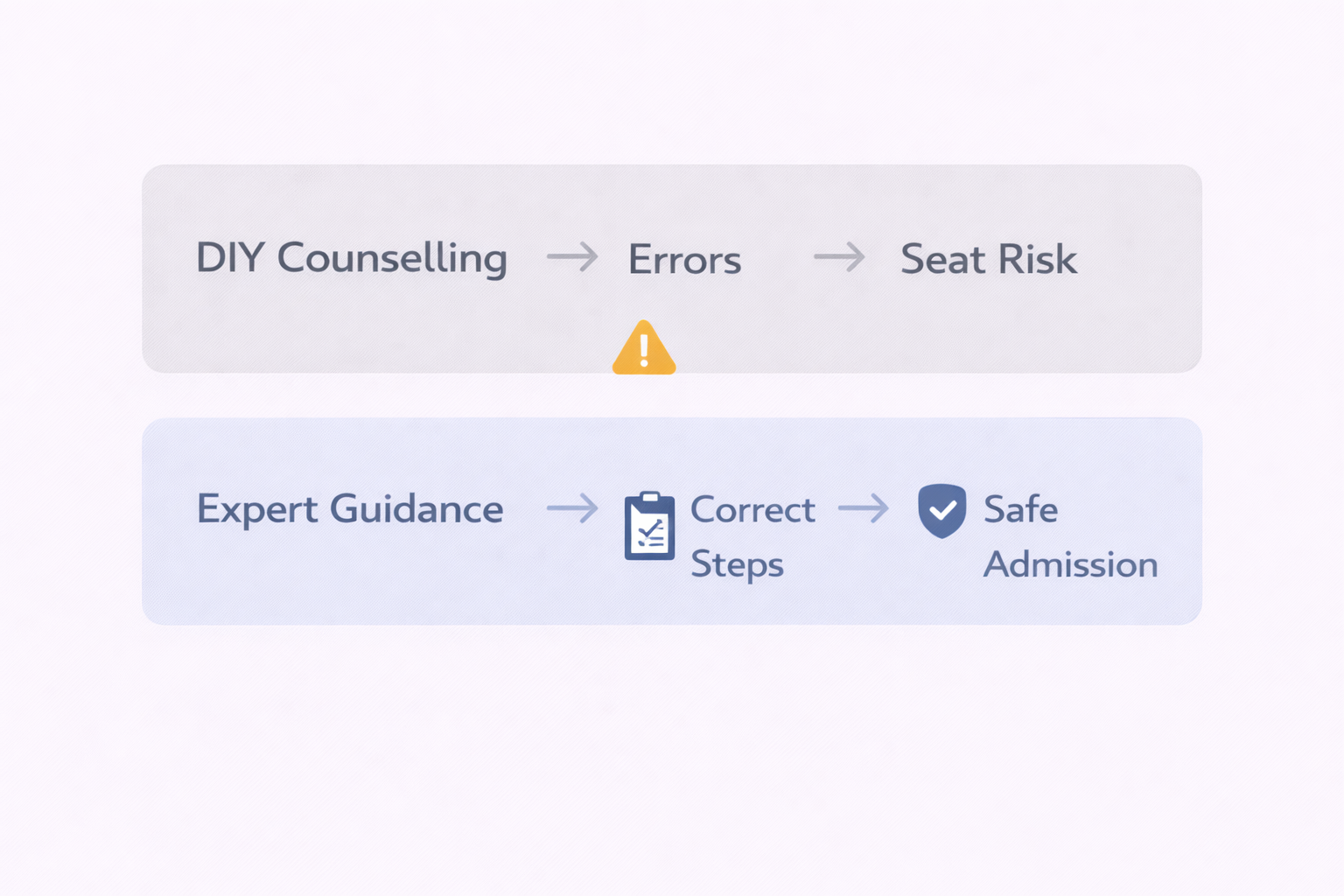
NRI quota MBBS admission is often misunderstood as a straightforward process driven mainly by fees.
In reality, it is a rule-intensive, documentation-sensitive counselling system where small errors can have serious consequences.
This is why many NRI families seek expert counselling support rather than relying on a do-it-yourself approach.
Why DIY Counselling is Risky in NRI Quota Admissions
While counselling portals appear simple on the surface, NRI quota admissions involve decisions that are difficult to reverse once submitted.
Common risks in DIY counselling include:
-
Selecting the wrong category during registration
-
Misinterpreting eligibility or sponsor rules
-
Uploading incomplete or weak documents
-
Filling choices without understanding state-specific restrictions
Most counselling systems do not allow corrections after critical stages.
A single incorrect step can permanently affect eligibility for that admission cycle.
Complexity of State-wise NRI Quota Rules
Unlike general counselling, NRI quota rules are not standardized across India.
Each state differs in:
-
Counselling authority and timelines
-
Sponsor eligibility and relationship acceptance
-
Document formats and verification standards
-
Fee approval and payment procedures
What is valid in one state may be invalid in another, even within the same admission year.
Expert counselling focuses on state-specific interpretation, not generic advice.
Real Counselling Risks Faced by NRI Applicants
In practical counselling scenarios, families commonly face issues such as:
-
Seat allotment cancellation due to document mismatch
-
Rejection of sponsor proof during verification
-
Disqualification after provisional allotment
-
Missed counselling rounds due to timeline confusion
These outcomes are usually not due to lack of eligibility, but due to procedural errors.
Such risks cannot be resolved through assumptions, informal advice, or verbal assurances.
How Expert Counselling Adds Value
Experienced counselling support helps by:
-
Verifying eligibility before registration
-
Ensuring correct category selection
-
Reviewing documents before upload
-
Guiding state-specific choice filling strategy
-
Reducing avoidable risks during counselling
The goal of expert counselling is not to promise outcomes, but to ensure that eligible candidates do not lose opportunities due to preventable mistakes.
Making Informed, Safe Decisions
MBBS admission under the NRI quota is a high-stakes, once-a-year decision.
Approaching it with structured guidance allows families to move forward with clarity and confidence.
This is why many NRI applicants prefer a process-driven counselling approach rather than trial-and-error methods.
Why Choose MCMF for NRI MBBS Admissions (2026)
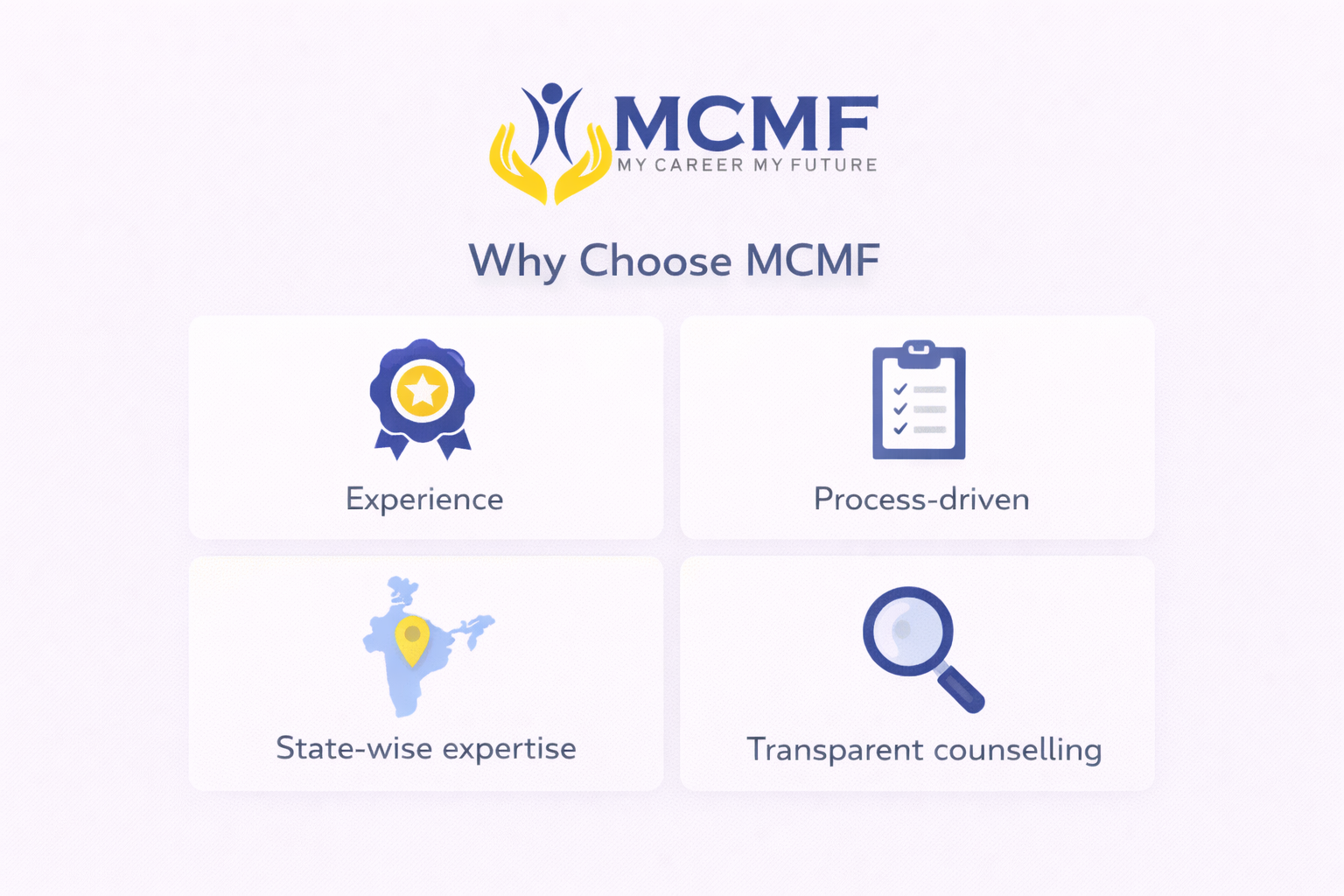
Choosing the right counselling partner is as important as understanding the admission rules themselves.
For NRI quota MBBS admissions, clarity, accuracy, and process discipline matter more than promises.
MCMF follows a counselling-first approach focused on rule compliance and safe decision-making.
Experience with NRI Quota Admissions
MCMF has worked closely with:
-
NRI parents and students across multiple admission cycles
-
State counselling authorities and MCC counselling frameworks
-
Complex NRI sponsor and documentation cases
This experience allows us to anticipate practical counselling challenges, not just theoretical eligibility.
Process-Driven Counselling Approach
NRI quota MBBS admission is treated as a structured workflow, not a one-time form submission.
Our approach focuses on:
-
Pre-registration eligibility assessment
-
Correct category and counselling authority selection
-
Document readiness before upload
-
Counselling-stage guidance rather than post-problem handling
Each step is handled with the understanding that most errors cannot be corrected later.
Strong State-wise Expertise
NRI quota rules differ significantly across states and counselling bodies.
MCMF provides state-specific guidance, not generalized advice.
This includes:
-
Understanding which states allow sponsor-based NRI admissions
-
Awareness of state-level document expectations
-
Counselling timelines and procedural nuances
-
Deemed University versus state counselling differentiation
State-wise clarity reduces the risk of applying incorrect rules to the wrong counselling system.
Transparent and Realistic Counselling
MCMF follows a transparent counselling philosophy:
-
No guaranteed seat claims
-
No misleading fee or cut-off promises
-
No verbal assurances without rule backing
Families are informed about:
-
Eligibility limitations
-
Counselling risks
-
Realistic possibilities based on NEET score and documentation
The objective is to help families make informed and compliant decisions, not rushed or assumption-based ones.
Focus on Safe Admissions, Not Shortcuts
NRI quota MBBS admission involves significant financial and academic stakes.
MCMF’s role is to ensure that eligible students do not lose opportunities due to avoidable counselling or documentation errors.
This focus on safety, accuracy, and process is what many families value when navigating NRI quota admissions for MBBS 2026.
FAQs – NRI MBBS Admission 2026
Can OCI candidates apply under NRI quota for MBBS in 2026?
OCI candidates are required to qualify NEET 2026 to be eligible for MBBS admission in India.
Eligibility under the NRI quota depends on the counselling authority and college type.
Some counselling authorities allow OCI candidates under NRI or equivalent categories, while others have separate guidelines.
OCI candidates must always verify state-specific or MCC rules before applying.
Can parents sponsor a student under NRI quota?
Yes, parents can sponsor a student under the NRI quota if they:
-
Qualify as NRIs, and
-
Provide valid proof of overseas residence, income, and relationship
Parent sponsorship is one of the most commonly accepted NRI sponsorship arrangements, subject to proper documentation and counselling authority approval.
Is NEET cut-off the same for NRI quota candidates?
No, the NEET cut-off for NRI quota is not the same as general category.
However:
-
NEET qualification is mandatory for all NRI quota candidates
-
Actual cut-off ranks vary by state, college, and counselling authority
-
There is no fixed or guaranteed cut-off for NRI quota admissions
Meeting the qualifying criteria makes a candidate eligible, but seat allotment depends on multiple factors.
Is donation involved in NRI quota MBBS admission?
No. Donation is not part of the official NRI quota admission process.
NRI quota admissions:
-
Are conducted through official counselling authorities
-
Have approved fee structures declared by colleges
-
Do not allow unofficial payments or guarantees
Any claim involving donation or guaranteed admission should be treated with caution.
Can a student apply for both NRI quota and general counselling?
Yes, in many cases, students can:
-
Participate in general counselling, and
-
Apply under NRI quota if eligible
However, category selection must be done carefully, as counselling systems may restrict changes after registration.
Is NEET required for foreign passport holders?
Yes. NEET qualification is mandatory for foreign passport holders seeking MBBS admission in India, including under NRI or equivalent categories, as per current regulations.
Eligibility and category placement depend on counselling authority rules applicable for 2026.
Are NRI quota seats available in all states?
No. NRI quota seats are not available uniformly across all states.
Availability depends on:
-
State policies
-
Type of medical colleges
-
Counselling authority norms
This is why state-wise guidance is essential before applying.
Can NRI quota admission be done without counselling?
No. All NRI quota MBBS admissions must go through official counselling.
There is no legal provision for:
-
Direct admissions
-
Spot admissions outside counselling
-
Private or unofficial allotments
Admissions not routed through official counselling authorities are invalid.
Final Step: Get Clarity Before You Apply
NRI quota MBBS admission is a one-time, high-stakes decision where small mistakes can have long-term consequences.
Before proceeding with counselling registration, it is important to ensure that your eligibility, category selection, and documents are aligned with the applicable rules.
If you need clarity at any stage, MCMF offers structured guidance to help families make safe and informed decisions.
How We Can Help
-
Check your eligibility under NRI quota based on NEET 2026 and documentation
-
Get state-wise guidance aligned with the counselling authority you plan to apply through
-
Speak with an experienced NRI counselling expert to understand your options clearly
This support is meant to reduce uncertainty and help you proceed with confidence.
Take the Next Step
If you are planning MBBS admission under the NRI quota for 2026 and want clarity before applying, you can explore your options through MCMF’s official guidance channels.
You may choose to:
-
Review your eligibility
-
Understand state-specific rules
-
Clarify documentation requirements
Taking the right step at the right time helps avoid unnecessary risks during counselling.
Why Choose MCMF for MBBS Admission?
MCMF (My Career My Future) is trusted by thousands of NEET aspirants every year for their MBBS admission journey.
Expert Guidance
Our experienced MBBS admission counsellors help you at every step - from NEET result to final seat allotment.
Personalized Support
We guide you based on your NEET score, category, budget, and preferences, so you make the right choices.
Complete Counselling Assistance
Get full support for All India Quota (AIQ), State Quota, Deemed Universities, and NRI Quota admissions.
Latest Updates
Stay updated with NEET UG counselling notices, important dates, and admission alerts through our NAS (Notification Alert Software).
Accurate Tools
Our MBBS College Predictor Tool gives you reliable predictions using latest NEET UG data.
Trusted by Students Across India
Thousands of NEET aspirants have successfully secured MBBS seats with our help.
At MCMF, we are committed to making your MBBS admission process smooth, transparent, and stress-free.
Start your MBBS journey with MCMF - where your career comes first!